Xây dựng CV & Liên hệ Giáo sư
CV Building & Professors Outreach
Cấu trúc CV học thuật cho hồ sơ cao học, cách viết từng mục sao cho hội đồng đọc được năng lực nghiên cứu, những lỗi khiến CV bị loại, và cách viết email liên hệ giáo sư trong từng tình huống funding khác nhau.
How to structure an academic CV for a graduate application, how to write each entry so a committee can read your research ability, the mistakes that sink a CV, and how to write the outreach email for each funding situation you might face.
CV học thuật khác gì một chiếc resume
What makes an academic CV different from a resume
Workshop 2.2 đi qua hai tài liệu cuối cùng bạn gửi đi trong một bộ hồ sơ: chiếc CV học thuật và lá email đầu tiên gửi cho giáo sư. Sổ tay giữ đúng thứ tự đó. Bấm vào bất kỳ chặng nào để đi thẳng tới nội dung.
Workshop 2.2 covers the last two documents you send out in an application: the academic CV, and the first email you write to a professor. This handbook keeps that order. Tap any stage to jump straight to it.
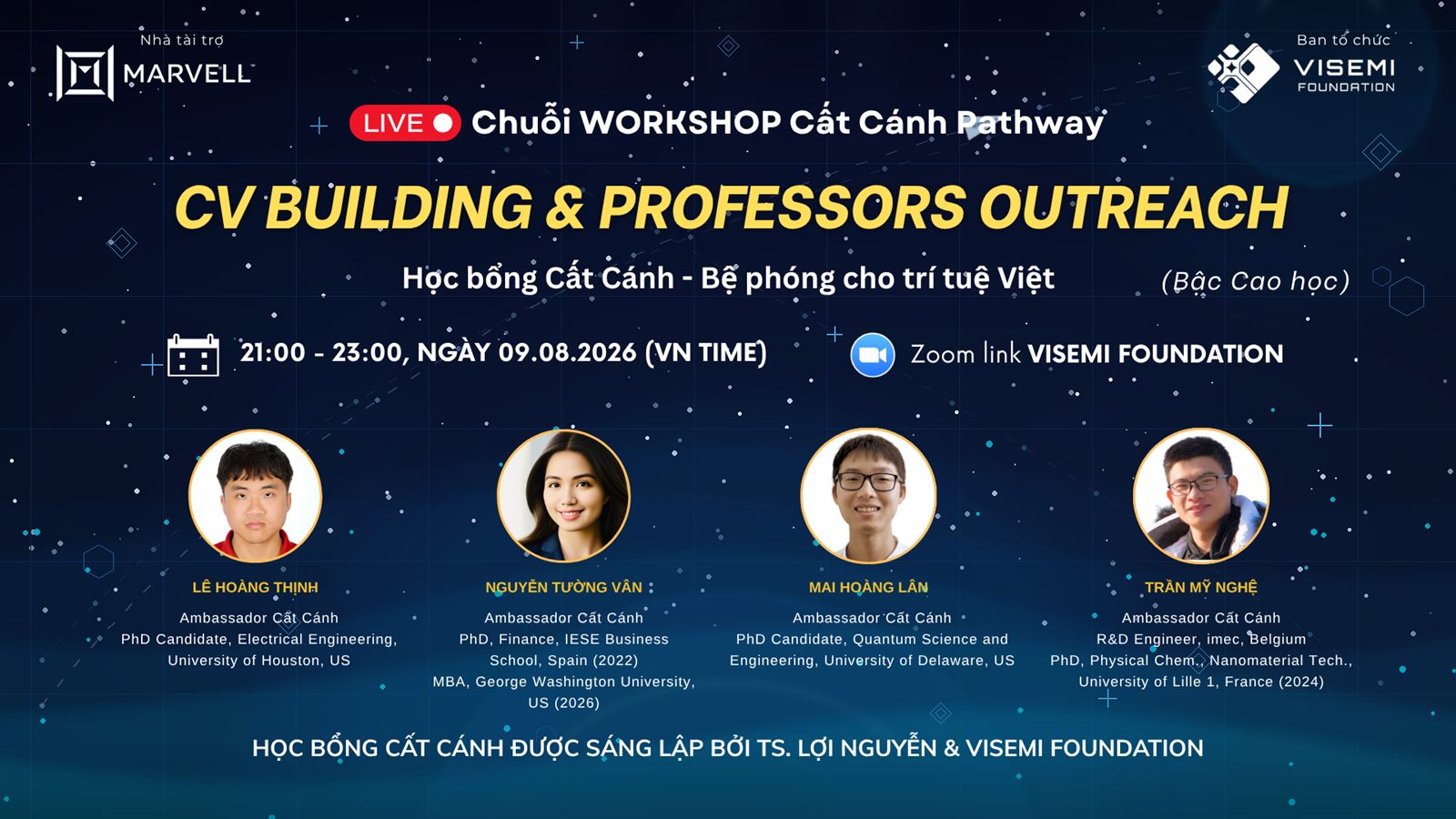
Cấu trúc CV
CV structure
Mục nào bắt buộc, và viết mỗi entry thế nào.
Which sections are required, and how to write an entry.
Trình bày
Format
Độ dài, font, file, và điều nên bỏ ra.
Length, font, file format, and what to leave out.
Lỗi thường gặp
Common mistakes
Bảy lỗi thường gặp, và một CV mẫu trước sau.
Seven common mistakes, and one sample CV before and after.
Vì sao email
Why email
Vì sao viết, và khi nào thì không nên viết.
Why you write, and when you should not.
Viết email
Writing it
Bốn phần của một email, kèm hai email mẫu.
The four parts of the email, with two annotated samples.
Sau khi gửi
After you send
Lỗi khiến email bị bỏ qua, và khi bị im lặng.
What gets an email ignored, and what silence means.
CV học thuật dùng để làm gì
What an academic CV is for
- Helps admissions committees assess your academic potential and research readiness
- Shows what you have studied, built, investigated and contributed
- Gets you an offer of admission and funding
- Giúp hội đồng tuyển sinh đánh giá tiềm năng học thuật và mức độ sẵn sàng nghiên cứu của bạn
- Cho thấy bạn đã học gì, xây gì, tìm hiểu gì và đóng góp gì
- Đưa bạn tới một offer nhập học kèm tài trợ
Khác gì một chiếc resume
How it differs from a resume
- No page limit: the length reflects the depth of your academic record
- Research, projects and publications take priority over work history
- No photo, no objective statement, no soft skills such as “teamwork”
- Consistent across every programme you apply to
- Không giới hạn số trang: độ dài phản ánh chiều sâu hồ sơ học thuật của bạn
- Research, project và publication được ưu tiên hơn lịch sử đi làm
- Không ảnh, không objective statement, không kỹ năng mềm kiểu “teamwork”
- Nhất quán trên mọi chương trình bạn nộp
That is fine. Strong project experience and good references still make a competitive application.
Không sao cả. Project experience tốt cùng những thư giới thiệu tốt vẫn tạo nên một hồ sơ cạnh tranh.
Cấu trúc CV và cách viết từng mục
The CV structure, section by section
Cấu trúc dưới đây bám theo hướng dẫn của các trung tâm hướng nghiệp đại học lớn, và gần như giống nhau giữa các quốc gia. Phần quan trọng nhất là Research and Project Experience, nên nó được tách riêng.
The structure below follows the guidance of major university career centres, and it barely changes between countries. The section that matters most is Research and Project Experience, so it gets its own treatment.
Bắt buộc
Required
- Contact information
- Education, always first
- Skills
- Contact information
- Education, luôn đứng đầu
- Skills
Tùy kinh nghiệm, cần ít nhất một
Experience-dependent, at least one
- Research / Research Experience
- Projects / Academic Projects / Research Projects
- Professional / Internship Experience
- Teaching Experience
- Research / Research Experience
- Projects / Academic Projects / Research Projects
- Professional / Internship Experience
- Teaching Experience
Không bắt buộc
Optional
- Honors & awards
- Publications & conferences
- Leadership / Activities
- References
- Honors & awards
- Publications & conferences
- Leadership / Activities
- References
Depending on how impressive each kind of experience is for you, you can be flexible with the order of the experience sections. What does not move is Education, which always comes first.
Tùy vào việc loại kinh nghiệm nào của bạn ấn tượng hơn, bạn có thể linh hoạt thứ tự giữa các mục kinh nghiệm. Điều không đổi là Education, luôn đứng đầu.
Research and Project Experience
Research and Project Experience
Mỗi entry phải có
Every entry must include
- Organization, lab or department name, and location
- Project title, named clearly
- Supervisor or advisor name
- Date range, as Month Year to Month Year
- 3 to 5 bullet points per entry
- Tên organization, lab hoặc department, kèm địa điểm
- Project title, đặt tên rõ ràng
- Tên supervisor hoặc advisor
- Khoảng thời gian, dạng Month Year to Month Year
- 3 đến 5 bullet point cho mỗi entry
Công thức cho mỗi bullet
The bullet formula
Action verb + what you did and how + result or outcome.
Avoid “Helped with…”, “Assisted in…”, “Participated in…”.
Action verb + bạn đã làm gì và làm thế nào + kết quả hoặc outcome.
Tránh “Helped with…”, “Assisted in…”, “Participated in…”.
Ngân hàng động từ mạnh
Strong action verbs
“Proved the Hausdorff dimension formula holds for even k by extending the construction to non-standard fractal geometries”
It names the verb, the method and the result, so a reader knows exactly what you did.
“Proved the Hausdorff dimension formula holds for even k by extending the construction to non-standard fractal geometries”
Một bullet như trên nêu rõ động từ, phương pháp và kết quả, nên người đọc biết chính xác bạn đã làm gì.
Publications and Presentations
Publications and Presentations
Độ dài, định dạng và những gì nên bỏ ra
Length, format and what to leave out
Phần này ít gây tranh cãi nhất nhưng lại là nơi mất điểm dễ nhất, vì phần lớn lỗi ở đây có thể sửa trong mười phút.
This is the least debatable part of a CV and the easiest place to lose points, because almost every mistake here takes ten minutes to fix.
| Guidance | |
|---|---|
| Length | Master’s: 1 to 2 pages. PhD: 2 to 4 pages. Never pad. List sections in order of importance. |
| Font and size | Calibri, Times New Roman or Cambria. 10 to 12pt body; your name may be larger. Consistent throughout. |
| Margins and spacing | 0.5 to 1 inch on all sides. Generous white space aids readability. Dates right-aligned, organizations left-aligned. |
| Dates | Month Year format, such as Aug 2021 or Aug 2021 to May 2022. Abbreviating months is fine if consistent. Avoid numerals-only formats like 1/2/2024. |
| File format | Always PDF, named LastName_FirstName_CV.pdf. Never .docx; formatting shifts between devices. |
| Links | Hyperlink your email and Google Scholar. GitHub if code is part of your research. LinkedIn only if polished and current. |
| Hướng dẫn | |
|---|---|
| Độ dài | Thạc sĩ: 1 đến 2 trang. Tiến sĩ: 2 đến 4 trang. Đừng viết dài cho đủ. Sắp xếp các mục theo thứ tự quan trọng. |
| Font và cỡ chữ | Calibri, Times New Roman hoặc Cambria. Thân bài 10 đến 12pt; tên có thể lớn hơn. Nhất quán toàn bộ tài liệu. |
| Lề và giãn dòng | Lề 0.5 đến 1 inch mọi phía. Khoảng trắng rộng rãi giúp dễ đọc. Ngày căn phải, tên tổ chức căn trái. |
| Ngày tháng | Dạng Month Year, ví dụ Aug 2021 hoặc Aug 2021 to May 2022. Viết tắt tháng được, miễn là nhất quán. Tránh dạng chỉ có số như 1/2/2024. |
| Định dạng file | Luôn là PDF, đặt tên LastName_FirstName_CV.pdf. Không dùng .docx; định dạng xô lệch giữa các máy. |
| Liên kết | Gắn hyperlink cho email và Google Scholar. GitHub nếu code là một phần nghiên cứu. LinkedIn chỉ khi đã chỉn chu và cập nhật. |
Nên làm
Do
- Include your GPA with its scale, such as 3.9/4.0, or your rank such as top 5 percent of the cohort
- Put a TOEFL iBT 100+ or IELTS 7.0+ score in the Education section
- Name your thesis or capstone project with its full title
- List conference presentations and regional talks; they count
- Note honors and scholarships, including tuition awards
- Have a fluent English speaker proofread it before you submit
- Research the CV conventions of the universities and countries you are applying to
- Ghi GPA kèm thang điểm, ví dụ 3.9/4.0, hoặc thứ hạng như top 5 phần trăm của khóa
- Đưa điểm TOEFL iBT 100+ hoặc IELTS 7.0+ vào mục Education
- Ghi đầy đủ tên luận văn hoặc capstone project
- Liệt kê các conference presentation và báo cáo cấp vùng; chúng đều được tính
- Ghi các honor và học bổng, kể cả tuition award
- Nhờ một người nói tiếng Anh thành thạo đọc soát trước khi nộp
- Tìm hiểu quy ước CV của trường và quốc gia bạn đang nộp vào
Không nên
Do not
- Do not include a photo, nationality, age or marital status
- Do not write an objective statement
- Do not list every course you took; only the research-relevant ones
- Do not worry about having no overseas experience; strong research transcends borders
- Do not submit .docx; always PDF
- Không đưa ảnh, quốc tịch, tuổi hay tình trạng hôn nhân
- Không viết objective statement
- Không liệt kê mọi môn đã học; chỉ những môn liên quan tới nghiên cứu
- Không lo lắng vì chưa có kinh nghiệm ở nước ngoài; nghiên cứu tốt vượt qua biên giới
- Không nộp .docx; luôn là PDF
Bảy lỗi thường gặp và một CV mẫu được sửa lại
Seven common mistakes, and a sample CV rewritten
Buổi workshop dành riêng một hoạt động để người tham dự tự tìm lỗi trên một CV mẫu. Phần này dựng lại đúng hoạt động đó: bản có lỗi trước, bản đã sửa sau.
The workshop ran an activity where the audience hunted for mistakes in a sample CV. This stage reconstructs that activity: the flawed version first, the corrected version after.
Bullet chung chung
Vague bullets
“Assisted in laboratory work” or “Participated in project X” tells a committee nothing about what you can do.
“Assisted in laboratory work” hay “Participated in project X” không nói cho hội đồng biết bất cứ điều gì về năng lực của bạn.
Coi coursework là kinh nghiệm nghiên cứu
Listing coursework as research experience
They are different sections and a committee reads them differently.
Đó là hai mục khác nhau, và hội đồng đọc chúng theo hai cách khác nhau.
Đưa thông tin cá nhân không cần thiết
Including unnecessary personal details
No photo, birthdate, nationality or marital status.
Không ảnh, không ngày sinh, không quốc tịch, không tình trạng hôn nhân.
Nộp .docx thay vì PDF
Submitting .docx instead of PDF
Formatting breaks on other computers, and the reader sees a different document from the one you wrote.
Định dạng vỡ trên máy khác, và người đọc nhìn thấy một tài liệu khác với tài liệu bạn đã viết.
GPA không kèm thang điểm
No GPA scale or cohort ranking
For a transcript from outside the US, a bare number is unreadable. Give the scale, or your rank in the cohort.
Với bảng điểm ngoài hệ Mỹ, một con số trần là không đọc được. Hãy ghi thang điểm, hoặc thứ hạng của bạn trong khóa.
Thư giới thiệu yếu
Weak references
Only course instructors, with no research supervisor among them.
Chỉ có giảng viên dạy môn, không có supervisor nghiên cứu nào.
Thiếu tên advisor trên mỗi entry nghiên cứu
No advisor name on each research entry
A research entry without a named advisor is hard for a committee to verify or weigh.
Một entry nghiên cứu không có tên advisor thì hội đồng khó kiểm chứng và khó đánh giá.
Hoạt động: bạn có thấy lỗi trong CV này không?
Activity: can you see the mistakes in this CV?
Slide hoạt động từ buổi workshop
The activity slide, as shown in the workshop
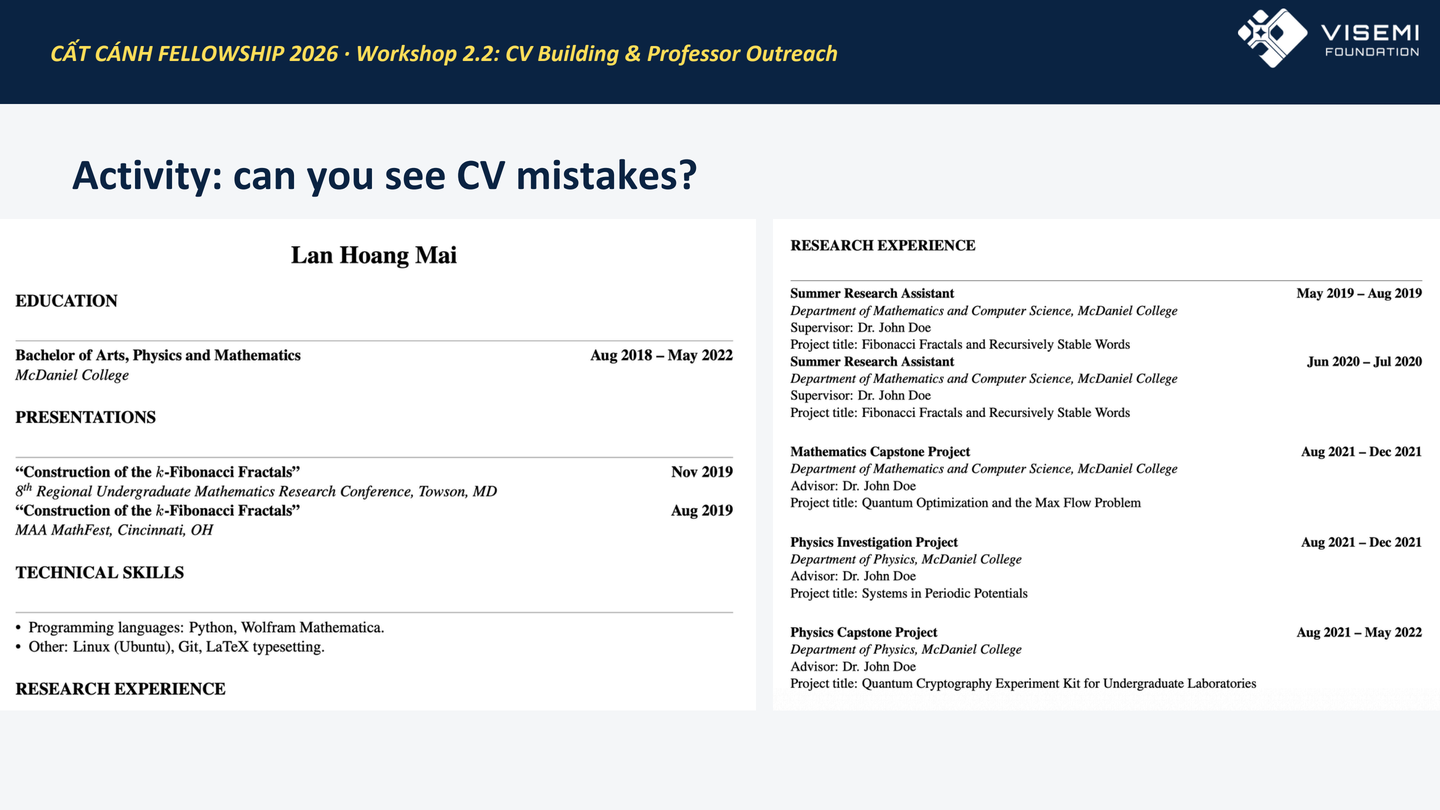
EDUCATION
Bachelor of Arts, Physics and Mathematics · Aug 2018 to May 2022
PRESENTATIONS
TECHNICAL SKILLS
RESEARCH EXPERIENCE
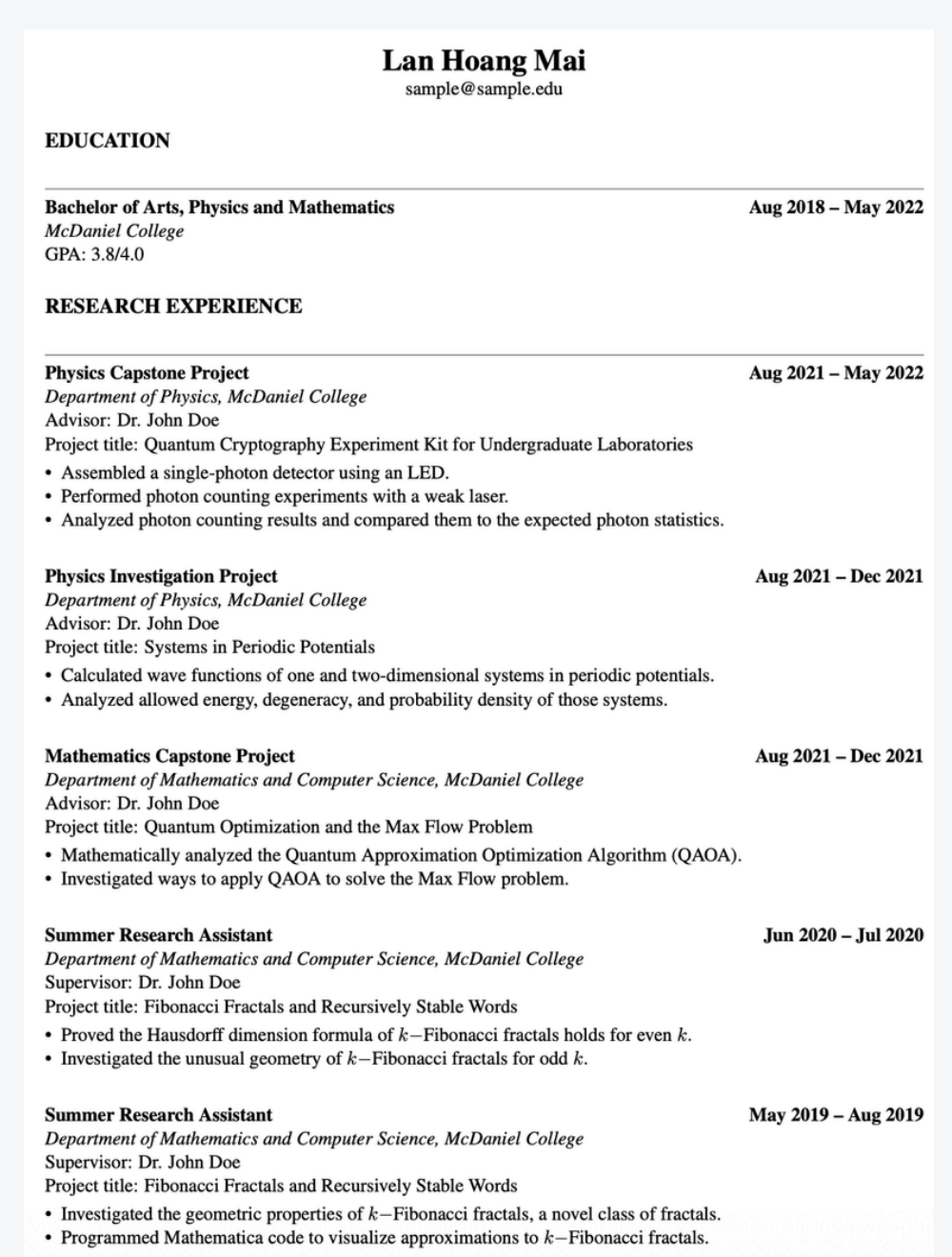
Ví dụ dựng lại từ bản trình bày và đã ẩn danh. Mọi thông tin liên hệ đều là giả định.Example reconstructed from the deck and anonymised. All contact details are placeholders.
EDUCATION
Bachelor of Arts, Physics and Mathematics · Aug 2018 to May 2022 GPA: 3.8/4.0
Physics Capstone Project · Aug 2021 to May 2022 Advisor: Dr. John Doe Project title: Quantum Cryptography Experiment Kit for Undergraduate Laboratories
- Assembled a single-photon detector using an LED.
- Performed photon counting experiments with a weak laser.
- Analyzed photon counting results and compared them to the expected photon statistics.
Summer Research Assistant · Jun 2020 to Jul 2020 Supervisor: Dr. John Doe Project title: Fibonacci Fractals and Recursively Stable Words
- Proved the Hausdorff dimension formula of k-Fibonacci fractals holds for even k.
- Investigated the unusual geometry of k-Fibonacci fractals for odd k.
Cùng một hồ sơ, viết lại. Thông tin liên hệ là giả định.The same record, rewritten. Contact details are placeholders.
Slide CV mẫu đã sửa, từ buổi workshop
The corrected sample CV, from the workshop slides
- Research and project entries have a title, an advisor, an organization and dates
- Every bullet is action verb plus method plus result or outcome
- GPA listed with its scale, and cohort rank if available
- TOEFL or IELTS score in the Education section
- No photo, age, nationality or marital status
- Publications and presentations listed in full citation format
- Saved as PDF, named LastName_FirstName_CV.pdf
- A fluent English speaker has proofread it
- The CV and the Statement of Purpose tell one coherent research story
- Mỗi entry research và project có title, advisor, tổ chức và thời gian
- Mỗi bullet là action verb kèm phương pháp kèm kết quả hoặc outcome
- GPA ghi kèm thang điểm, và thứ hạng khóa nếu có
- Điểm TOEFL hoặc IELTS nằm trong mục Education
- Không ảnh, không tuổi, không quốc tịch, không tình trạng hôn nhân
- Publication và presentation ghi đủ định dạng trích dẫn
- Lưu dạng PDF, đặt tên LastName_FirstName_CV.pdf
- Đã có người nói tiếng Anh thành thạo đọc soát
- CV và Statement of Purpose kể cùng một câu chuyện nghiên cứu
Vì sao và khi nào nên gửi email cho giáo sư
Why and when to email a professor
Đây là phần nhiều người làm sai nhất, vì câu trả lời không phải lúc nào cũng là gửi. Có tình huống mà gửi email trước cho giáo sư là sai quy trình.
This is where most people go wrong, because the answer is not always to send. There is a situation where emailing the professor first is the wrong move.
Vì sao cần viết email cho giáo sư
Why the email is worth writing
- It shows initiative, and that you have done your homework on their work
- It builds goodwill, makes an impression, and opens an academic connection
- It introduces your research record and your profile, briefly
- It opens a professional conversation
- Thể hiện sự chủ động, và cho thấy bạn đã tìm hiểu kỹ về công việc của họ
- Tạo thiện cảm, gây ấn tượng và mở ra một kết nối học thuật
- Giới thiệu ngắn gọn thành tích nghiên cứu và hồ sơ cá nhân của bạn
- Mở đầu một trao đổi chuyên môn
Khi nào nên gửi, và khi nào không
When to send, and when not to
| The professor or programme already has | What to do |
|---|---|
| A research direction and funding | Required: apply through the link or the email address the programme designates. Do not email the professor first. Optionally, you may send a light reminder to the professor afterwards. |
| Funding only | Email now, to look for an opening. |
| A research direction only | Email now to look for an opening, and apply for funding together. |
| Neither a direction nor funding | Email now, to find a research direction together and apply for funding together. |
| Giáo sư hoặc chương trình đã có sẵn | Nên làm gì |
|---|---|
| Hướng nghiên cứu và funding | Bắt buộc: nộp theo link hoặc email mà chương trình chỉ định. Không gửi mail cho giáo sư trước. Sau đó bạn có thể tùy chọn gửi cho giáo sư một email nhắc nhẹ. |
| Chỉ có funding | Gửi email ngay, để tìm kiếm cơ hội. |
| Chỉ có hướng nghiên cứu | Gửi email ngay để tìm cơ hội, và cùng nhau xin funding. |
| Chưa có hướng nghiên cứu lẫn funding | Gửi email ngay, để cùng tìm hướng nghiên cứu và cùng xin funding. |
A funded posting names who receives your application. If it names the professor as the first point of contact, you go through the professor. If it names the school, you go through the school. Getting this wrong is the most avoidable way to lose a position.
Một tin tuyển có funding luôn ghi rõ ai là người nhận hồ sơ. Nếu tin ghi giáo sư là first point of contact thì bạn nộp qua giáo sư. Nếu tin ghi nhà trường thì bạn nộp qua trường. Nhầm chỗ này là cách mất một vị trí một cách đáng tiếc nhất.
Nội dung email và hai email mẫu có chú thích
What goes in the email, with two annotated samples
Hai email mẫu dưới đây là email thật đã gửi đi, cho hai tình huống funding khác nhau. Chú thích đánh số theo đúng cách bản trình bày gốc đã đánh dấu chúng.
The two samples below are real emails that were actually sent, for two different funding situations. The numbered annotations follow exactly how the original deck marked them up.
State the purpose plainly, for example “Application for PhD position”.
Nêu thẳng mục đích, ví dụ “Application for PhD position”.
Who you are, where you study now, when you graduate, and what you have been working on.
Bạn là ai, đang học ở đâu, tốt nghiệp khi nào, và bạn đang làm về cái gì.
Name the specific posting or the specific paper, connect it to your own work, and list what you have attached.
Nêu đích danh tin tuyển hoặc bài báo cụ thể, nối nó với công việc của chính bạn, và liệt kê những gì bạn đính kèm.
Offer to send more information, thank them for their time, and sign off.
Ngỏ ý sẵn sàng cung cấp thêm thông tin, cảm ơn họ đã dành thời gian, và ký tên.
Email mẫu 1 · giáo sư đã có funding và hướng nghiên cứu
Sample email 1 · the professor has funding and a research direction
Subject: Application for PhD position
Dear Professor [Name],
I hope you are doing well and are in the good health.
My name is [Name] and I am Vietnamese. Currently, I have been a master student at Faculty of Nano physics, [University] in South Korea with an expected degree date of August 2021.
During my master course, I was concentrating on synthesis of 2D materials (Ti3C2 MXenes, g-C3N4, r-GO) and metal oxide semiconductors (TiO2, ZnO) for various applications such as photocatalysis, adsorption, water treatment and gas sensors.
I hope you will find some interesting things in those files and I am looking forward to hearing from you soon. If you need any more information, please let me know and I will provide everything I have.
Thank you very much for your time.
Yours sincerely, [Name]
Email thật, đã ẩn danh: tên người gửi, địa chỉ email, tên giáo sư và mã số tin tuyển đều được thay bằng thông tin giả định.A real email, anonymised: the sender's name, the email address, the professor's name and the posting reference number are all replaced with placeholders.
Email mẫu 2 · giáo sư chưa có funding và hướng nghiên cứu
Sample email 2 · the professor has neither funding nor a direction
Dear Professor [Name],
I hope you are doing well and are in the good health.
My name is [Name] and I am Vietnamese. Currently, I have been a master student at Faculty of Nano physics, [University] in South Korea with an expected degree date of August 2021.
I hope you will find some interesting things in those files and I am looking forward to hearing from you soon. If you need any more information, please let me know and I will provide everything I have.
Thank you very much for your time.
Yours sincerely, [Name]
Email thật, đã ẩn danh. Khác biệt nằm ở đoạn thứ ba.A real email, anonymised. The difference lies in the third block.
Khi email bị bỏ qua hoặc bị từ chối
When the email is ignored or refused
Không nhận được phản hồi là kết quả phổ biến nhất, và phần lớn lý do không nằm ở bạn. Phần này nói thẳng về điều đó, kèm những gì nên đính kèm và một checklist trước khi bấm gửi.
No reply is the most common outcome, and most of the reasons have nothing to do with you. This stage says so plainly, and covers what to attach and a checklist to run before you hit send.
Gửi thư hàng loạt
Mass mailing
An email sent in bulk without personalisation reads as careless and unserious.
Email gửi hàng loạt mà không cá nhân hóa dễ bị coi là hời hợt và thiếu nghiêm túc.
Hỏi thẳng về kết quả
Asking directly about your chances
Asking whether your GPA or GRE is enough to get in is not a question professors usually answer by email.
Hỏi xem GPA hay GRE của mình có đủ đậu không thường không phải câu giáo sư trả lời qua email.
Khoe khoang quá mức
Overselling yourself
Praising yourself instead of demonstrating ability through a project or real experience works against you.
Khoe bản thân quá mức thay vì chứng minh năng lực bằng dự án hay kinh nghiệm thực tế sẽ gây phản tác dụng.
Đính kèm quá nhiều file
Attaching too many files
A first email loaded with attachments looks unprofessional and is a burden to open.
Email đầu tiên đính kèm quá nhiều tệp trông thiếu chuyên nghiệp và gây quá tải cho người nhận.
Email dài dòng và sai chính tả
Long emails and typos
A rambling email with spelling errors gets skipped and loses value in the professor’s eyes.
Email dài dòng kèm lỗi chính tả dễ bị bỏ qua và mất giá trị trong mắt giáo sư.
After a set period with no reply, treat it as a no. The reasons are usually ordinary: the professor found a stronger candidate, they already had someone lined up before the post went out, they have no funding and no direction right now, or they simply did not see your email. What to do next: keep your confidence, review your CV, improve the file, and apply to another position.
Sau một khoảng thời gian nhất định mà không có phản hồi, hãy coi đó là một lời từ chối. Lý do thường rất bình thường: giáo sư đã có ứng viên tốt hơn, họ đã có người từ trước khi đăng tin, họ hiện không có funding và hướng nghiên cứu, hoặc đơn giản là họ không nhìn thấy email của bạn. Việc nên làm: giữ vững sự tự tin, rà soát lại CV, cải thiện hồ sơ và nộp cho một vị trí khác.
Tầm quan trọng của CV học thuật
Why the academic CV matters here
A short, regularly updated academic CV is what creates a positive first impression with a professor.
Một CV học thuật ngắn gọn và được cập nhật thường xuyên là thứ tạo ấn tượng tích cực đầu tiên với giáo sư.
Vai trò của website cá nhân
What a personal page adds
A personal website shows you can present information and that you are serious about a research direction. Google Scholar, LinkedIn and a QR code all serve the same purpose.
Website cá nhân cho thấy bạn có khả năng trình bày thông tin và nghiêm túc với một định hướng nghiên cứu. Google Scholar, LinkedIn và mã QR đều phục vụ cùng mục đích đó.
- Read the professor’s website
- Read at least one of their papers
- Personalise the email
- Make the subject line clear
- Update your CV
- Check the grammar
- Check that your GitHub and website links work
- Đọc website của giáo sư
- Đọc ít nhất một bài báo của họ
- Cá nhân hóa email
- Subject rõ ràng
- CV đã cập nhật
- Kiểm tra ngữ pháp
- Kiểm tra liên kết GitHub và website còn hoạt động
Câu hỏi thường gặp
Q&A highlights
Những câu hỏi được đặt trực tiếp trong buổi workshop.
Questions asked directly during the workshop.
Giáo không phản hồi email thì có nên gửi lại không? If a professor does not reply, should I send the email again?
Yes. If two or three weeks pass with no reply, you may wait a little longer and then send a polite reminder, forwarding the original email. Say plainly that you applied, have not seen a reply, and are not sure it was received. If there is still no answer after that second message, you have genuinely been passed over, and the right move is to put your effort elsewhere.
Có. Nếu khoảng hai đến ba tuần trôi qua mà không có phản hồi, bạn có thể chờ thêm một chút rồi gửi một email nhắc lịch sự, forward lại email cũ. Hãy nói thẳng thắn rằng bạn đã nộp, chưa thấy phản hồi, và không rõ email đã tới nơi chưa. Nếu sau lần thứ hai vẫn không có hồi âm thì thực sự là bạn đã không được chọn, và việc nên làm là dồn công sức sang nơi khác.
Có nên gây chú ý bằng cách chỉ ra research gap trong bài báo của giáo sư và đề xuất hướng nghiên cứu không? Should I get a professor's attention by pointing out a research gap in their paper and proposing a direction?
Not in the email. An email is not long enough to lay out a research gap and propose a new idea properly, and pointing out a gap in someone’s published work in a first email tends to land badly rather than impress. Keep the email to three things: your own experience, your interest in their research direction, and the opportunity to join it. Proposing an idea belongs in the case where the professor has no research direction yet. Save the research gap for the interview, where you can prepare slides and present a proposal in full. Bear in mind too that what you have identified as a gap may not actually be one.
Không nên đưa vào email. Một email không đủ dài để trình bày tử tế một research gap và đề xuất một ý tưởng mới, và việc chỉ ra lỗ hổng trong công trình đã công bố của ai đó ngay ở email đầu tiên thường gây phản cảm hơn là gây ấn tượng. Hãy giữ email trong ba ý: kinh nghiệm của bản thân, sự quan tâm tới hướng nghiên cứu của giáo sư, và cơ hội được tham gia hướng nghiên cứu đó. Việc đề xuất ý tưởng chỉ hợp trong trường hợp giáo sư chưa có hướng nghiên cứu. Hãy để dành research gap cho buổi phỏng vấn, nơi bạn chuẩn bị được slide và trình bày trọn vẹn một bản proposal. Cũng nên nhớ rằng điều bạn cho là một lỗ hổng chưa chắc đã đúng.
Giáo không phản hồi thì có nên nộp hồ sơ cho trường đó nữa không? If the professor does not reply, should I still apply to that school?
It depends on what the posting said. Read the end of the posting and find who it designates as the first point of contact. If it names the professor, that is the route, and if the professor does not reply then you were not selected, so applying through the school afterwards achieves nothing. If it names the school, apply through the school. Being clear about who is designated to receive your application is the whole answer here.
Tùy vào nội dung của tin tuyển. Hãy đọc phần cuối tin tuyển và tìm xem ai được chỉ định là first point of contact. Nếu tin ghi giáo sư thì đó là đường đi, và khi giáo sư không phản hồi thì tức là bạn không được chọn, nên nộp qua trường sau đó cũng không có ý nghĩa gì. Nếu tin ghi nhà trường thì bạn nộp qua trường. Phân biệt rõ ai là người được chỉ định nhận hồ sơ chính là toàn bộ câu trả lời ở đây.
Cover letter nên viết thế nào? How should a cover letter be structured?
This was answered briefly, outside the session’s planned scope, so treat it as a sketch rather than a full guide. A cover letter is a letter showing you are a good fit for one position, and it usually runs to three paragraphs: an introduction, then your current experience, then why that experience matches their research direction. Concretely, if the position is about the morphology of nanomaterials and you are practised at SEM, TEM and XPS measurements, say so and connect it. One practical tip: a long cover letter often goes unread, so bold the parts that carry your experience, the techniques and the materials, and a skimming reader will still see them.
Câu này được trả lời ngắn gọn và nằm ngoài phạm vi đã chuẩn bị của buổi workshop, nên hãy xem đây là một phác thảo chứ không phải hướng dẫn đầy đủ. Cover letter là lá thư cho thấy bạn là good fit cho một vị trí cụ thể, và thường gồm ba đoạn: giới thiệu, kinh nghiệm hiện có, rồi vì sao kinh nghiệm đó phù hợp với hướng nghiên cứu của họ. Cụ thể, nếu vị trí đó nghiên cứu về morphology của vật liệu nano mà bạn thành thạo đo SEM, TEM, XPS thì hãy nói ra và nối hai điều đó lại. Một mẹo thực tế: cover letter dài thường không được đọc hết, nên hãy bôi đậm những chỗ chứa kinh nghiệm, kỹ thuật và vật liệu của bạn, để người đọc lướt vẫn nhìn thấy.
Diễn giả của buổi workshop
The workshop speakers
PhD student in Applied Electromagnetics at the University of Houston, with an MS in Electrical Engineering from the University of North Texas. Opened the session and hosted the Q&A.
Nghiên cứu sinh PhD ngành Applied Electromagnetics tại University of Houston, tốt nghiệp MS Electrical Engineering tại University of North Texas. Mở đầu buổi workshop và điều phối phần hỏi đáp.
PhD in Finance from IESE Business School in Spain, and a STEM MBA candidate at George Washington University. Presented the CV structure.
Tiến sĩ Finance tại IESE Business School, Tây Ban Nha, và đang học STEM MBA tại George Washington University. Trình bày phần cấu trúc CV.
PhD candidate in Quantum Science and Engineering at the University of Delaware. Led the sample-CV walkthrough as an interactive activity.
Nghiên cứu sinh PhD ngành Quantum Science and Engineering tại University of Delaware. Dẫn dắt phần đọc CV mẫu dưới dạng hoạt động tương tác.
R&D Engineer at imec in Belgium, with a PhD in Physical Chemistry and Nanomaterial Technology from the University of Lille, France. Presented the professor outreach email.
R&D Engineer tại imec, Bỉ, với bằng Tiến sĩ Physical Chemistry và Nanomaterial Technology tại University of Lille, Pháp. Trình bày phần email liên hệ giáo sư.
Về cẩm nang này
About this handbook
Sổ tay này tổng hợp nội dung buổi Workshop 2.2 thuộc chuỗi Cất Cánh Pathway, do VISEMI Foundation tổ chức, tiếp nối loạt workshop kỹ năng 2.x với phần chia sẻ của các Ambassador Cất Cánh.
This handbook compiles Workshop 2.2 of the Cất Cánh Pathway series, hosted by VISEMI Foundation, continuing the 2.x skills series with sessions from Cất Cánh Ambassadors.
Nội dung mang tính tham khảo; yêu cầu tuyển sinh thay đổi theo từng trường và từng năm, hãy kiểm tra thông tin chính thức của trường.
For reference only; admission requirements vary by school and year, so always check each school’s official information.