Viết luận ứng tuyển sau đại học
Graduate Application Essays
Statement of Purpose, Personal Statement, Motivation Letter, Cover Letter, Research Proposal, Autobiography và Study Plan: mỗi bài để làm gì, viết theo cấu trúc nào, và sắp xếp bộ bài luận theo yêu cầu của từng trường.
Statement of Purpose, Personal Statement, Motivation Letter, Cover Letter, Research Proposal, Autobiography and Study Plan: what each essay is for, how to structure it, and how to arrange the set for each school.
Bộ bài luận ứng tuyển sau đại học
The graduate application essay set
Workshop 2.1 mở đầu chuỗi kỹ năng 2.x: thay vì một điểm đến, buổi này đi qua từng bài luận trong bộ hồ sơ cao học. Sổ tay giữ đúng thứ tự đó, mỗi chặng là một loại bài luận. Bấm vào bất kỳ chặng nào để đi thẳng tới nội dung.
Workshop 2.1 opens the 2.x skills series: instead of a destination, it walks through every essay in a graduate application. This handbook keeps that order, one essay type per stage. Tap any stage to jump straight to it.
SOP & Personal Statement
SOP & Personal Statement
Bài SOP khoảng 1000 từ và Personal Statement 150 đến 250 từ.
The ~1000 word SOP and the 150 to 250 word Personal Statement.
Motivation & Cover Letter
Motivation & Cover Letter
Motivation Letter cho bậc Thạc sĩ, Cover Letter cho dự án PhD.
Motivation Letters for Master's, Cover Letters for PhD projects.
Research Proposal
Research Proposal
Điều hội đồng muốn thấy là cách bạn tư duy.
What the committee wants to see is how you think.
Autobiography & Study Plan
Autobiography & Study Plan
Bạn là ai, và bạn muốn trở thành ai.
Who you are, and who you want to become.
Mẹo viết & AI
Writing tips & AI
Chi tiết nhưng cô đọng, topic sentence, và dùng AI đúng cách.
Detailed but concise, topic sentences, and using AI well.
Bảy bài luận, một bộ hồ sơ
Seven essays, one application
Buổi workshop đưa ra dàn ý chi tiết cho từng loại bài luận; việc của bạn là sắp xếp các mảnh đó theo đúng bộ hồ sơ mà trường mục tiêu yêu cầu. Rất hiếm trường yêu cầu đủ cả bảy bài, và mỗi nơi đòi một tổ hợp khác nhau.
The workshop gives a detailed outline for every essay type; your job is to arrange those pieces into the exact set your target school asks for. Few schools ask for all seven, and the combination differs from place to place.
Statement of Purpose SOP
Bài luận học thuật trung tâm, khoảng 1000 từ: định hướng nghiên cứu, kinh nghiệm và lý do chọn trường.
The central academic essay, about 1000 words: your research direction, experience and why this school.
Personal Statement PS
Câu chuyện cá nhân trong 150 đến 250 từ, trả lời đúng câu hỏi mà trường đặt ra.
Your personal story in 150 to 250 words, answering the exact question the school asks.
Motivation Letter
Lá thư 1 đến 2 trang cho chương trình Thạc sĩ và học bổng, phổ biến ở châu Âu.
A 1 to 2 page letter for Master’s programs and scholarships, common in Europe.
Cover Letter
Một trang khi ứng tuyển một dự án PhD cụ thể: vì sao bạn là người phù hợp với chính dự án này.
One page when applying to a specific PhD project: why you are the right person for this exact project.
Research Proposal
Khoảng 1000 đến 2000 từ trình bày vấn đề, literature review, research gap và phương pháp.
About 1000 to 2000 words laying out the problem, the literature review, the research gap and the method.
Autobiography
Bạn là ai: nền tảng, bước ngoặt, trưởng thành và tầm nhìn, kể như một câu chuyện.
Who you are: background, turning point, growth and vision, told as a story.
Study Plan
Bạn muốn trở thành ai: lộ trình học tập cá nhân hóa để lấp đúng những skill gap của bạn.
Who you want to become: a personalised roadmap that closes your specific skill gaps.
Bài nào dành cho điểm đến nào
Which essay goes with which destination
Đây là cách buổi workshop phân chia các phần. Hãy coi đây là điểm khởi đầu chứ không phải quy tắc cứng: yêu cầu cuối cùng luôn nằm trên website của chương trình bạn nhắm tới.
This is how the workshop itself divided the sessions. Treat it as a starting point rather than a rule: the final word is always on your target program’s own website.
| Bài luận | Thường được yêu cầu ở |
|---|---|
| Statement of Purpose, Personal Statement | Mỹ, cho bậc PhD và các chương trình thiên về nghiên cứu |
| Motivation Letter, Cover Letter | Châu Âu |
| Research Proposal | Châu Á và châu Âu |
| Autobiography, Study Plan | Châu Á, rõ nhất là Đài Loan |
| Essay | Usually asked for by |
|---|---|
| Statement of Purpose, Personal Statement | The US, for PhD and research-track programs |
| Motivation Letter, Cover Letter | Europe |
| Research Proposal | Asia and Europe |
| Autobiography, Study Plan | Asia, most clearly Taiwan |
Lời khuyên chung xuyên suốt buổi workshop: bắt đầu viết càng sớm càng tốt. Càng viết nhiều, bạn càng nhận ra mình đang thiếu gì và cần sửa gì.
The advice repeated throughout the workshop: start writing as early as you can. The more you write, the faster you discover what is missing and what needs fixing.
Statement of Purpose và Personal Statement
Statement of Purpose and Personal Statement
SOP là bài luận học thuật trung tâm của hồ sơ, thường được admission committee đọc đầu tiên. Personal Statement ngắn hơn, kể câu chuyện cá nhân. Hiểu rõ sự khác nhau giúp bạn không viết trùng.
The SOP is the application's central academic essay, often read first by the admission committee. The Personal Statement is shorter and tells your personal story. Knowing the difference keeps the two from overlapping.
SOP là gì?
What is an SOP?
Khoảng 1000 từ, thường được admission committee đọc đầu tiên hoặc thứ hai trong bộ hồ sơ. Một bài SOP tốt trả lời trọn vẹn các câu hỏi sau:
About 1000 words, and typically the first or second document the admission committee reads. A strong SOP answers all of these questions:
- Research question hoặc mục tiêu nghiên cứu của bạn là gì?
- Vì sao bạn muốn theo đuổi những câu hỏi đó?
- Chương trình PhD này giúp bạn trả lời chúng như thế nào?
- Bạn có bằng chứng thuyết phục nào cho thấy mình sẵn sàng 100%?
- Vì sao trường này, chương trình này, và vì sao họ nên chọn bạn?
- What are your research questions or goals?
- Why are you interested in pursuing them?
- How will this PhD program help you answer them?
- What convincing proof do you have that you are 100% ready?
- Why this university, why this program, and why should they choose you?
Dàn ý bốn phần
The four-part outline
Mở bài: 3 đến 5 câu
Introduction: 3 to 5 sentences
Ngắn và đi thẳng vào trọng tâm: bạn quan tâm điều gì và điều gì khơi dậy mong muốn học cao học. Một “moment of change” có thể giúp mở bài đáng nhớ, nhưng không bắt buộc. Đừng sa đà kể tiểu sử.
Short and straight to the point: what you are interested in and what sparked your desire for graduate study. A “moment of change” can make it memorable, but is not required. Do not drift into autobiography here.
Các đoạn nghiên cứu: phần lớn bài
Research paragraphs: the majority
Chọn 2 đến 3 dự án, sắp theo thời gian, giải thích sao cho người ngoài ngành cũng hiểu. Với mỗi dự án: research problem, đóng góp cụ thể của chính bạn (kỹ thuật, dùng “I”), và kết quả. Nhớ nêu tên người hướng dẫn và nơi thực hiện. Các bài trình bày hay publication là phần optional: nếu còn giới hạn từ thì hãy nhắc tới, còn không thì CV của bạn đã ghi rồi.
Pick 2 to 3 projects, organise them in time, and explain them so anyone can understand. For each project: the research problem, your own specific contributions (be technical, use “I”), and the outcomes. Name your supervisor and where the work happened. Presentations and papers are optional: mention them if the word limit allows, otherwise your CV already carries them.
Đoạn Why-This-School
Why-This-School paragraph
Nêu tên ít nhất 3 giảng viên bạn muốn làm việc cùng và lý do, mỗi người 1 đến 2 câu. Nhắc tới chương trình, cơ sở vật chất hoặc thiết bị cụ thể khiến bạn chọn nơi này. Đọc kỹ website của chương trình, và viết một đoạn riêng cho từng trường.
Name at least 3 faculty members you would like to work with and why, 1 to 2 sentences each. Point to the specific programs, facilities or equipment that draw you there. Read the program website carefully, and write a different paragraph for every school.
Kết bài
Conclusion
Khẳng định mong muốn và sự sẵn sàng cho việc học cao học, gắn với mục tiêu dài hạn của bạn.
Close on your desire and readiness for graduate study, tied to your long-term goal.
Bốn phần đó trông như thế nào
What those four parts look like
Bốn đoạn dưới đây là ví dụ thật, trích nguyên văn từ các trang hướng dẫn công khai của MIT Communication Lab và được dùng lại trong buổi workshop. Phần chú thích bên lề chỉ ra từng câu đang làm nhiệm vụ gì.
The four specimens below are real examples, quoted verbatim from MIT Communication Lab’s public guides and used in the workshop. The margin notes point out what each sentence is doing.
Nguồn: MIT Communication Lab, EECS CommKit, Example #2. Giữ nguyên văn.Source: MIT Communication Lab, EECS CommKit, Example #2. Quoted verbatim.
Nguồn: MIT Communication Lab, EECS CommKit, Example #1. Giữ nguyên văn.Source: MIT Communication Lab, EECS CommKit, Example #1. Quoted verbatim.
Cũng đoạn văn đó, theo cách workshop tô màu
The same paragraph, as the workshop marked it up
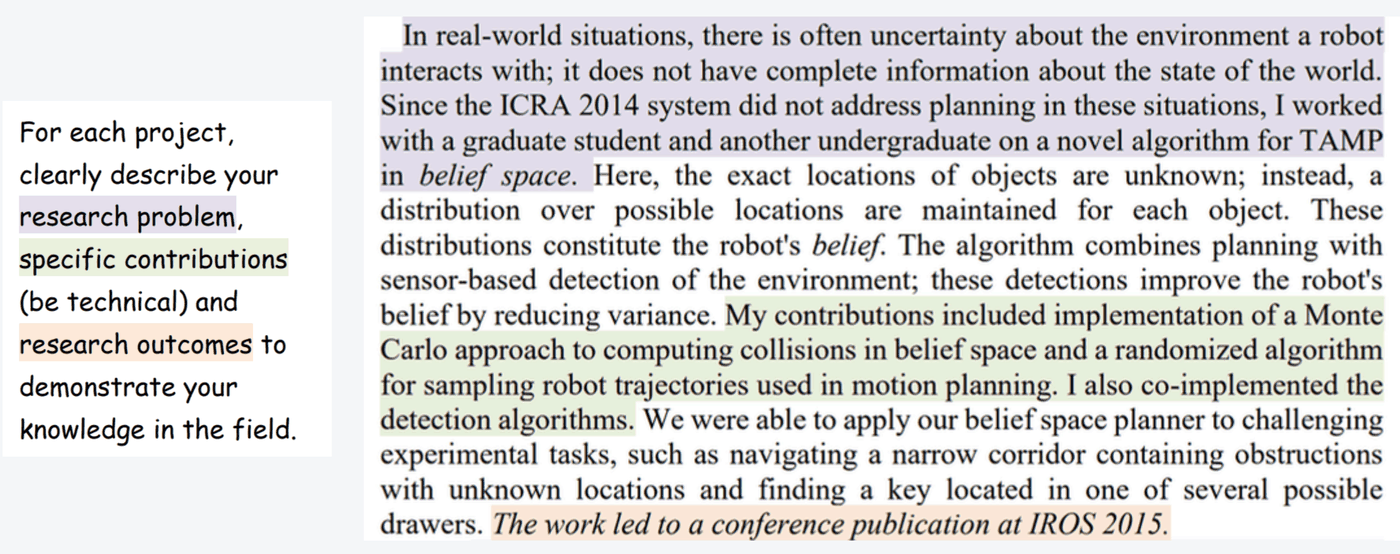
Nguồn: MIT Communication Lab, EECS CommKit, Example #1. Giữ nguyên văn, tên giáo sư đã được rút gọn ngay trong bản gốc.Source: MIT Communication Lab, EECS CommKit, Example #1. Quoted verbatim; the faculty name was already reduced to initials in the original.
Ví dụ trình bày trong workshop, cho một chương trình Thạc sĩ Materials Science.An example shown in the workshop, for a Master's program in Materials Science.
Viết xong phần “why this university”, hãy thử thay tên trường bằng một trường khác. Nếu mọi câu vẫn đúng, đoạn văn chưa đủ cụ thể và bạn cần đào sâu thêm về trường mục tiêu. Mỗi trường một đoạn riêng, không tái sử dụng.
After writing your “why this university” section, swap in another school’s name. If everything still reads true, it is not specific enough and you need to dig deeper into the target school. One paragraph per school, never recycled.
Personal (History) Statement
The Personal (History) Statement
Đề bài thường hỏi gì
What it asks
- Thường có câu hỏi cụ thể về leadership, mentorship, diversity: trả lời đủ mọi ý được hỏi
- Trải nghiệm nào định hình tính cách và hoài bão của bạn
- Khó khăn bạn đã vượt qua và trưởng thành từ đó
- Chưa có câu chuyện cá nhân? Một bản tin hoặc một con người truyền cảm hứng cũng dùng được
- Usually a specific question about leadership, mentorship or diversity: answer every part asked
- Which experiences shaped your personality and ambition
- Obstacles you persevered through and grew from
- No personal story? A piece of news or a specific person that inspires you works too
Bài viết nên như thế nào
How it reads
- Khoảng 150 đến 250 từ, linh hoạt hơn SOP, không có cấu trúc cố định
- Dàn ý gợi ý: Hook, Body, Wrap-up
- Gắn câu chuyện với giá trị và mục tiêu của trường, của khoa
- Cho thấy trường giúp bạn đạt mục tiêu cá nhân và bạn đóng góp gì cho văn hóa của khoa
- About 150 to 250 words, more flexible than the SOP, no fixed structure
- Suggested outline: Hook, Body, Wrap-up
- Align your story with the university and department’s values and goals
- Show how the school helps your personal goal and what you bring to its culture
SOP và Personal Statement khác nhau thế nào
How the SOP and Personal Statement differ
| Statement of Purpose | Personal Statement | |
|---|---|---|
| Trọng tâm | Nền tảng học thuật, thế mạnh, kinh nghiệm làm việc và nghiên cứu, thành tích, hướng nghiên cứu, độ phù hợp với chương trình, mục tiêu sự nghiệp. | Câu chuyện cá nhân, động lực chung, thành tựu cá nhân, những chi tiết làm nên “câu chuyện của bạn”, khó khăn đã vượt qua. |
| Độ dài | Khoảng 1000 từ. | Khoảng 150 đến 250 từ. |
| Cấu trúc | Dàn ý bốn phần khá cố định: mở bài, các đoạn nghiên cứu, why this school, kết bài. | Linh hoạt hơn, không có cấu trúc bắt buộc; dàn ý gợi ý là Hook, Body, Wrap-up. |
| Statement of Purpose | Personal Statement | |
|---|---|---|
| Focus | Academic background, strengths, professional and research experience, achievements, research interests, fit with the program, career goals. | Personal history, general motivations, personal accomplishments, the details of “your story”, challenges overcome. |
| Length | About 1000 words. | About 150 to 250 words. |
| Structure | A fairly fixed four-part outline: introduction, research paragraphs, why-this-school, conclusion. | More flexible, with no required structure; the suggested outline is Hook, Body, Wrap-up. |
Dàn ý gợi ý cho Personal Statement
The suggested Personal Statement outline
Hook
Hook
Dùng một trải nghiệm có sức nặng để giữ sự chú ý của người đọc ngay từ đầu: trải nghiệm cá nhân khiến bạn quyết định học cao học hoặc chọn ngành này, một sự kiện làm thay đổi hẳn cách bạn nhìn nhận vấn đề, hoặc một ví dụ có thật từ tin tức hay giới học thuật.
Use an impactful experience to grab the reviewer’s attention from the very beginning: a personal experience that made you decide to pursue grad school or this field, a moving event that completely changed how you see something, or a real example from the news or academia.
Body
Body
Triển khai ý ở đoạn đầu bằng các chi tiết cụ thể. Gắn câu chuyện cá nhân với mục đích của bài luận, tức là chứng minh bạn phù hợp với chương trình. Dùng câu chuyện để thể hiện kỹ năng, ví dụ khả năng lãnh đạo, vượt khó và hợp tác. Nếu thấy mình đang gò câu chuyện cho khớp với một kỹ năng nào đó, hãy tìm câu chuyện khác hợp hơn.
Expand the opening idea with concrete detail. Link the personal story to the aim of the statement, which is to show you fit the specific program. Use the story to demonstrate skills such as leadership, overcoming challenges and collaborating. If you find yourself forcing a story to highlight a skill, brainstorm a different story that showcases it better.
Wrap-up
Wrap-up
Khép lại câu chuyện một cách có ý nghĩa: những trải nghiệm đã qua tác động thế nào tới mục tiêu tương lai, và việc học cao học hỗ trợ ra sao. Kể theo trình tự thời gian giúp người đọc hiểu bạn đã đi tới đây bằng cách nào và muốn đi tiếp tới đâu.
Give the story a meaningful ending: how your past experiences shape your future goals, and how graduate school supports them. A chronological order helps the reader follow how you reached this point and where you want to go next.
Cũng dàn ý đó, theo cách workshop trình bày
The same outline, as the workshop presented it
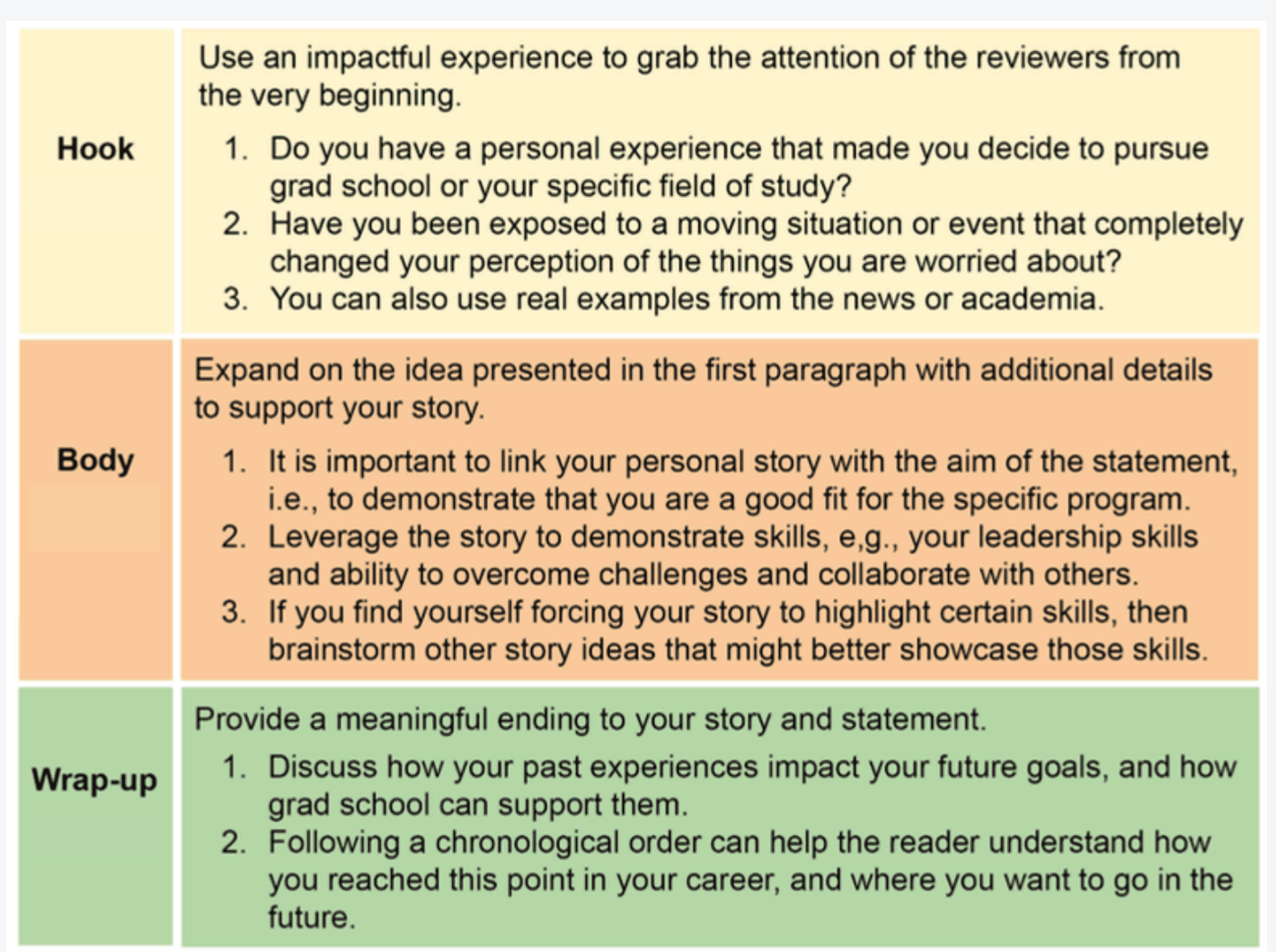
Nguồn: MIT Communication Lab, CEE CommKit.
Source: MIT Communication Lab, CEE CommKit.
Do và Don’t khi viết SOP
SOP writing: do and don’t
Nên
Do
- Show, don’t tell; chọn lọc chi tiết
- Mỗi đoạn một ý
- Ngôn ngữ trang trọng, câu chủ động: “I do” thay vì “A was done”
- Hạn chế “So”, “One of”, “Some”, “Thing”, “Very”, “Like”; dùng “I”
- Show, don’t tell; be selective about the details
- One point per paragraph
- Formal language and active sentences: “I do” instead of “A was done”
- Minimise “So”, “One of”, “Some”, “Thing”, “Very”, “Like”; use “I”
Tránh
Don't
- Tự khen, tự nhận phẩm chất mà không có bằng chứng
- Trình bày nghiên cứu như thể ai cũng hiểu sẵn
- Kể khó khăn theo cách để lại ấn tượng tiêu cực
- Nói về nghiên cứu mà không làm nổi bật phẩm chất nghiên cứu của bạn
- Biến SOP thành một bản CV thứ hai
- Self-praise or claiming qualities without evidence
- Presenting research as if readers already understand it
- Framing difficulties in a way that leaves a negative vibe
- Talking about research without highlighting your qualities as a researcher
- Turning the SOP into a second CV
Tài liệu tham khảo
Helpful resources
- SOP: outline và ví dụ phân tích chi tiết (MIT EECS CommKit)
- Personal Statement: outline và ví dụ phân tích chi tiết (MIT CEE CommKit)
- Ví dụ SOP thực tế (Eugenie Y. Lai, PhD EECS MIT)
- Nên viết gì trong Personal Statement (Stanford)
- Hướng dẫn viết statement (UC Berkeley Graduate Division)
- So sánh SOP và Personal Statement (MIT CEE CommKit)
- Tổng hợp tài liệu viết SOP (r/gradadmissions)
- Bộ sưu tập 40 bài SOP mẫu (Clever Academy)
- SOP: outline and worked example (MIT EECS CommKit)
- Personal Statement: outline and worked example (MIT CEE CommKit)
- A real SOP example (Eugenie Y. Lai, PhD EECS MIT)
- What to include in your Personal Statement (Stanford)
- Writing your statements (UC Berkeley Graduate Division)
- The SOP and Personal Statement compared (MIT CEE CommKit)
- A resource list for SOP writing (r/gradadmissions)
- A collection of 40 sample SOPs (Clever Academy)
Motivation Letter và Cover Letter
Motivation Letter and Cover Letter
Hai lá thư quen thuộc của hồ sơ châu Âu: Motivation Letter cho chương trình Thạc sĩ và học bổng, Cover Letter khi ứng tuyển một dự án PhD cụ thể. Mỗi nước, mỗi trường nhấn mạnh khác nhau, nên luôn đọc kỹ website của chương trình.
The two staple letters of European applications: the Motivation Letter for Master's programs and scholarships, and the Cover Letter when applying to a specific PhD project. Every country and university weighs them differently, so always read the program's website carefully.
Motivation Letter cho chương trình Thạc sĩ
The Motivation Letter for Master’s programs
Hồ sơ châu Âu khác nhau đáng kể giữa các nước và các chương trình học bổng. Ba biến thể thường gặp, độ dài 1 đến 2 trang (lý tưởng 1 đến 1.5 trang):
European applications vary considerably between countries and scholarship schemes. Three common variants, at 1 to 2 pages (ideally 1 to 1.5):
Thư cho admission
Admission letter
Chuẩn bị học thuật, độ phù hợp với chương trình, hướng nghiên cứu và sự nghiệp, đóng góp cho chương trình.
Academic preparation, program fit, research and career direction, contribution to the program.
Thư cho học bổng
Scholarship letter
Thành tích, tiềm năng và động lực, tác động xã hội, và vì sao khoản tài trợ này quan trọng với bạn.
Achievement, potential and motivation, societal impact, and why the funding matters to you.
Thư kết hợp
Combined letter
Một câu chuyện trả lời trọn 6 câu hỏi: why this field, why this program, why now, why you, why this scholarship, và bạn tạo ra tác động gì.
One story answering all 6 questions: why this field, why this program, why now, why you, why this scholarship, and what impact you can make.
Cấu trúc: Why me x Why them x Why now
The structure: Why me x Why them x Why now
Dòng chảy tự nhiên của lá thư là quá khứ, hiện tại, tương lai:
The letter flows naturally from past to present to future:
Mở đầu: động lực trung tâm
Opening: the central motivation
Một đoạn ngắn nêu điều thôi thúc bạn theo đuổi lĩnh vực này.
A short paragraph on what drives you toward this field.
Nền tảng học thuật
Academic background
GPA, các môn liên quan, cuộc thi, trao đổi, các khóa đào tạo khác: bằng chứng bạn được chuẩn bị tốt.
GPA, relevant courses, competitions, exchanges, other trainings: the proof of your academic preparation.
Kiểm tra yêu cầu tín chỉ trước khi viết
Check the credit requirements before you write
Riêng với châu Âu, academic fit thường là điều kiện cứng chứ không chỉ là điểm cộng: nhiều chương trình yêu cầu bạn đã học đúng các môn nhất định và đủ số tín chỉ. Hãy kiểm tra điều này trước, vì không bài luận nào cứu được một hồ sơ không đạt điều kiện đầu vào.
In Europe especially, academic fit is often a hard condition rather than a bonus: many programs require that you have already taken particular courses and accumulated enough credits in them. Check this first, because no essay can rescue an application that fails an eligibility rule.
Kinh nghiệm liên quan
Relevant experience
Bằng chứng của sự quan tâm và năng lực: chuyên môn, nghiên cứu, hoạt động xã hội.
Evidence of interest and ability: professional, research, social.
Vì sao chương trình Thạc sĩ này
Why this Master's
Công thức hữu ích: I have X, I lack Y (for my career goals), this program gives me Y, therefore I need this programme.
A useful formula: I have X, I lack Y (for my career goals), this program gives me Y, therefore I need this programme.
Vì sao học bổng này: tác động
Why this scholarship: impact
Học bổng thường ưu tiên người tạo được tác động xã hội: chuyển giao tri thức, công nghệ bền vững, đóng góp cho hệ sinh thái khoa học của đất nước, đúng với chủ đề của học bổng.
Scholarships often favour applicants who can make societal impact: transferring knowledge, developing sustainable technologies, contributing to your country’s scientific ecosystem, aligned with the scholarship’s theme.
Kết thư
Closing
Ngắn gọn, hướng về phía trước. Lưu ý: mỗi nước, mỗi trường nhấn mạnh khác nhau, hãy phân tích kỹ website và tìm góc nhìn từ alumni.
Short and forward-looking. Note: each country and university has a different emphasis, so analyse their website carefully and search for alumni insights.
Cover Letter khi ứng tuyển dự án PhD
The Cover Letter for a PhD project application
Một trang, một câu hỏi trung tâm
One page, one central question
“Vì sao bạn là đúng người để thực hiện dự án PhD này, và vì sao PhD này là bước tiếp theo hợp logic trong hành trình nghiên cứu của bạn?”
“Why are you the right person to carry out this PhD project, and why is this PhD the logical next step in your research trajectory?”
- Mở đầu hoàn toàn trực tiếp, không cần hook: bạn là ai, tốt nghiệp ở đâu, ứng tuyển dự án nào; rồi quỹ đạo học thuật thật cô đọng, cho thấy tư duy khoa học trưởng thành dần
- Kinh nghiệm liên quan và độ sẵn sàng kỹ thuật: đào sâu kỹ năng phù hợp nhất; nghiên cứu ở bậc Thạc sĩ rất quan trọng; cho thấy tính tự lập, thiết kế thí nghiệm, troubleshooting
- Why this PhD project: research question nào đang hấp dẫn bạn, vì sao dự án này, bạn đóng góp gì, bạn muốn học gì
- Research potential: kế hoạch sự nghiệp và vì sao cần PhD, viết thật cô đọng
- Cấu trúc hữu ích: “The project needs X. I have experience with X. My experience with X led me to Y. This project gives me the opportunity to develop Y further.”
- A completely direct introduction, no hook: who you are, where you graduated, which project you are applying to; then a concise academic trajectory showing how your scientific thinking developed
- Relevant experience and technical readiness: dive deep into the most relevant skills; your Master’s research matters most; show independence, experiment design, troubleshooting
- Why this PhD project: what research question now interests you, why this project, what you can contribute, what you want to learn
- Research potential: career plan and why a PhD, written concisely
- A useful structure: “The project needs X. I have experience with X. My experience with X led me to Y. This project gives me the opportunity to develop Y further.”
Cover Letter được đọc bằng con mắt khoa học. Điều quan trọng nhất cần chứng minh là project fit: kinh nghiệm của bạn khớp với chính xác những gì dự án cần. Tìm yêu cầu đó trên website của lab hoặc trong mô tả dự án.
The Cover Letter is read with a scientific eye. The single most important thing to prove is project fit: your experience matches exactly what the project needs. Find those needs on the lab’s website or in the project description.
Tài liệu tham khảo
Helpful resources
- Các thư động lực được tuyển chọn (LMU Munich)
- Hints and tips for writing a Letter of Motivation (Charité Molecular Medicine)
- How to Write a Great Statement of Purpose (Vince Gotera)
- Cover Letter: outline và ví dụ (University of Illinois)
- How I write cover letters (Dr. Veronika Cheplygina)
- Cover letter học thuật khác cover letter xin việc thế nào (Kickresume)
- Viết cover letter thuyết phục cho PhD và postdoc (Dr. Maryam Ziaei)
- Selected motivation letters (LMU Munich)
- Hints and tips for writing a Letter of Motivation (Charité Molecular Medicine)
- How to Write a Great Statement of Purpose (Vince Gotera)
- Cover Letter: outline and example (University of Illinois)
- How I write cover letters (Dr. Veronika Cheplygina)
- Business vs academic cover letters (Kickresume)
- How to write a convincing cover letter for a PhD or postdoc (Dr. Maryam Ziaei)
Research Proposal
The Research Proposal
Proposal có thể thay đổi sau khi nhập học, nhưng cách lập luận của bạn phải hiện rõ ngay từ bây giờ: vấn đề có đáng nghiên cứu không, bạn đã đọc gì, câu hỏi có logic không, và dự án có khả thi không.
The proposal may evolve after admission, but your reasoning must already be visible: is the problem worth investigating, what have you read, does the question follow logically, and is the project feasible.
Vì sao cần Research Proposal?
Why do you need a Research Proposal?
Điều hội đồng muốn thấy là cách bạn tư duy. Proposal có thể thay đổi sau khi nhập học; điều phải hiện rõ ngay từ bây giờ là lập luận của bạn:
What the committee wants to see is how you think. The proposal may evolve after admission; what must already be visible is your reasoning:
- Problem: bạn có nhận diện được một vấn đề đáng nghiên cứu, thay vì chỉ một chủ đề chung chung bạn thích?
- Evidence: bạn đã đọc literature liên quan và nắm được các ý chính, các tranh luận, các giới hạn?
- Logic: research question có bật ra từ vấn đề và literature không; phương pháp đề xuất có thực sự trả lời được câu hỏi?
- Feasibility: dự án có hoàn thành được với thời gian, kỹ năng, dữ liệu, thiết bị sẵn có trong chương trình học?
- Fit: dự án có hợp với khoa không; một ý tưởng hay vẫn bị từ chối nếu không có người hướng dẫn hay môi trường nghiên cứu phù hợp.
- Problem: can you identify a meaningful problem, rather than only a general subject that interests you?
- Evidence: have you read the relevant literature and identified the main ideas, debates and limitations?
- Logic: does the research question emerge from the problem and the literature; will the proposed method actually answer it?
- Feasibility: can the project be completed with the time, skills, data and equipment available during the degree?
- Fit: does the project fit the department; a university may like an idea and still reject it if no appropriate supervisor or research environment is available.
Định dạng và dàn ý
Format and outline
Luôn kiểm tra định dạng mà trường hoặc khoa quy định. Khi không có mẫu: khoảng 1000 đến 2000 từ, hoặc 5 đến 10 trang, trình bày 1 hoặc 2 cột. Một cách hình dung trực quan, proposal lần lượt nói:
Always check the university or department’s required format. Without one: about 1000 to 2000 words, or 5 to 10 pages, in 1 or 2 columns. Intuitively, a proposal says, in order:
Đây là một vấn đề quan trọng
Here is an important problem
Và đây là bối cảnh của nó (Title, Background).
And here is its context (Title, Background).
Đây là những gì ta đã biết
Here is what we already know
Literature review vẽ lại cuộc thảo luận của ngành (Literature).
The literature review maps the conversation (Literature).
Đây là điều còn bỏ ngỏ
Here is what remains uncertain
Research gap là lý do nghiên cứu mới tồn tại (Gap).
The research gap justifies the new study (Gap).
Đây là câu hỏi tôi sẽ nghiên cứu
Here is the question I will investigate
Research question thu hẹp trọng tâm của dự án (Questions).
The research question focuses the project (Questions).
Đây là phương pháp khả thi và có đạo đức
Here is a realistic, ethical method
Method kiểm chứng evidence; Timeline chứng minh dự án thực tế (Method, Timeline).
The method tests the evidence; the timeline proves the project realistic (Method, Timeline).
Đây là vì sao kết quả có ý nghĩa
Here is why the results matter
Contribution nêu giá trị của phát hiện; References làm nền cho toàn bộ đề xuất (Contribution, References).
The contribution explains the value of the findings; references ground the proposal (Contribution, References).
Thu hẹp đề tài: càng hẹp càng mạnh
Narrowing the topic: stronger when narrower
| Tầng | Câu hỏi tự vấn |
|---|---|
| Broad field | Lĩnh vực nào khiến mình quan tâm? |
| Specific topic | Phần nào của lĩnh vực đó hấp dẫn mình? |
| Research problem | Điều gì đang diễn ra và nó có đáng quan tâm không? |
| Research gap | Điều gì còn chưa chắc chắn hoặc chưa được khám phá? |
| Research question | Chính xác thì mình sẽ nghiên cứu điều gì? |
| Layer | The question to ask yourself |
|---|---|
| Broad field | What area interests me? |
| Specific topic | Which part of that field interests me? |
| Research problem | What is happening and does it matter? |
| Research gap | What remains uncertain or underexplored? |
| Research question | What exactly will I investigate? |
Literature review: tìm ra khuôn mẫu
Literature review: find the pattern
Đừng liệt kê rời rạc “Paper A tìm thấy…, Paper B tìm thấy…”. Hãy chỉ ra nơi các phát hiện hội tụ, nơi các cách giải thích mâu thuẫn, và điều gì còn bỏ ngỏ: một khuôn mẫu dẫn thẳng tới research gap và research question.
Do not list disconnected facts: “Paper A found…, Paper B found…”. Show where findings converge, where explanations conflict, and what remains unresolved: a pattern that leads straight to the research gap and question.
Method: ba câu trả lời
Method: three answers
Question: mình cần hiểu điều gì (Design). Evidence: bằng chứng nào trả lời được câu hỏi (Data). Method: thu thập và phân tích bằng chứng đó như thế nào (Analysis).
Question: what must I understand (Design). Evidence: what would answer it (Data). Method: how will I collect and analyse that evidence (Analysis).
Quy trình gợi ý
The suggested workflow
Xác định một research gap và câu hỏi đủ mạnh, phát triển phương pháp, chuẩn bị bản draft và tìm title, đối chiếu với các proposal mẫu chất lượng cao, rồi mài giũa bản cuối.
Identify a strong research gap and question, develop the methodology, prepare a draft and find a title, refer to high-quality sample proposals, then refine and polish.
Autobiography và Study Plan
Autobiography and Study Plan
Autobiography giải thích bạn là ai; Study Plan giải thích bạn muốn trở thành ai. Đặt cạnh nhau, hai bài phải kể một câu chuyện liền mạch và thuyết phục.
An Autobiography explains who you are; a Study Plan explains who you want to become. Side by side, they should tell one coherent and convincing story.
Hai bài luận, một câu chuyện
Two essays, one story
Autobiography giải thích bạn là ai; Study Plan giải thích bạn muốn trở thành ai. Đây là cặp bài luận hay gặp nhất ở châu Á, rõ nhất là Đài Loan. Cả hai đều linh hoạt: điều chỉnh trọng tâm theo giới hạn từ và các tài liệu khác trong hồ sơ. Độ dài khuyến nghị 1.5 đến 3 trang, lý tưởng là 1.5 đến 2 trang. Ưu tiên thể chủ động; thể bị động vẫn dùng được nhưng nên thật hiếm.
An Autobiography explains who you are; a Study Plan explains who you want to become. This is the pair you meet most often in Asia, most clearly in Taiwan. Both are flexible essays: adjust the focus to the word limit and the other documents in your application. Recommended length 1.5 to 3 pages, with 1.5 to 2 the ideal. Prefer an active voice; the passive is allowed but should stay rare.
| Autobiography | Study Plan |
|---|---|
| Bạn là ai? | Bạn sẽ làm gì? |
| Nền tảng của bạn | Định hướng học thuật tương lai |
| Trải nghiệm quá khứ | Mục tiêu tương lai |
| Động lực | Hướng nghiên cứu |
| Câu chuyện cá nhân | Timeline và sự nghiệp |
| Autobiography | Study Plan |
|---|---|
| Who are you? | What will you do? |
| Your background | Your future academics |
| Past experiences | Future goals |
| Motivation | Research interests |
| Personal story | Timeline and career |
Mười phần trăm còn lại dành cho thư giới thiệu và các tài liệu bổ sung như công bố khoa học, chứng nhận học bổng hay báo cáo nghiên cứu. Đây là tiêu chí của một trường cụ thể, nên hãy tra đúng bảng trọng số của trường bạn nhắm tới. Điểm đáng chú ý: năng lực tiếng Trung được tính ngang một bài luận, nên nếu bạn đang học hoặc dự định học tiếng Trung, hãy nói rõ điều đó trong Study Plan.
The remaining ten percent covers the recommendation letter and supporting documents such as publications, scholarship certificates or research reports. These are one specific school’s criteria, so look up the weighting table for the school you are targeting. One thing worth noticing: Chinese language proficiency counts as much as either essay, so if you are learning Chinese or plan to, say so explicitly in your Study Plan.
Autobiography: Experience, Reflection, Growth, Motivation
The Autobiography: Experience, Reflection, Growth, Motivation
Hook / Identity: bạn là ai lúc này?
Hook / Identity: who are you now?
Mở bằng thành tựu mạnh nhất hoặc trải nghiệm định hình bạn, không phải tuổi thơ. Ngay đoạn đầu, người đọc phải biết bạn là ai, điều gì khiến bạn khác biệt, và vì sao câu chuyện đáng đọc tiếp.
Open with your strongest achievement or defining experience, not childhood. From the first paragraph the reader should know who you are, what distinguishes you, and why the story is worth reading.
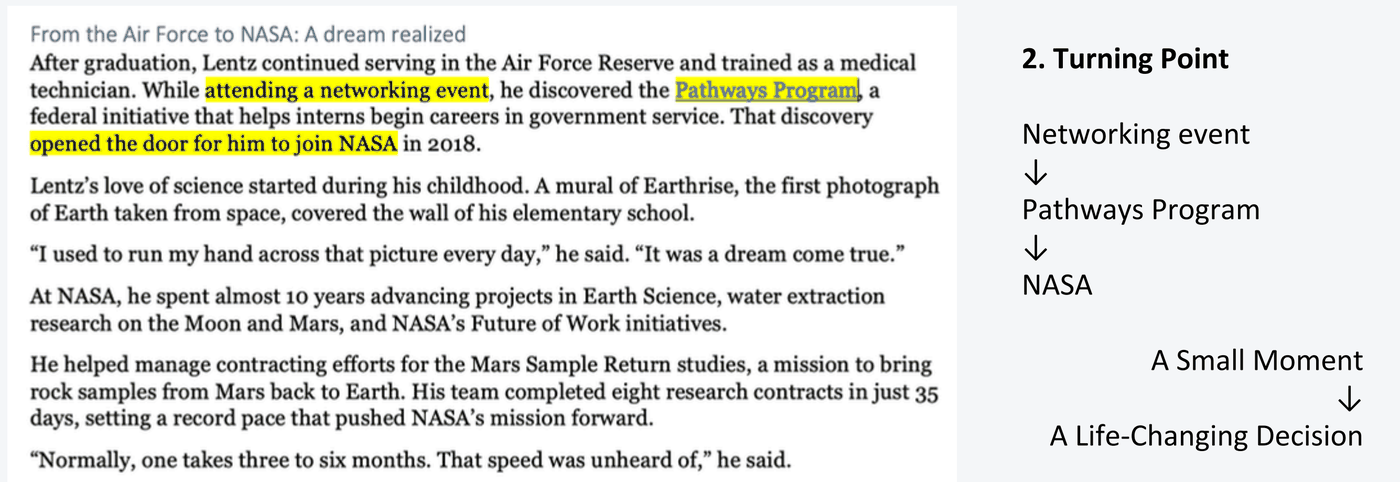
Bước ngoặt
Turning point
Một khoảnh khắc nhỏ dẫn tới một quyết định thay đổi cuộc đời: sự kiện, con người hoặc cơ hội đã chuyển hướng hành trình của bạn.
A small moment that led to a life-changing decision: the event, person or opportunity that redirected your path.
Trưởng thành học thuật và nghề nghiệp
Academic and professional growth
Trưởng thành qua từng trải nghiệm, kể cả thử thách và thất bại: chúng cho thấy bạn là kiểu người như thế nào.
Growth through each experience, including challenges and failures: they show what kind of person you are.
Vì sao lĩnh vực này, và tầm nhìn tương lai
Why this field, and the future vision
Khép lại bằng lý do bạn chọn lĩnh vực và hình dung về tương lai. Mẹo nhỏ: nhắc đến một người tham chiếu (người thầy, người truyền cảm hứng) làm câu chuyện đáng tin hơn.
Close with why this field and your future vision. A small note: mentioning a reference (a mentor, an inspiration) makes the story more credible.
Bốn phần đó trên một câu chuyện có thật
The four parts on a real story
Workshop dùng một bài viết đã đăng công khai của Missouri State University làm mẫu về cấu trúc. Đây là bài báo giới thiệu nhân vật, không phải bài luận nộp hồ sơ, nên hãy đọc nó như một mẫu về trình tự kể chuyện chứ không phải mẫu về văn phong hồ sơ.
The workshop used a published Missouri State University profile as a model for the shape. It is a news feature rather than a submitted application essay, so read it for the order the story is told in, not as a model of application prose.
Nguồn: blogs.missouristate.edu, hồ sơ nhân vật đã đăng công khai. Giữ nguyên văn.Source: blogs.missouristate.edu, a publicly published profile. Quoted verbatim.
Bước ngoặt, theo cách workshop tô màu
The turning point, as the workshop marked it up
Nên
Do
- Kể một câu chuyện
- Cho thấy sự trưởng thành
- Chiêm nghiệm từ trải nghiệm
- Dựa trên bằng chứng
- Tell a story
- Show growth
- Reflect on experiences
- Stay evidence-based
Tránh
Don't
- Lặp lại CV
- Liệt kê thành tích
- Generic statement, câu nói chung chung đúng với bất kỳ ai
- Repeat your CV
- List achievements
- Generic statements that could belong to anyone
Study Plan: Current, Skill Gap, Program Resources, Future Career
The Study Plan: Current, Skill Gap, Program Resources, Future Career
Một Study Plan mạnh giải thích rõ vì sao chương trình này là lựa chọn đúng và mục tiêu học thuật, sự nghiệp sẽ đạt được bằng cách nào. Dàn ý gợi ý sáu phần:
A strong Study Plan clearly explains why this program is the right choice and how your academic and career goals will be achieved. A suggested six-part outline:
Introduction
Introduction
Nền tảng học thuật, mục tiêu sự nghiệp, vì sao ứng tuyển đúng chương trình này, và kết nối với nguyện vọng tương lai.
Academic background, career goals, why this specific program, and the connection to your future aspirations.
Academic Study Plan
Academic Study Plan
Thời lượng dự kiến, kế hoạch môn học từng kỳ, môn bắt buộc và tự chọn, kỹ năng bổ trợ, và mỗi giai đoạn đóng góp gì cho mục tiêu học tập chung.
Expected duration, planned course load per semester, core and elective courses, supporting skills, and how each stage contributes to the overall learning objectives.
Research & Academic Development
Research & Academic Development
Hướng nghiên cứu hoặc đề tài dự kiến, lý do chọn, và sự hướng dẫn kỳ vọng từ giảng viên cùng nguồn lực nghiên cứu.
Proposed research interests or thesis topic, the reasons behind them, and the guidance and resources you expect.
Extracurricular & Professional Activities
Extracurricular & Professional Activities
Tổ chức sinh viên, hội thảo, dự án nghiên cứu, thực tập, hoạt động trao đổi văn hóa, và cách chúng bổ trợ việc học.
Student organisations, conferences, research projects, internships, cultural exchange, and how they complement the academics.
Language Development
Language Development
Mục tiêu cải thiện ngoại ngữ, kế hoạch học hàng tuần, chứng chỉ, và ngôn ngữ hỗ trợ học tập cùng sự nghiệp ra sao.
Language goals, a weekly learning plan, certifications, and how language skills support study and career.
Future Career Plan
Future Career Plan
Mục tiêu ngắn hạn sau tốt nghiệp, kế hoạch dài hạn, và kiến thức thu được đóng góp gì cho ngành, giáo dục, xã hội.
Short-term goals after graduation, long-term plans, and how the acquired knowledge contributes to industry, education and society.
Thay vì “em luôn yêu thích ngành này nên muốn học thêm”, hãy chỉ ra dự án cụ thể đã làm lộ skill gap của bạn, rồi cho thấy coursework và nghiên cứu của chương trình lấp khoảng trống đó thế nào. Program fit, kết nối logic, và skill gap được gọi tên rõ là ba điểm cộng; lặp lại thông tin, mục tiêu phi thực tế, và các phần rời rạc là ba điểm trừ.
Instead of “I have always loved this field and want to learn more”, name the concrete project that revealed your skill gap, then show how the program’s coursework and research bridge it. Program fit, a logical connection, and clearly identified skill gaps are the three wins; repeated information, unrealistic goals, and disconnected parts are the three losses.
Mẹo viết chung, AI và đạo văn
General writing tips, AI use and plagiarism
Những nguyên tắc áp dụng cho mọi bài luận trong bộ hồ sơ: viết chi tiết nhưng cô đọng, mở đoạn bằng topic sentence, và dùng AI như công cụ hỗ trợ chứ không phải người viết thay.
Principles that apply to every essay in the set: write with concrete detail but stay concise, open paragraphs with a topic sentence, and treat AI as an assistant, never a ghostwriter.
Chi tiết, nhưng cô đọng
Detailed, but concise
Một trải nghiệm mơ hồ thua một trải nghiệm cụ thể, và trải nghiệm cụ thể viết dài dòng lại thua phiên bản chi tiết mà cô đọng. Ba ví dụ dưới đây là cùng một trải nghiệm được viết lại hai lần, lấy nguyên từ workshop. Cột thứ ba mới là đích đến: mỗi câu nêu đúng hành động, công cụ, và kết quả.
A vague experience loses to a concrete one, and a long-winded concrete one loses to the detailed-but-concise version. The three examples below are the same experience rewritten twice, taken from the workshop. The third column is the target: every sentence names the action, the tool and the outcome.
| Mơ hồ | Cụ thể | Chi tiết mà cô đọng |
|---|---|---|
| As a senior, I received an A in a graduate-level Structure Mechanics course. | My interest in structural analysis led me to take advanced coursework to learn more about Steel structures. At the graduate-level Structural Mechanics course, I learned about joints design which boosted my interest in… | To deepen my structural analysis skills, I took a graduate-level Structural Mechanics course, where studying steel joint design sharpened my interest in [specific area]. |
| During my third year, I worked on a project for my Hydrology class that made me get interested in numerical modelling. | During my third year, I had the chance to conduct a research-oriented class project about the hydrology of the Mississippi river and the impact of global warming in its regime. In this project, I ran a hydrological numerical model using the open source software… While working in this project, I faced with the difficulty of getting updated topographic data of the study area. I managed to overcome this issue by… | For a third-year research project, I modeled the Mississippi River’s hydrology under climate change using open-source software, overcoming a shortage of current topographic data by [method]. |
| I volunteered at the Career Fair for the last three years. At this position, I demonstrated my leadership and management skills. | Committed to being a great ambassador of our class, I volunteered at the Career Fair for last three years, welcoming the companies’ representatives, guiding them to their locations, and helping them assemble their booths. This experience allowed me to gain training on dealing with time constraints and a large group of people. Last year, for example… | Over three years volunteering at the Career Fair, I welcomed company representatives, guided them to their booths, and helped set up, building skills in managing tight deadlines and large groups. |
| Vague experience | Concrete experience | Detailed and concise |
|---|---|---|
| As a senior, I received an A in a graduate-level Structure Mechanics course. | My interest in structural analysis led me to take advanced coursework to learn more about Steel structures. At the graduate-level Structural Mechanics course, I learned about joints design which boosted my interest in… | To deepen my structural analysis skills, I took a graduate-level Structural Mechanics course, where studying steel joint design sharpened my interest in [specific area]. |
| During my third year, I worked on a project for my Hydrology class that made me get interested in numerical modelling. | During my third year, I had the chance to conduct a research-oriented class project about the hydrology of the Mississippi river and the impact of global warming in its regime. In this project, I ran a hydrological numerical model using the open source software… While working in this project, I faced with the difficulty of getting updated topographic data of the study area. I managed to overcome this issue by… | For a third-year research project, I modeled the Mississippi River’s hydrology under climate change using open-source software, overcoming a shortage of current topographic data by [method]. |
| I volunteered at the Career Fair for the last three years. At this position, I demonstrated my leadership and management skills. | Committed to being a great ambassador of our class, I volunteered at the Career Fair for last three years, welcoming the companies’ representatives, guiding them to their locations, and helping them assemble their booths. This experience allowed me to gain training on dealing with time constraints and a large group of people. Last year, for example… | Over three years volunteering at the Career Fair, I welcomed company representatives, guided them to their booths, and helped set up, building skills in managing tight deadlines and large groups. |
Cũng ba lần viết lại đó, theo cách workshop tô màu
The same three rewrites, as the workshop marked them up
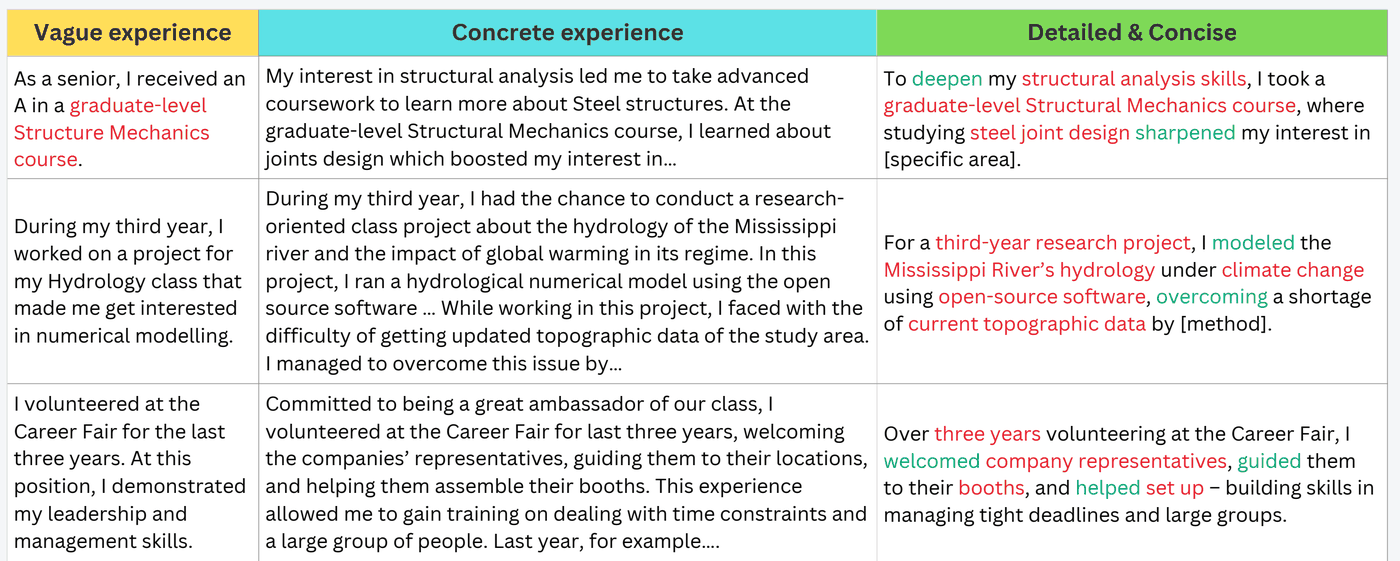
Nguồn: MIT Communication Lab, CEE CommKit.
Source: MIT Communication Lab, CEE CommKit.
Một đoạn văn cơ bản: 4 phần
A basic paragraph: 4 key parts
- Topic sentence: ý chính của đoạn
- Development: triển khai ý chi tiết hơn
- Example: bằng chứng, dữ liệu, số liệu
- Summary: chốt lại và đánh giá ý chính
- Topic sentence: the paragraph’s key point
- Development: the idea in more detail
- Example: support, evidence, data
- Summary: the main point, summarised and evaluated
Ai thực sự đọc phần nào
Who actually reads what
Admission committee thường đọc lướt, nên topic sentence phải gánh được ý chính. Nhưng khi hồ sơ được chuyển đến những giáo sư bạn nhắc tên, họ rất có thể đọc kỹ từng câu. Câu nào cũng phải chỉn chu.
The admission committee skims, so topic sentences must carry the argument. But when your file reaches the professors you mention, they are likely to read closely. Every sentence has to hold up.
Sáu từ nên hạn chế
Six words to use sparingly
Mỗi từ dưới đây thường đứng thay cho một chi tiết cụ thể mà bạn chưa viết ra. Gặp chúng trong bản draft, hãy hỏi lại: cụ thể là cái nào, bao nhiêu, ở đâu.
Each word below usually stands in for a specific detail you have not written yet. When one turns up in a draft, ask: which one, how many, where.
- So
- One of
- Some
- Thing
- Very
- Like
- So
- One of
- Some
- Thing
- Very
- Like
Nêu hạn chế của mình là được, nhưng phải đi kèm cách bạn xử lý. Ví dụ workshop đưa ra về cách viết sai: “My undergraduate institute is bad, I dont have much resource for my experiment.” Câu này để lại ấn tượng tiêu cực mà không cho thấy bạn đã làm gì. Hãy viết lại thành thứ bạn xoay xở được với nguồn lực sẵn có, rồi mới nói tới giới hạn.
Naming a limitation is fine, but it has to arrive with what you did about it. The workshop’s example of getting this wrong: “My undergraduate institute is bad, I dont have much resource for my experiment.” It leaves a negative impression without showing what you did. Rewrite it as what you managed to build with the resources you had, and let the limit follow from that.
Do và Don’t khi dùng AI
Do and don’t when using AI
Dùng AI để
Use AI for
- Brainstorm chủ đề và từ khóa tìm kiếm
- Sắp xếp ghi chú ban đầu
- Cải thiện độ rõ của câu, kiểm tra ngữ pháp
- Tự viết bản draft đầu tiên, rồi dùng AI cải thiện cấu trúc qua từng draft
- Brainstorming topics and search terms
- Organising early notes
- Improving sentence clarity and checking grammar
- Writing your first draft yourself, then using AI to improve structure draft by draft
Đừng bao giờ để AI
Never let AI
- Viết thay từ đầu: bố cục chung chung, không có nét riêng, giáo sư đọc là nhận ra
- Được sao chép nguyên văn vào bài luận
- Thay bạn kiểm tra fact, trích dẫn, giọng văn
- Quyết định bản cuối: bản cuối phải mang giọng của chính bạn
- Write from scratch: the generic layout shows no uniqueness, and professors recognise it immediately
- Be copied verbatim into your essay
- Replace your own checking of facts, citations and tone
- Decide the final draft: the final draft must be personal, in your own voice
Hai prompt nên dùng: “Improve this paragraph to make it clearer and more concise, but keep the original meaning.” · “Identify the weaknesses in this paragraph then suggest specific ways to improve it.” Prompt thứ ba, “Using my background and experiences, help me build an SOP that clearly links my story to the target program.”, thì nên hạn chế hoặc dùng thật ít, vì nó mời AI viết bản draft đầu tiên thay bạn.
The two to lean on: “Improve this paragraph to make it clearer and more concise, but keep the original meaning.” · “Identify the weaknesses in this paragraph then suggest specific ways to improve it.” Use the third, “Using my background and experiences, help me build an SOP that clearly links my story to the target program.”, sparingly if at all, since it invites AI to write your first draft for you.
Điều cực kỳ quan trọng: bạn phải chịu trách nhiệm cho mọi luận điểm và mọi trích dẫn trong bài của mình, kể cả khi AI gợi ý chúng. Mỗi câu chữ nên có ý nghĩa với toàn bộ câu chuyện. Và hãy tuân thủ nghiêm quy định của từng trường về việc sử dụng và khai báo AI. Một lưu ý thực tế: AI hay viết câu bị động, hãy chuyển về thể chủ động.
It is extremely important that you own every claim and every citation in your essay, even the ones AI suggested. Every sentence should be meaningful to the whole story. Strictly follow each university’s rules on AI use and disclosure. One practical note: AI tends to write passive sentences, so convert them to active voice.
Có những chương trình mentorship miễn phí
Free mentorship programs exist
Một số khoa tại các trường lớn (được nhắc đến trong workshop: MIT và CMU) có chương trình mentorship miễn phí hỗ trợ ứng viên viết SOP, ví dụ MIT ChemE CHAMP cho ngành Chemical Engineering. Tiêu chí quen thuộc của Cất Cánh: cái gì miễn phí thì không lãng phí.
Some departments at major universities (MIT and CMU were mentioned in the workshop) run free mentorship programs that help applicants with the SOP, for example MIT ChemE CHAMP for Chemical Engineering. The familiar Cất Cánh rule applies: if it is free, it is never a waste.
Tài liệu tham khảo
Helpful resources
Câu hỏi thường gặp
Q&A highlights
Những câu hỏi được đặt trong buổi workshop, cùng vài lưu ý các diễn giả chủ động chia sẻ thêm.
Questions asked during the workshop, plus a few points the speakers raised themselves.
Làm sao để SOP không lặp lại CV? How do I keep the SOP from repeating my CV?
Trong các đoạn nghiên cứu, hãy kể những khó khăn bạn gặp và cách vượt qua, cùng những người bạn đã làm việc chung: đó là nội dung CV không thể chứa, và nó cho thấy bạn là người không ngại thử thách. Bạn được phép dùng lại các dữ kiện có trong CV, nhưng chỉ chọn những dữ kiện phục vụ câu chuyện, đừng kể lại theo kiểu liệt kê từng năm. Hội đồng chắc chắn sẽ đọc CV của bạn, nên đừng sợ thiếu thông tin.
In the research paragraphs, narrate the difficulties you met and how you got through them, and the people you worked with: content a CV cannot carry, and it shows you are someone unafraid of hardship. You may reuse facts that appear in the CV, but pick only the ones that serve the story, never the year-by-year listing. The committee will read your CV anyway, so do not fear missing information.
Một hồ sơ yêu cầu nhiều bài luận na ná nhau thì viết sao cho khỏi trùng lặp? One application asks for several near-identical essays. How do I keep them from overlapping?
Lập một bảng so sánh: liệt kê những thông tin mỗi bài luận mong đợi vào từng cột, nhìn ra chính xác các mục trùng nhau, rồi quyết định tài liệu nào “sở hữu” mục nào. Sau đó dựng mạch truyện của từng bài từ những mục còn lại trong cột của nó; người đọc sẽ không thấy lặp lại mà còn thấy thêm nhiều khía cạnh của bạn. Trước khi nộp, dành 1 đến 2 ngày đọc lại toàn bộ hồ sơ như thể bạn là người xét tuyển, hoặc đặt một buổi Office Hour miễn phí của Cất Cánh để có người soát giúp các điểm thiếu logic.
Build a comparison table: list the information each essay expects in its own column, see exactly which items overlap, then decide which document owns each item. Build each essay’s storyline from what remains in its column; the reader never feels repetition and gets to see more facets of you. Before submitting, spend 1 to 2 days re-reading the whole application as if you were the admissions officer, or book a free Cất Cánh Office Hour and have someone catch the inconsistencies.
Chưa tìm được hướng nghiên cứu rõ ràng trước khi nộp thì sao, và nếu nghiên cứu sau này khác proposal thì có sao không? What if I have no clear research direction before applying, and what if my actual research later diverges from the proposal?
Hãy nhắm vào một giáo sư cụ thể: đọc các bài báo của lab đó cùng các bài lân cận trong ngành cho tới khi một research gap phù hợp với giáo sư đó hiện ra. Proposal khi nộp được hiểu là tạm thời: nếu sau khi nhập học bạn nảy ra ý tưởng khác, hãy trao đổi với người hướng dẫn và chuyển hướng khi có sự đồng ý; một số giáo sư khá cởi mở với những hướng đi khác với phạm vi nghiên cứu của chính họ.
Target a specific professor: read that lab’s papers plus the neighbouring papers in the field until a research gap that fits that professor emerges. The submitted proposal is understood to be tentative: if a different idea appears after you start, discuss it with your supervisor and pivot with their agreement; some professors are open to directions outside their own scope.
Nộp nhiều trường cùng lúc: quản lý khối lượng và deadline thế nào? Applying to many schools at once: how do I manage the workload and the deadlines?
Lập một bảng tính liệt kê mọi trường mục tiêu kèm deadline, tô màu theo ba nhóm: trường mơ ước (đã nhắm giáo sư cụ thể), trường vừa sức, và trường dự phòng; đính kèm link tuyển sinh của từng trường, sắp xếp theo ngày deadline, và đánh dấu những trường đã nộp xong. Quan trọng nhất: hoàn thiện một bản draft chỉn chu càng sớm càng tốt, vì các lá thư lặp lại rất nhiều và thường chỉ phần why this school phải viết lại; mỗi chương trình một thư mục riêng, đặt tên file đúng để không bao giờ gửi nhầm tên trường hay tên giáo sư.
Keep a spreadsheet of every target school and its deadline, colour-coded in three tiers: dream schools (a specific professor targeted), fit schools, and backups; attach each school’s admissions link, sort by deadline, and tick off finished schools. Most important of all: finish one polished master draft as early as possible, because the letters repeat heavily and usually only the why-this-school part changes; keep one folder per program and name files correctly so a recycled essay never carries the wrong school or professor name.
Thư giới thiệu và phí nộp hồ sơ thì sao? What about recommendation letters and application fees?
Nộp hồ sơ sớm, vì đa số trường chỉ gửi link cho người giới thiệu sau khi bạn nộp, và thư phải hoàn tất trước deadline. Cho thầy cô ít nhất một tuần, hỏi từ sớm và chuyên nghiệp, chuẩn bị tinh thần tự soạn bản nháp để thầy cô chỉnh sửa, và sau khi thầy cô nhận lời hãy gửi kèm một tài liệu tóm tắt thành tích cùng những tương tác tốt giữa hai người: thư càng chi tiết càng thuyết phục. Về chi phí, hãy tận dụng fee waiver từ Reddit, GradCafe, email thẳng văn phòng tuyển sinh, hoặc các buổi open house; trong workshop, một diễn giả nộp bốn mươi trường mà tổng phí chỉ 750 đô nhờ waiver. Lưu ý bối cảnh: bốn mươi trường đó ở châu Á, và chính diễn giả này nói rằng nộp bốn mươi trường ở Mỹ với mức khoảng tám chục đô mỗi trường thì tốn kém hơn hẳn.
Submit early, since most schools only email recommenders their link after you submit, and letters must be completed before the deadline. Give professors at least a week, ask early and professionally, be prepared to draft the letter yourself for them to edit, and once they agree, follow up with a document summarising your achievements and interactions with them: detailed letters convince more. On cost, hunt for fee waivers on Reddit and GradCafe, by emailing admissions offices directly, or at open houses; in the workshop, one speaker applied to forty schools for a total of 750 dollars in fees thanks to waivers. Context worth keeping: those forty schools were in Asia, and the same speaker noted that forty US applications at around eighty dollars each costs considerably more.
Đại học nghiên cứu ngành A nhưng muốn học cao học ngành B thì viết thế nào? I researched field A in undergrad but want a graduate degree in field B. How do I write the essays?
Tìm phần giao thoa: làm nổi nền tảng chung và các kỹ năng chuyển đổi được, dùng từ khóa của ngành mới. Việc chọn chương trình quan trọng ngang bài luận: cùng một bộ hồ sơ có thể bị từ chối ở chương trình đòi đúng nền tảng nhưng được nhận ở chương trình cởi mở với nhiều xuất phát điểm. Neo cú chuyển ngành vào một khoảnh khắc động lực cụ thể, và cho thấy bạn đang tự lấp skill gap ngay từ bây giờ, ví dụ vừa học lập trình vừa làm một dự án thật. Một lối đi khác được nhắc tới: học thêm một bằng Thạc sĩ để chuyển ngành, đặc biệt khả thi ở Pháp vì có thể vào thẳng năm hai của chương trình Thạc sĩ. Một bước nên làm sớm: email trợ lý của khoa để hỏi bạn cần học bổ sung những môn nào. Thông thường sẽ có vài môn bắt buộc phải học mà không được tính tín chỉ cho chương trình cao học, và biết trước điều này vừa giúp bạn chọn đúng chương trình vừa cho hội đồng thấy bạn hiểu rõ mình còn thiếu gì.
Find the overlap: surface the shared foundations and transferable skills, using the new field’s keywords. Program choice matters as much as the essay: the identical dossier can be rejected by programs requiring an exact background and accepted by programs open to diverse ones. Anchor the pivot in a concrete motivation moment, and show you are already closing the skill gap right now, for example learning to code while shipping a real project. One alternative route mentioned: take another Master’s to switch fields, especially viable in France, which can admit you directly into a Master’s second year. One step worth taking early: email the department’s assistant to ask which supplementary courses you would need. There are usually a few required courses that do not count toward the graduate degree, and knowing this in advance both guides your program choice and shows the committee you understand your own gaps.
Lời nhắn từ năm diễn giả
Parting advice from the five speakers
Tận dụng tối đa những gì bạn đang có: matching với Ambassador và Office Hour miễn phí. Đừng tự giới hạn số trường mình nộp; người khác nộp được hai mươi, bốn mươi trường thì bạn cũng làm được.
Make the most of everything available to you: Ambassador matching and free Office Hours. Do not cap yourself at a handful of schools; if others can handle twenty or forty applications, so can you.
Viết sớm, viết thường xuyên: càng viết nhiều càng nhận ra mình thiếu gì, cần sửa gì. Và hãy xem AI output như một bản nháp khởi đầu; bản cuối cùng phải là của chính bạn.
Write early, write frequently: the more you write, the faster you find what is missing and what needs fixing. Treat AI output as a draft or starting point; the final draft must be your own.
Hoàn thiện một bản draft chỉn chu càng sớm càng tốt: các lá thư lặp lại rất nhiều, thường chỉ phần why this school phải viết lại, nên có bản draft tốt thì mỗi hồ sơ sau đó rất nhanh. Đừng để burnout cuối mùa khiến bạn bỏ dở.
Finish one polished draft as early as possible: the letters repeat heavily and usually only the why-this-school part changes, so a good draft makes every later dossier fast. Do not let end-of-season burnout make you drop applications.
Đừng gây ấn tượng bằng sự phức tạp; hãy gây ấn tượng bằng sự rõ ràng, bằng chứng và khả năng phán đoán. Dùng AI như một trợ lý chứ không phải người thay thế: bạn chịu trách nhiệm cho mọi luận điểm và trích dẫn.
Do not impress with complexity; impress with clarity, evidence and judgement. Use AI as an assistant, never a replacement: you answer for every claim and citation.
Hãy tận dụng hỗ trợ từ VISEMI: nhờ fee waiver, bốn mươi trường của mình chỉ tốn 750 đô. Nộp thì bạn chẳng mất gì; cứ chuẩn bị tốt nhất có thể, còn nhận hay không là việc của trường.
Use VISEMI’s fellowship support: with fee waivers, my forty schools cost 750 dollars in total. You lose nothing by applying; prepare the best you can, and whether they accept is the school’s problem.
Về cẩm nang này
About this handbook
Sổ tay này tổng hợp nội dung buổi Workshop 2.1 thuộc chuỗi Cất Cánh Pathway, do VISEMI Foundation tổ chức, mở đầu loạt workshop kỹ năng 2.x với phần chia sẻ của các Ambassador Cất Cánh.
This handbook compiles Workshop 2.1 of the Cất Cánh Pathway series, hosted by VISEMI Foundation, opening the 2.x skills series with sessions from Cất Cánh Ambassadors.
Nội dung mang tính tham khảo; yêu cầu tuyển sinh thay đổi theo từng trường và từng năm, hãy kiểm tra thông tin chính thức của trường.
For reference only; admission requirements vary by school and year, so always check each school’s official information.