Chapter 7 of 9Chương 7/9 6 min6 phút
Thin-film depositionLắng đọng màng mỏng
Every floor of the chip high-rise needs new material laid down. Sometimes the coat must be only atoms thick, and sometimes it has to line a trench far deeper than it is wide, top to bottom, without sealing the opening. How do you lay down a film like that?
Mỗi tầng của “tòa nhà chip” đều cần phủ thêm vật liệu mới. Có khi lớp phủ ấy chỉ được dày vài nguyên tử, có khi nó phải lót kín một cái rãnh sâu hơn bề ngang rất nhiều, từ miệng xuống tận đáy, mà không được bít miệng rãnh lại. Làm sao phủ được một lớp màng như thế?
In this chapter
Trong chương này
- The three ways a fab lays down a thin film
- Why deep, narrow trenches are the test every method must pass
- How atomic layer deposition builds a film layer by layer, and why it is slow
- How thermal ALD differs from plasma ALD, and how the slowest method can be made faster
- Ba cách nhà máy sản xuất chip (fab) phủ màng mỏng lên wafer
- Vì sao những rãnh sâu và hẹp là bài kiểm tra mà mọi phương pháp đều phải vượt qua
- Lắng đọng nguyên tử (ALD) phủ màng từng lớp một như thế nào, và vì sao nó chậm
- ALD dùng nhiệt khác ALD dùng plasma như thế nào, và làm sao để tăng tốc ALD
A film can be laid down with atomic precision
Lớp màng được phủ chính xác đến từng nguyên tử
If an atom were the size of a soccer ball, one cycle of atomic layer deposition (ALD), the most precise way a fab lays down a film, would be like covering the entire bumpy surface of the Moon with soccer balls, no spot missed, no two balls overlapping, in about a second. A 300 mm wafer gets that treatment on every cycle.
Nếu một nguyên tử to bằng quả bóng đá, thì một chu kỳ lắng đọng nguyên tử (ALD), cách phủ màng chính xác nhất trong fab, giống như phủ kín toàn bộ bề mặt gồ ghề của Mặt Trăng bằng những quả bóng đá, không sót chỗ nào, không có hai quả nào chồng lên nhau, chỉ trong khoảng một giây. Trên một wafer 300 mm, việc ấy diễn ra ở mỗi chu kỳ.
The three deposition methods work by different mechanisms
Ba phương pháp lắng đọng màng mỏng dựa trên ba cơ chế khác nhau
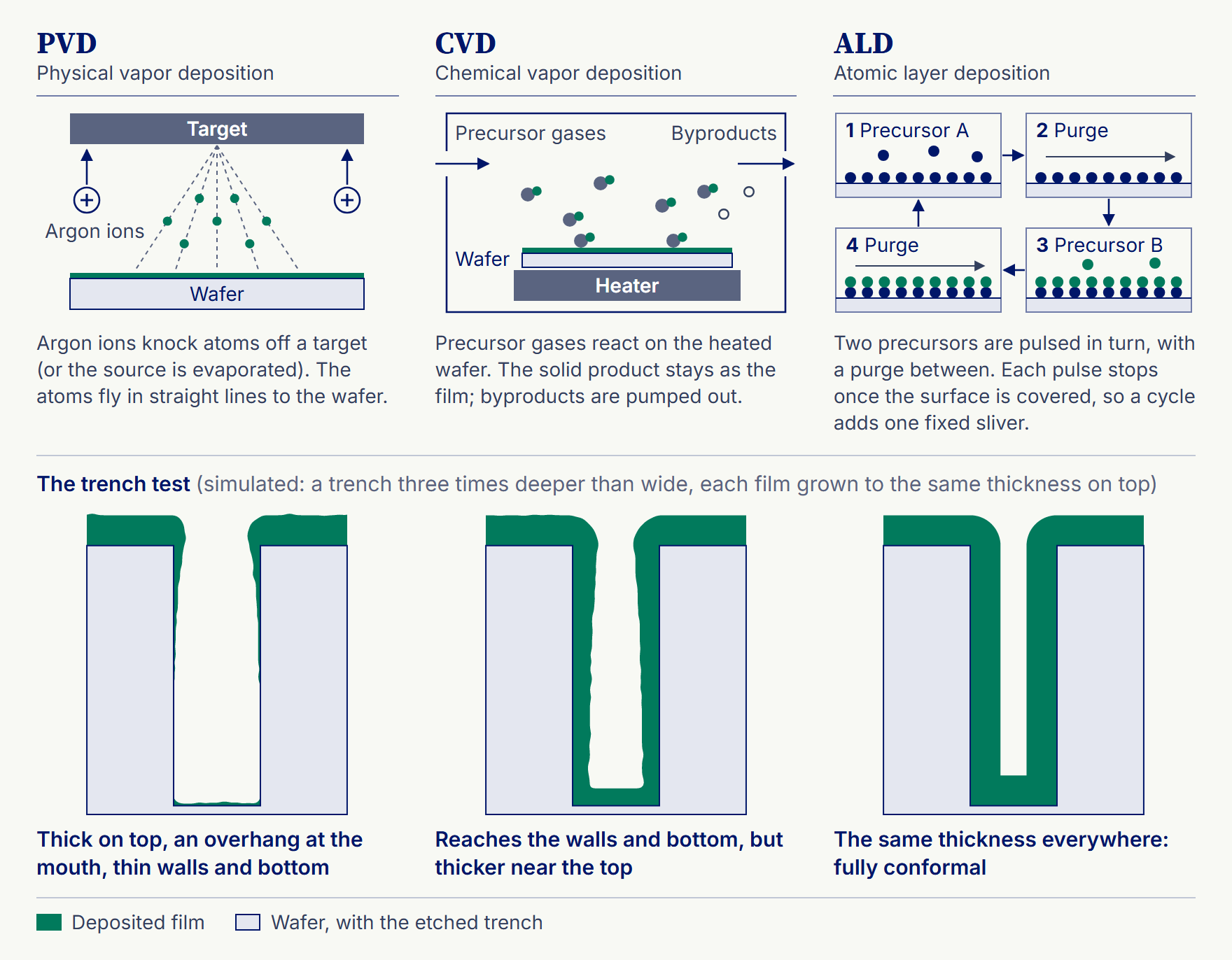
Thin-film deposition puts new material onto the wafer, and the three main families differ in what does the work. In Physical Vapor Deposition (PVD) the work is physical: a plasma accelerates argon ions into a target made of the material to be deposited, and the atoms knocked loose fly onto the wafer.
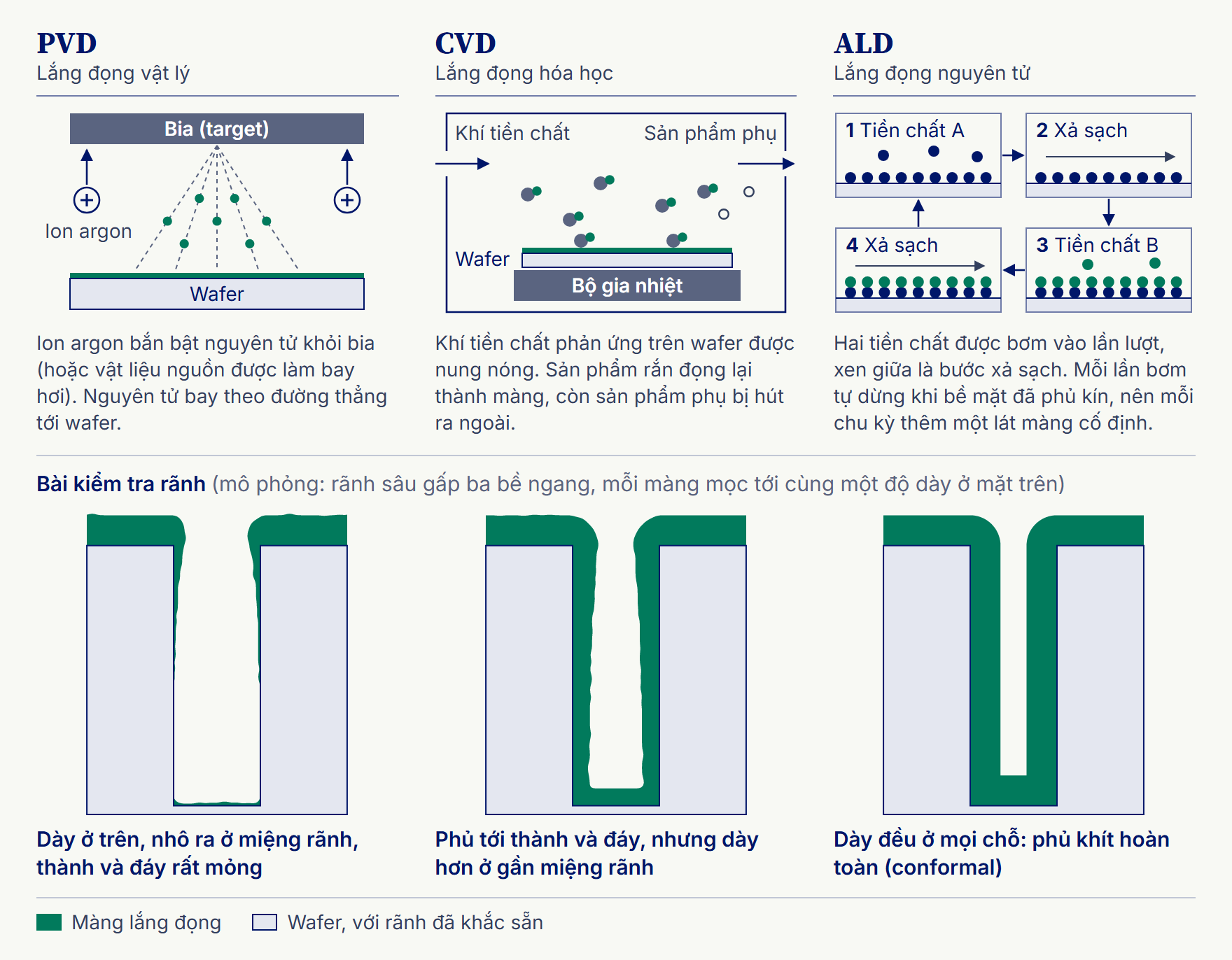
Lắng đọng màng mỏng đưa vật liệu mới lên wafer, và ba hướng chính khác nhau ở cơ chế. Ở lắng đọng vật lý (PVD), cơ chế là bắn phá vật lý: plasma tăng tốc các ion argon đập vào một bia (target) làm từ vật liệu cần lắng đọng, và các nguyên tử bị bắn bật ra bay lên wafer.
In Chemical Vapor Deposition (CVD) the work is chemical: precursor gases, the starting chemicals that carry the film’s ingredients, react inside the chamber, powered by heat or plasma, and the product settles on the wafer.
Ở lắng đọng hóa học (CVD), cơ chế là phản ứng hóa học: các khí tiền chất (precursor), tức những hóa chất ban đầu mang thành phần của màng, phản ứng bên trong buồng nhờ năng lượng từ nhiệt hoặc plasma, và sản phẩm lắng xuống wafer.
ALD is CVD taken to its logical extreme: the reaction is split into separate, self-limiting steps so the film grows by a fixed, tiny amount per cycle, usually less than one atomic layer. The test that separates the three is a deep, narrow trench: PVD tends to pinch off at the opening, CVD fills better, and ALD coats every surface with the same thickness.7.1
ALD thực chất là một kiểu CVD ở mức tinh vi nhất: phản ứng được tách thành các bước riêng rẽ và tự giới hạn (self-limiting), để màng mọc thêm một lượng cố định và rất nhỏ mỗi chu kỳ, thường là chưa tới một lớp nguyên tử. Bài kiểm tra phân biệt ba cách là một rãnh sâu và hẹp: PVD thường bị bít lại ở miệng rãnh, CVD lấp đầy tốt hơn, còn ALD phủ mọi bề mặt với cùng một độ dày.7.1
| Method | What does the work | Strengths | Weakness |
|---|---|---|---|
| PVD | Argon ions knock atoms off a target | Fast; very pure films; ideal for metals | Line-of-sight: struggles with deep trenches |
| CVD | Precursor gases react in the chamber | Good coverage; fills complex 3D structures | Usually needs high temperature unless plasma-enhanced (PECVD); reaction byproducts can leave impurities in the film |
| ALD | Self-limiting reactions, a fixed sliver of film per cycle | Perfect uniformity and atomic-level thickness control | Very slow and expensive |
| Phương pháp | Cơ chế | Điểm mạnh | Điểm yếu |
|---|---|---|---|
| PVD | Các ion argon bắn nguyên tử khỏi bia | Nhanh; màng rất tinh khiết; lý tưởng cho kim loại | Phủ theo đường thẳng: gặp khó với rãnh sâu |
| CVD | Các khí tiền chất phản ứng trong buồng | Phủ tốt; lấp đầy cấu trúc 3D phức tạp | Thường cần nhiệt độ cao, trừ khi dùng plasma (PECVD); sản phẩm phụ của phản ứng có thể để lại tạp chất trong màng |
| ALD | Phản ứng tự giới hạn, mỗi chu kỳ thêm một lát màng cố định | Độ đồng đều hoàn hảo và kiểm soát độ dày ở cấp nguyên tử | Rất chậm và đắt |
ALD builds a film layer by layer
ALD phủ màng từng lớp một
The key to ALD is the self-limiting reaction. To grow aluminum oxide, the precursor TMA, an aluminum compound, is pulsed into the chamber; it bonds only to sites on the wafer surface that are still free, and once every site is taken, no more can attach, no matter how much is supplied. An inert gas purge sweeps out the leftovers, then water vapor is pulsed in and reacts with the TMA layer in the same self-limiting way. One cycle adds a fixed sliver of film, about a tenth of a nanometer of aluminum oxide, and the film’s thickness is controlled almost atom by atom.
Điểm mấu chốt của ALD là phản ứng tự giới hạn. Để mọc nhôm oxit, tiền chất TMA, một hợp chất của nhôm, được bơm vào buồng; nó chỉ bám vào những vị trí trên bề mặt wafer còn trống, và một khi mọi vị trí đã được lấp đầy thì không gì bám thêm được nữa, dù có cung cấp bao nhiêu đi chăng nữa. Một luồng khí trơ xả sạch (purge) quét hết phần còn thừa, rồi hơi nước được bơm vào, phản ứng với lớp TMA theo cùng cách tự giới hạn. Mỗi chu kỳ thêm một lát màng mỏng cố định, khoảng một phần mười nanomet nhôm oxit, và độ dày của màng được kiểm soát gần như tới từng nguyên tử.
The result is a film of superb quality: uniform on the top, walls, and bottom of the most complex 3D structures, and pure. That is why ALD is the preferred method at advanced nodes, in FinFET and GAAFET structures and in memory. The price is speed: building a film a fraction of an atomic layer per cycle makes ALD the slowest and most expensive of the three methods.
Kết quả là màng có chất lượng tuyệt vời: tinh khiết, đồng đều ở đỉnh, thành bên và đáy của những cấu trúc 3D phức tạp nhất. Vì thế, ALD là phương pháp được ưa chuộng ở các tiến trình bán dẫn (node) tiên tiến, trong các cấu trúc FinFET và GAAFET cũng như trong bộ nhớ. Cái giá phải trả là tốc độ: mỗi chu kỳ chỉ dựng thêm chưa tới một lớp nguyên tử, nên ALD là cách chậm nhất và đắt nhất trong ba phương pháp.
How thermal, plasma and spatial ALD differ
ALD nhiệt, PEALD và spatial ALD khác nhau ra sao
Thermal and plasma ALD differ in what drives the reaction, heat or plasma; the third kind, spatial ALD, changes how the chemicals are delivered. Heat is uniform and does little damage to the film, so thermal ALD makes the best films. The catch is that the heat uses up part of the thermal budget, the total amount of heat the devices already on the wafer can tolerate. Plasma Enhanced ALD (PEALD) uses plasma instead, so it runs at low temperature.
ALD nhiệt và PEALD khác nhau ở nguồn năng lượng thúc đẩy phản ứng là nhiệt hay plasma; dạng thứ ba, spatial ALD, thì thay đổi cách đưa hóa chất tới wafer. Nhiệt rất đồng đều và ít làm hỏng màng, nên ALD nhiệt cho màng tốt nhất. Đổi lại, nhiệt tiêu tốn một phần thermal budget, tức tổng lượng nhiệt mà các linh kiện đã có trên wafer chịu được. Plasma Enhanced ALD (PEALD) dùng plasma thay cho nhiệt, nên chạy được ở nhiệt độ thấp.
The ions in the plasma also bring a surprising advantage. By tuning the process, a film can be made durable on some surfaces and easy to remove on others. After a wet etch, which dissolves material in liquid chemicals, the film then remains only on the tops and bottoms of a structure, or only on its sidewalls. Combined with surface treatment, this enables area-selective deposition: a film that grows only where it is wanted.
Các ion trong plasma còn mang lại một lợi thế bất ngờ. Khi tinh chỉnh quy trình, có thể làm cho màng bền trên một số bề mặt nhưng dễ gỡ bỏ trên những bề mặt khác. Nhờ vậy, sau bước khắc ướt, tức hòa tan vật liệu bằng dung dịch hóa chất, màng chỉ còn lại ở đỉnh và đáy của cấu trúc, hoặc chỉ ở thành bên. Kết hợp với xử lý bề mặt, cách làm này cho phép lắng đọng chọn lọc theo vùng (area-selective deposition): màng chỉ mọc ở đúng nơi cần có.
And the speed problem has an answer too: spatial ALD. Instead of pulsing and purging one chemical at a time, the chamber holds the precursors in separate zones divided by walls of flowing gas rather than solid ones, and the wafer shuttles back and forth beneath them. Each pass is one cycle, and throughput rises dramatically.
Và bài toán tốc độ cũng có lời giải: spatial ALD. Thay vì lần lượt bơm từng hóa chất vào rồi xả sạch, buồng giữ các tiền chất trong những vùng riêng biệt, ngăn với nhau bằng những “bức tường khí” đang chảy chứ không phải vách ngăn vật lý, và wafer chạy qua lại bên dưới chúng. Mỗi lượt đi qua là một chu kỳ, và năng suất tăng vọt.