Chapter 8 of 9Chương 8/9 7 min7 phút
Etching and cleaningKhắc và làm sạch
Deposition lays material down; etching takes it away, and a chip is shaped as much by what is removed as by what is added. Follow that second job closely and it leads somewhere unexpected: to the millions of liters of water a fab drinks every day.
Lắng đọng đắp vật liệu lên, khắc lấy vật liệu đi, và hình dạng một con chip do phần bị lấy đi quyết định không kém phần được đắp thêm. Lần theo công việc thứ hai ấy, ta sẽ đến một chỗ không ngờ: hàng triệu lít nước mà một nhà máy sản xuất chip (fab) tiêu thụ mỗi ngày.
In this chapter
Trong chương này
- Why dry etch cuts straight down while wet etch is more selective
- The four kinds of dry etch, from pure chemistry to pure ion bombardment
- Wet etch as the fab’s dishwasher, used in about a third of all steps
- Why the water must be purer than machines can measure
- Vì sao khắc khô (dry etch) đi thẳng xuống, còn khắc ướt (wet etch) chọn lọc hơn
- Bốn kiểu khắc khô, từ hóa học thuần túy đến bắn phá ion thuần túy
- Khắc ướt trong vai “máy rửa bát” của fab, có mặt ở khoảng một phần ba số bước xử lý
- Vì sao nước phải tinh khiết hơn mức máy móc có thể đo được
Dry etch and wet etch each have their own strength
Khắc khô và khắc ướt, mỗi cách có thế mạnh riêng
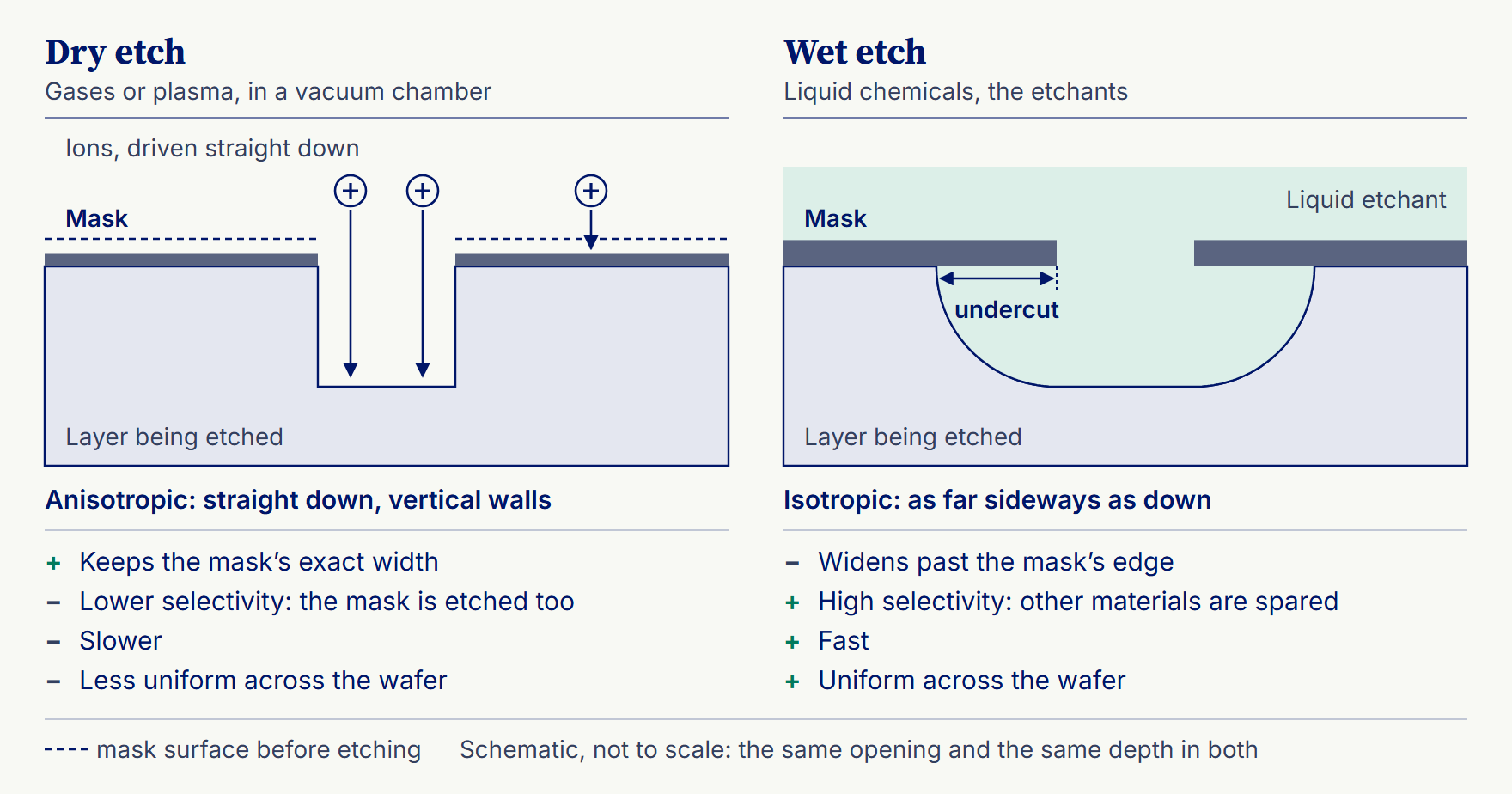
Dry etch happens in a vacuum chamber, using reactive gas or plasma; wet etch uses liquid chemicals, the etchants. The trade-off between them is direction versus selectivity. When a plasma’s ions are accelerated toward the wafer, dry etch can carve in one straight direction (anisotropic), which is what precise features like gates demand. A liquid diffuses everywhere, so wet etch removes material in all directions (isotropic) and can eat sideways under a mask, but it can be extremely selective: with the right chemical, one material dissolves while its neighbors are untouched.
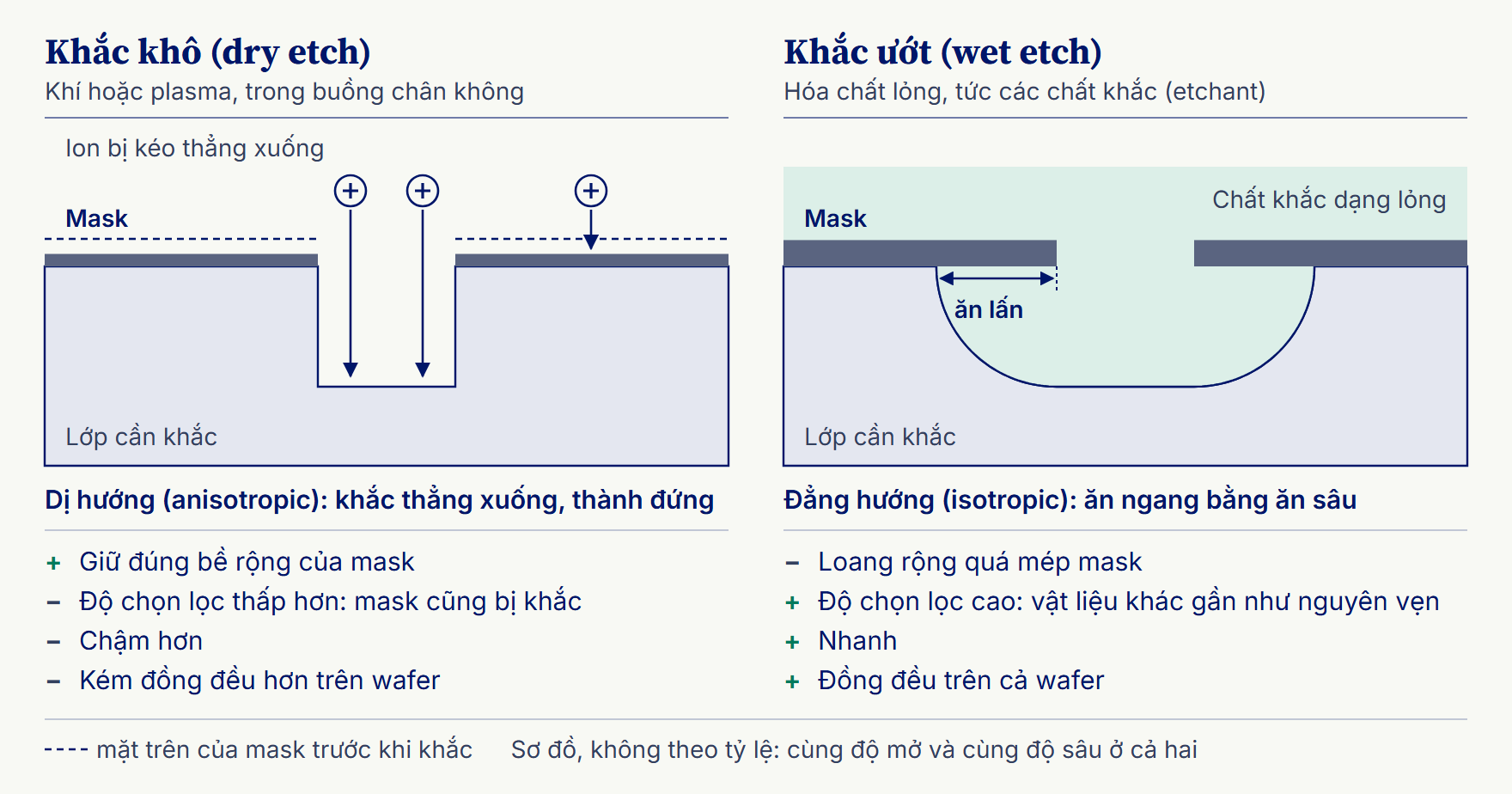
Khắc khô (dry etch) diễn ra trong một buồng chân không, dùng khí phản ứng hoặc plasma; khắc ướt (wet etch) dùng hóa chất dạng lỏng, tức là các chất khắc (etchant). Chọn cách nào cũng là đánh đổi giữa tính định hướng và độ chọn lọc. Khi ion của plasma được gia tốc về phía wafer, khắc khô có thể ăn thẳng xuống theo một hướng (dị hướng, anisotropic), đúng thứ mà những chi tiết cần độ chính xác cao như gate đòi hỏi. Chất lỏng thì khuếch tán khắp nơi, nên khắc ướt loại bỏ vật liệu theo mọi hướng (đẳng hướng, isotropic) và có thể ăn lấn sang ngang, vào cả phần vật liệu nằm dưới mask. Bù lại, khắc ướt có thể cực kỳ chọn lọc: chọn đúng hóa chất thì một vật liệu tan ra còn các vật liệu bên cạnh vẫn nguyên vẹn.
What lets dry etch cut straight down
Nhờ đâu khắc khô tạo được những rãnh thẳng đứng
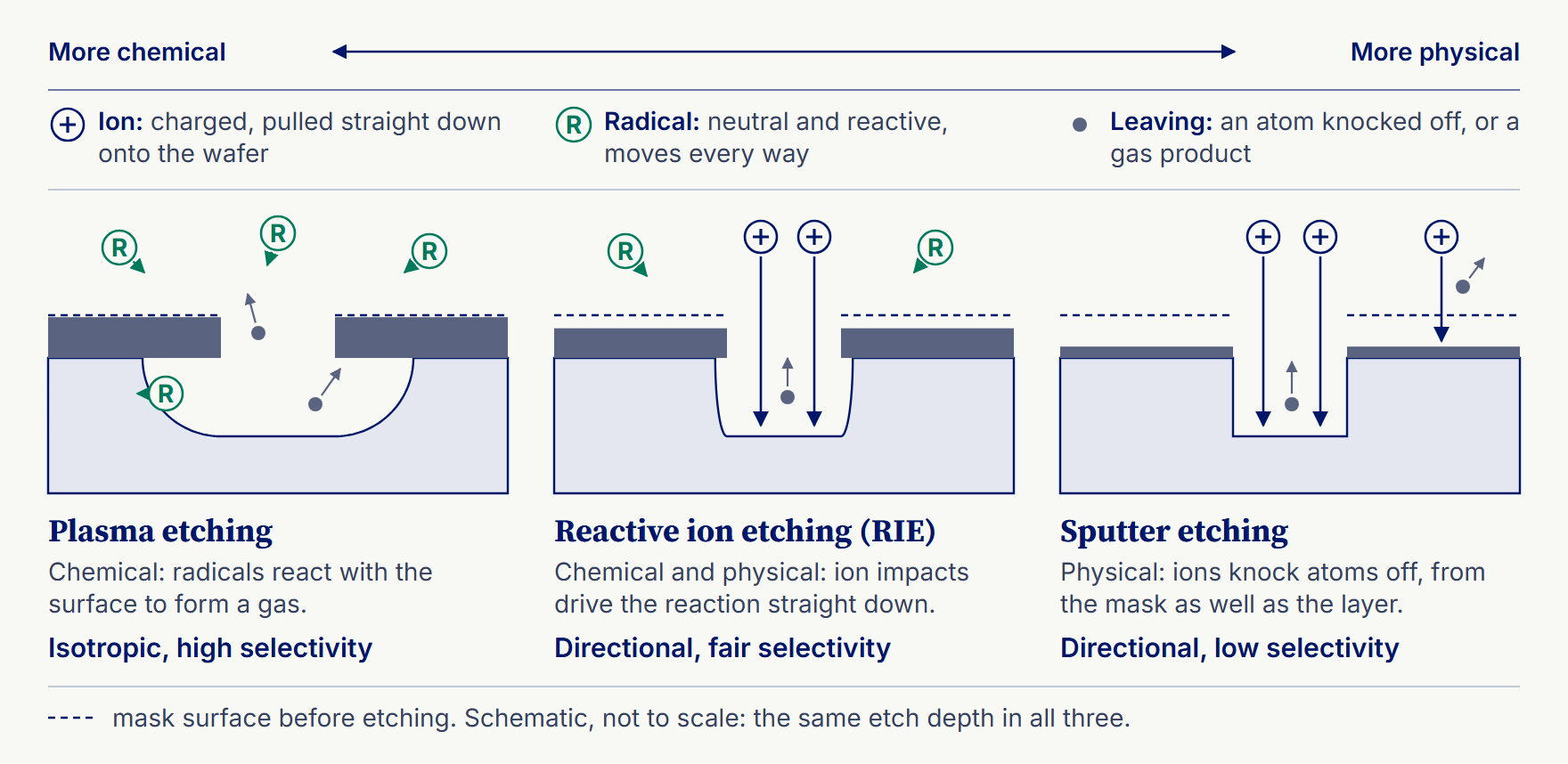
Ions that keep their direction all the way to the wafer let dry etch cut straight down, and low pressure keeps them from scattering. Dry etching itself spans a spectrum, from pure chemistry to pure physics. At one end, gas etching is all chemical reaction: gentle, very selective, but isotropic. At the other, sputter etching is all physics: ions simply blast material away, directional but indiscriminate. Reactive ion etching (RIE) combines both, and one physical detail makes it precise: at low pressure the ions fly far between collisions (a long mean free path), keeping their energy and direction, so the etch goes straight down; at high pressure they collide constantly, lose their direction, and the etch spreads every way.
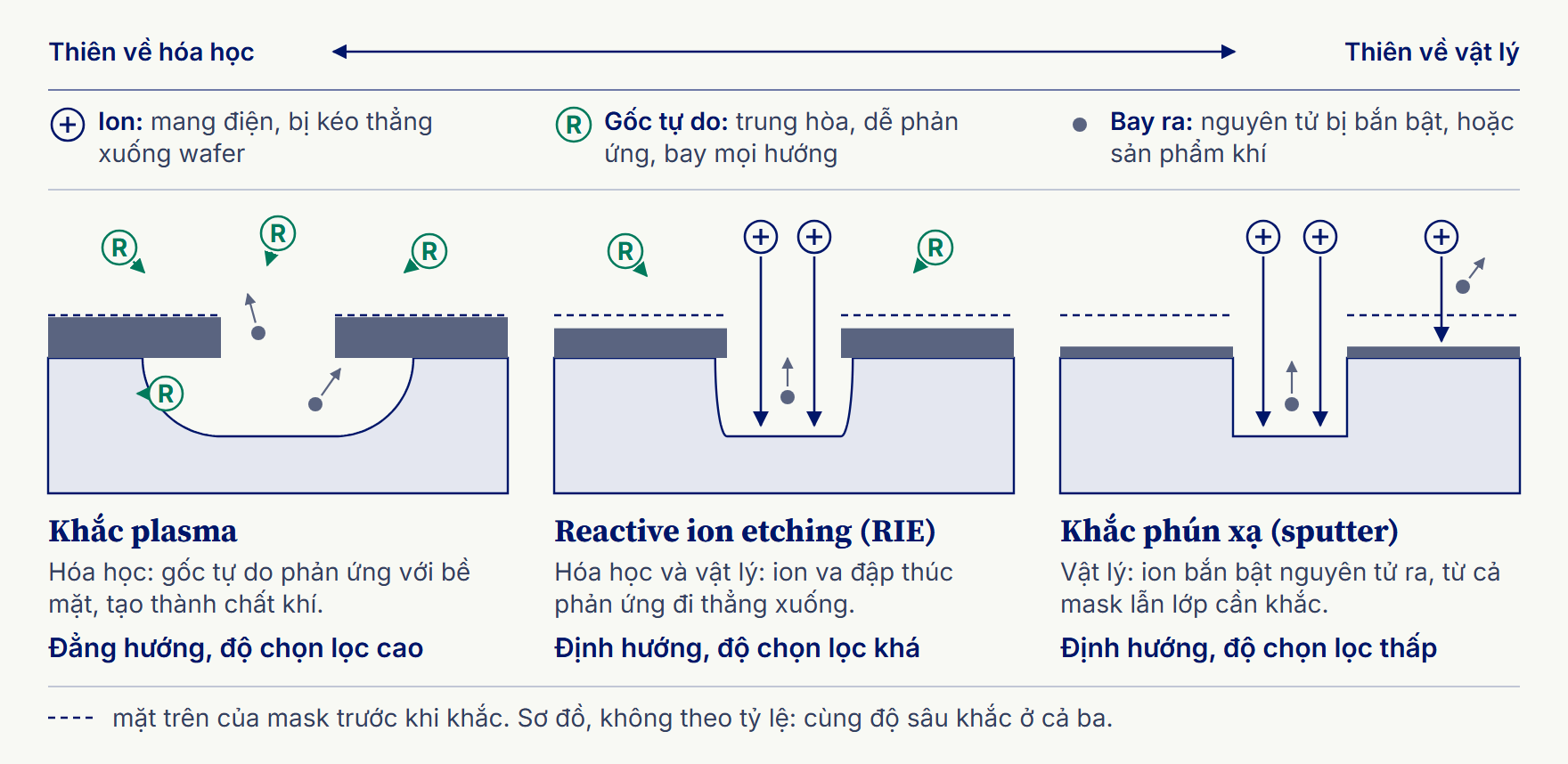
Khắc khô ăn thẳng xuống nhờ ion giữ nguyên hướng bay tới tận wafer, và áp suất thấp giúp ion không bị lệch hướng. Bản thân khắc khô gồm nhiều kiểu, trải từ hóa học thuần túy đến vật lý thuần túy. Ở một đầu, khắc bằng khí hoàn toàn là phản ứng hóa học: nhẹ nhàng, rất chọn lọc, nhưng đẳng hướng. Ở đầu kia, khắc phún xạ (sputter etching) hoàn toàn là vật lý: các ion chỉ đơn giản bắn vật liệu bay đi, có định hướng nhưng không phân biệt vật liệu. Reactive ion etching (RIE) kết hợp cả hai, và một chi tiết vật lý khiến nó chính xác: ở áp suất thấp, ion bay được quãng đường dài giữa hai lần va chạm (mean free path dài) nên giữ được năng lượng và hướng bay, vết khắc đi thẳng xuống. Áp suất cao thì va chạm dày đặc, ion mất hướng và vết khắc loang ra mọi phía.
That is how the deepest structures in a chip are carved, like the memory holes of 3D NAND flash, which must run enormously deeper than they are wide and still stay straight, without bending or drifting sideways. Only a directional etch can cut such a hole: a liquid would etch sideways and widen it, and its byproducts would be slow to leave, while a plasma’s gas-phase byproducts can be pumped away.
Những cấu trúc sâu nhất trên chip đều được khắc theo cách này, chẳng hạn các lỗ sâu (memory hole) trong bộ nhớ flash 3D NAND: lỗ phải đục rất sâu so với bề ngang mà vẫn thẳng, không méo, không chệch sang hai bên. Chỉ cách khắc có định hướng mới đục được lỗ như vậy: hóa chất lỏng sẽ ăn sang ngang làm lỗ rộng ra, sản phẩm phụ của nó cũng khó thoát lên, còn sản phẩm phụ của plasma ở dạng khí nên dễ hút ra.
| Etch type | Mechanism | Geometry | Selectivity | Pressure |
|---|---|---|---|---|
| Gas/vapor etching | Chemical | Isotropic | Very high | High (up to 760 torr) |
| Plasma etching | Chemical | Isotropic | High | Medium (above 100 mtorr) |
| Reactive ion etching | Chemical and physical | Directional | Fair | Low (10 to 100 mtorr) |
| Sputter etching | Physical | Directional | Low | Low (around 10 mtorr) |
| Kiểu khắc | Cơ chế | Hướng khắc | Độ chọn lọc | Áp suất |
|---|---|---|---|---|
| Khắc bằng khí/hơi | Hóa học | Đẳng hướng | Rất cao | Cao (tới 760 torr) |
| Khắc plasma | Hóa học | Đẳng hướng | Cao | Trung bình (trên 100 mtorr) |
| Reactive ion etching (RIE) | Hóa học và vật lý | Định hướng | Khá | Thấp (10 đến 100 mtorr) |
| Khắc phún xạ (sputter) | Vật lý | Định hướng | Thấp | Thấp (khoảng 10 mtorr) |
Wet etch is the fab's dishwasher
Khắc ướt là chiếc máy rửa bát của fab
Wet etch is the fab’s least famous module and one of its busiest: thirty to forty percent of all process steps pass through it. Its everyday job is cleaning. After nearly every deposition or dry-etch step there are byproducts to remove, and the wet-etch tool is the dishwasher that removes them: a robot delivers each wafer into a chamber, a nozzle on a scanning arm dispenses the right chemical at the right flow rate and temperature (reactions speed up with heat, so running too hot causes over-etch), and different solutions target different contaminants, from stray particles to adsorbed ions.
Khắc ướt là module ít nổi tiếng nhất của fab và cũng là một trong những module bận rộn nhất: từ ba mươi đến bốn mươi phần trăm tổng số bước xử lý đều đi qua nó. Công việc hằng ngày của nó là làm sạch. Sau gần như mỗi bước lắng đọng hay khắc khô đều có các sản phẩm phụ cần loại bỏ, và máy khắc ướt chính là chiếc máy rửa bát rửa trôi chúng. Robot đưa từng wafer vào buồng, một cánh tay quét (scan arm) mang vòi phun rải đúng hóa chất lên wafer ở đúng lưu lượng và nhiệt độ (nhiệt càng cao phản ứng càng nhanh, nên nóng quá sẽ khắc quá mức). Mỗi loại dung dịch nhắm vào một loại chất bẩn, từ các hạt bụi rời rạc cho đến các ion bị hấp phụ.
The sneaky-hard part is drying. A wafer must leave the chamber as dry and clean as it entered, but at advanced nodes the structures are so tall and thin that the surface tension of the rinse water can pull them over, a failure called pattern collapse. So the drying is engineered too: rinse with water, displace the water with an organic like IPA to lower the surface tension, then purge gently with nitrogen.
Phần khó lường nhất là công đoạn làm khô. Một wafer phải rời buồng trong trạng thái khô và sạch như lúc đưa vào, nhưng ở các tiến trình bán dẫn (node) tiên tiến, các cấu trúc cao và mảnh đến mức sức căng bề mặt của nước rửa có thể kéo chúng đổ xuống, một dạng hỏng gọi là sập cấu trúc (pattern collapse). Vì vậy, công đoạn làm khô cũng được thiết kế kỹ: rửa bằng nước, thay nước bằng một chất hữu cơ như IPA để giảm sức căng bề mặt, rồi thổi nhẹ bằng khí nitơ.
If wet etch mostly cleans, where does it actually etch?Nếu khắc ướt chủ yếu là rửa, vậy nó khắc ở chỗ nào?
Wherever chemistry beats direction. In a Gate-All-Around transistor, the silicon germanium (SiGe) layers between the future channels are sacrificial and must be removed sideways, which a directional dry etch cannot do; a selective wet etch dissolves them laterally. And hot phosphoric acid removes silicon nitride much faster than silicon oxide, so where both materials sit together, wet etch takes away exactly one of them.
Ở những nơi cần chọn đúng vật liệu hơn là cần khắc thẳng. Trong bóng bán dẫn (transistor) Gate-All-Around, các lớp silicon germanium (SiGe) là lớp hy sinh (sacrificial): chúng nằm xen giữa những lớp sẽ trở thành kênh dẫn (channel), và phải được loại bỏ theo chiều ngang, điều mà khắc khô có định hướng không làm được; bước khắc ướt có chọn lọc sẽ hòa tan chúng theo chiều ngang. Và axit phosphoric nóng loại bỏ silicon nitride nhanh hơn nhiều so với silicon oxide, nên ở chỗ hai vật liệu nằm cạnh nhau, khắc ướt lấy đi đúng một trong hai.
A fab uses millions of liters of water a day
Mỗi ngày, một fab dùng tới hàng triệu lít nước
Every chemical step ends with a rinse, because reactive residue cannot be left to dry on the wafer. The rinse uses water, often ozonated water for extra cleaning power (the same idea as the ozonated water some kitchens use to wash vegetables), and the water itself has to be manufactured: ultrapure water, filtered through so many stages that its remaining impurities fall below what today’s instruments can detect. Ordinary distilled water would not do; even air contact contaminates it.
Mỗi bước hóa học đều kết thúc bằng một lần rửa, vì không thể để wafer khô đi khi cặn hóa chất còn hoạt tính vẫn nằm trên bề mặt. Nước rửa thường là nước ozon cho sạch hơn (cùng nguyên lý với nước ozon dùng rửa rau), và chính nguồn nước ấy cũng phải được sản xuất ra: nước siêu tinh khiết, được lọc qua nhiều tầng đến mức tạp chất còn lại thấp hơn mức các thiết bị ngày nay có thể phát hiện. Nước cất thông thường cũng không đạt yêu cầu; ngay cả tiếp xúc với không khí cũng làm nó nhiễm bẩn.
Multiply a rinse by the three to four hundred cleaning steps in a thousand-step flow and the total is enormous, which is why a fab cannot be built just anywhere: it needs vast, stable supplies of water and power. Fabs typically filter and reuse sixty to seventy percent of their water rather than using it once and pouring it away.
Một quy trình khoảng một nghìn bước có tới ba, bốn trăm bước làm sạch, bước nào cũng kết thúc bằng rửa nước, nên tổng lượng nước tiêu thụ rất lớn. Vì vậy không thể đặt fab ở bất cứ đâu: nhà máy cần nguồn nước và điện dồi dào, ổn định. Các fab thường lọc lại và dùng lại sáu mươi đến bảy mươi phần trăm lượng nước, thay vì dùng một lần rồi đổ đi.
Where the errors come from
Lỗi đến từ đâu
It is hard to say exactly which step causes the most errors, but mistakes in the mask and lithography steps usually cost the most, because every step after them carries them forward. A well-known example is overlay, the layer-to-layer alignment from chapter 5: even a slight shift follows every layer built above it. Lithography is the “father” of etch, and etch the “father” of deposition, so an error early in the chain has consequences long after. Dry etch causes plenty of errors of its own too, especially when it digs narrow, deep structures shaped like wells. And the arithmetic is unforgiving: across a thousand steps, even 99 percent accuracy per step, compounded, leaves a chip that almost certainly fails.
Khó nói chính xác công đoạn nào gây lỗi nhiều nhất, nhưng sai ở khâu mask và quang khắc thường để lại hậu quả nặng nhất, vì mọi bước phía sau đều mang theo lỗi ấy. Ví dụ quen thuộc là overlay, độ khớp giữa các lớp đã nói ở chương 5: lệch một chút là sai lệch ấy đi theo mọi lớp bên trên. Quang khắc là “bố” của khắc, khắc lại là “bố” của lắng đọng, nên sai ở đầu chuỗi thì hậu quả kéo dài về sau. Bản thân khắc khô cũng sinh nhiều lỗi, nhất là khi đục những cấu trúc hẹp mà sâu như lòng giếng. Và phép tính không khoan nhượng: với một nghìn bước, dù mỗi bước chính xác tới 99 phần trăm, nhân dồn qua cả nghìn bước thì con chip gần như chắc chắn hỏng.