Chapter 6 of 9Chương 6/9 5 min5 phút
Plasma in chipmakingPlasma trong sản xuất chip
A plasma globe in a science museum, a neon sign, a bolt of lightning: you have met plasma many times. A fab tames the same glowing state of matter inside a vacuum chamber, because it needs materials to react hard and fast without the heat that would ruin the chip.
Quả cầu plasma phát sáng ở bảo tàng khoa học, tấm biển neon, tia sét: bạn đã gặp plasma nhiều lần rồi. Nhà máy sản xuất chip (fab) thuần hóa chính trạng thái vật chất phát sáng ấy trong một buồng chân không, vì fab cần vật liệu phản ứng mạnh và nhanh mà không phải dùng tới mức nhiệt đủ làm hỏng chip.
In this chapter
Trong chương này
- Why heat alone cannot do the job, and what plasma offers instead
- What plasma is: the fourth state of matter, made of ions, electrons, and excited atoms
- The three ways a fab lights a plasma, and what each one is good at
- Vì sao chỉ dùng nhiệt thì không đủ, và plasma mang lại điều gì
- Plasma là gì: trạng thái thứ tư của vật chất, gồm ion, electron và nguyên tử ở trạng thái kích thích
- Ba cách fab tạo ra plasma, và mỗi cách phù hợp với công đoạn nào
High heat damages a chip's devices, so fabs turn to plasma
Nhiệt độ cao làm hỏng linh kiện, nên fab cần đến plasma
A chip is built by changing materials, layer after layer, and materials resist change: they sit in their most stable state until energy pushes them out of it. A fab has two big levers for that push, heat and plasma. Heat has a hard limit, because high temperatures damage the very devices being built. Plasma delivers the reaction energy at low temperature, which is why it turns up in deposition, etching, and cleaning alike.
Con chip được dựng lên bằng cách biến đổi vật liệu, hết lớp này đến lớp khác, và vật liệu thì chống lại sự thay đổi: chúng luôn ở trạng thái bền nhất cho đến khi năng lượng đẩy chúng ra khỏi trạng thái đó. Fab có hai cách chính để tạo cú đẩy đó, nhiệt và plasma, nhưng nhiệt có giới hạn: nhiệt độ cao làm hỏng chính những linh kiện đang chế tạo. Plasma cung cấp năng lượng phản ứng ở nhiệt độ thấp, vì vậy plasma có mặt ở cả lắng đọng, khắc lẫn làm sạch.
Plasma is the fourth state of matter
Plasma là trạng thái thứ tư của vật chất
Plasma is ionized gas: give a gas enough energy and its atoms start losing electrons, leaving a mixture of positive ions, free electrons, and neutral atoms, many of them in an excited state. It is considered the fourth state of matter, after solid, liquid, and gas, and it is extremely reactive: reactions that would normally demand high temperature or pressure can start inside a plasma.
Plasma là chất khí bị ion hóa: khi một chất khí nhận đủ năng lượng, các nguyên tử của nó bắt đầu mất electron, để lại một hỗn hợp gồm ion dương, electron tự do và nguyên tử trung hòa, trong đó nhiều nguyên tử ở trạng thái kích thích. Nó được xem là trạng thái thứ tư của vật chất, sau rắn, lỏng và khí, và có hoạt tính hóa học rất cao: những phản ứng mà bình thường đòi hỏi nhiệt độ hoặc áp suất cao có thể bắt đầu ngay bên trong một plasma.
What plasma actually does
Plasma thực sự làm gì
Plasma tears gas molecules apart, and the excited neutral atoms it leaves behind are the main agents of the chemical reactions used in semiconductor processing. Take an ordinary oxygen molecule. Inside a plasma chamber the bond between its two atoms breaks and some atoms are ionized. The same oxygen that is breathed harmlessly all day becomes, in this state, violently reactive: a hand put into the plasma would meet ferocious reactions at once.
Plasma xé toạc các phân tử khí, và những nguyên tử trung hòa ở trạng thái kích thích mà nó để lại là tác nhân chính của các phản ứng hóa học dùng trong gia công bán dẫn. Lấy một phân tử oxy bình thường làm ví dụ. Trong buồng plasma, liên kết giữa hai nguyên tử của nó bị phá vỡ và một số nguyên tử bị ion hóa. Cùng một loại oxy mà con người hít thở vô hại suốt cả ngày, ở trạng thái này, lại có hoạt tính cực mạnh: một bàn tay đưa vào plasma sẽ lập tức gặp phải những phản ứng dữ dội.
A bolt of lightning and a fab chamber hold the same fourth state of matter. What the fab adds is control: it holds its plasma in a vacuum chamber, tunes its density and energy, and aims it at a wafer.
Tia sét và buồng plasma trong fab chứa cùng một trạng thái thứ tư của vật chất. Cái fab có thêm là sự kiểm soát: plasma được giữ trong buồng chân không, được chỉnh mật độ và năng lượng, rồi hướng thẳng vào wafer.
Three plasma sources serve different steps
Ba cách tạo plasma phục vụ những công đoạn khác nhau
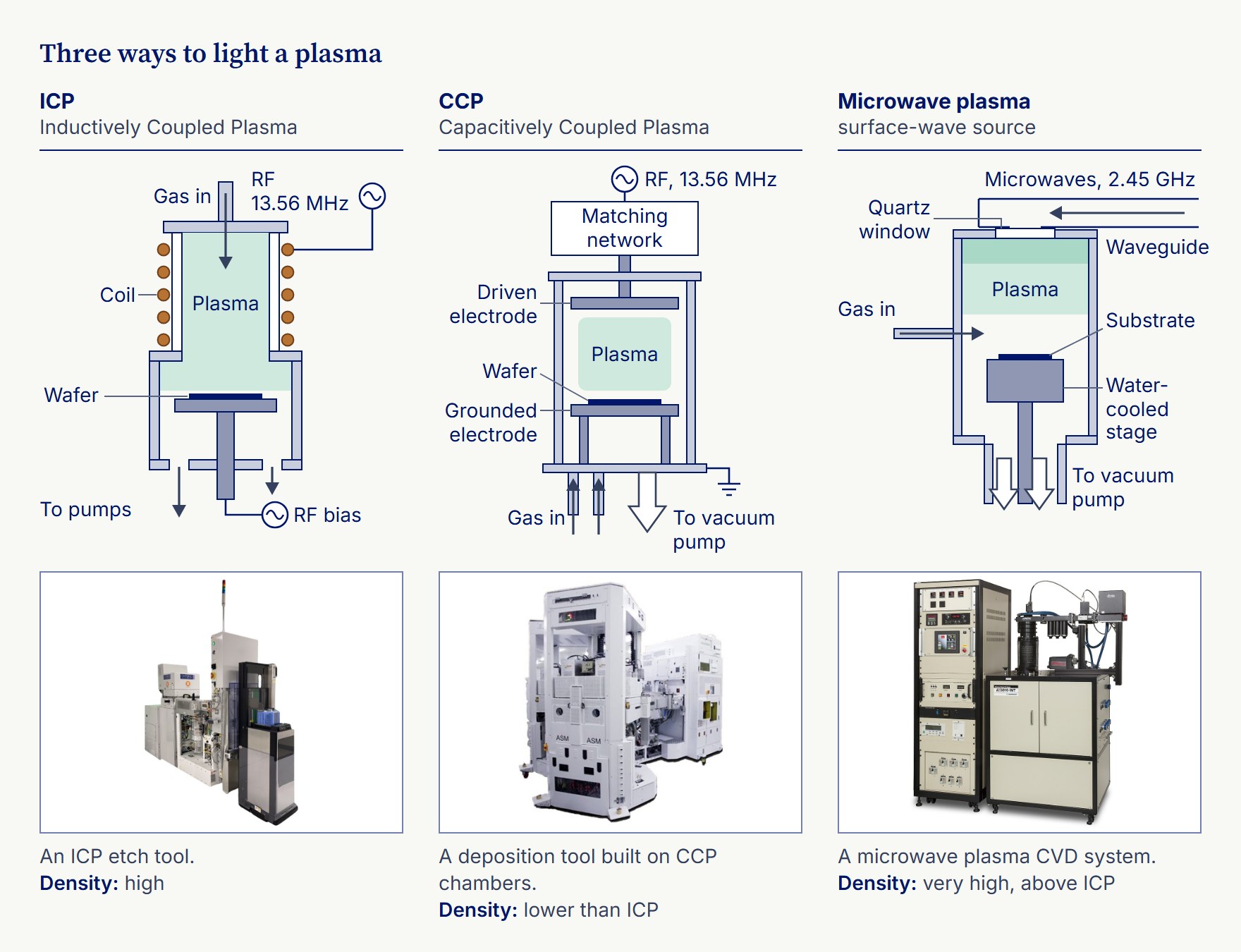
Fabs generate plasma in three main ways, and the choice shapes what the plasma is good at.6.1
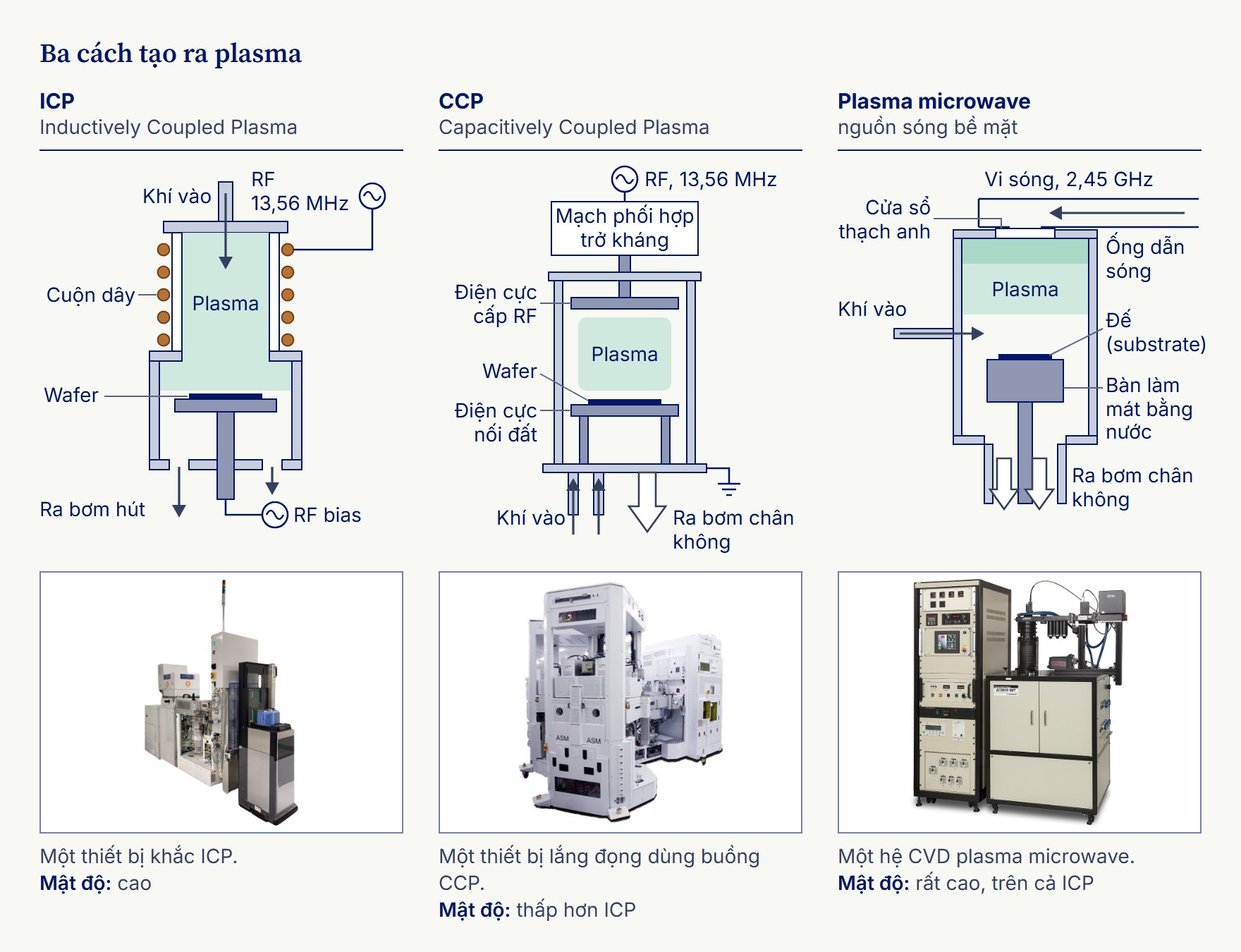
Các fab tạo ra plasma theo ba cách chính, và mỗi cách cho ra một loại plasma hợp với những việc khác nhau.6.1
| Source | How it works | Density | Typical use |
|---|---|---|---|
| ICP (Inductively Coupled Plasma) | Current in a coil wrapped around the chamber | High | Etching, especially silicon and metal, and cleaning; runs at low pressure (millitorr range) |
| CCP (Capacitively Coupled Plasma) | RF power between two electrode plates | Lower than ICP | Film deposition (PECVD, PEALD), whose radicals react without high heat, and dielectric etch; runs from tens of millitorr (etch) to a few torr (deposition) |
| Microwave plasma | Microwaves at 2.45 GHz | Very high, above ICP | Demanding CVD processes, even synthetic diamond growth |
| Nguồn | Cách hoạt động | Mật độ | Ứng dụng điển hình |
|---|---|---|---|
| ICP (Inductively Coupled Plasma) | Dòng điện trong một cuộn dây quấn quanh buồng | Cao | Khắc, nhất là khắc silicon và kim loại, cùng làm sạch; hoạt động ở áp suất thấp (cỡ millitorr) |
| CCP (Capacitively Coupled Plasma) | Công suất RF giữa hai tấm điện cực | Thấp hơn ICP | Lắng đọng màng mỏng (PECVD, PEALD) nhờ các gốc tự do phản ứng mà không cần nhiệt độ cao, và khắc điện môi; hoạt động từ vài chục millitorr (khắc) đến vài torr (lắng đọng) |
| Plasma microwave | Vi sóng ở tần số 2,45 GHz | Rất cao, trên cả ICP | Các quy trình lắng đọng CVD đòi hỏi khắt khe, thậm chí cả mọc kim cương nhân tạo |
Each source strikes its own balance between how dense the plasma is, how low the pressure runs, and how hard the ions hit, so the source is chosen to suit each step: a silicon or metal etch favors ICP’s dense, low-pressure plasma, an oxide etch or a deposition step often uses CCP, and the hardest chemistry calls for microwave power. The next two chapters put these sources to work: first laying films down on the wafer, then cutting into them.
Mỗi nguồn đều đánh đổi giữa mật độ, áp suất và năng lượng ion, vì vậy tùy yêu cầu của từng bước mà chọn nguồn plasma phù hợp: bước khắc silicon hay kim loại cần plasma đậm đặc, áp suất thấp của ICP, bước khắc oxide hoặc lắng đọng thường dùng CCP, còn những phản ứng hóa học khó nhất thì cần đến công suất microwave. Hai chương tiếp theo cho thấy các nguồn plasma này làm việc ra sao: trước là phủ màng lên wafer, sau là khắc vào chính những lớp màng ấy.