Chapter 1 of 9Chương 1/9 5 min5 phút
The semiconductor value chainChuỗi giá trị bán dẫn
NVIDIA and Apple design some of the best-known chips in the world, yet neither owns a factory that can build them. The factories that do the building stay mostly out of sight, and this book goes inside them.
NVIDIA và Apple thiết kế những con chip nổi tiếng bậc nhất thế giới, vậy mà không công ty nào có nhà máy để làm ra chúng. Những nhà máy làm việc ấy phần lớn nằm khuất khỏi tầm mắt người dùng, và cuốn sách này sẽ đưa bạn vào bên trong.
In this chapter
Trong chương này
- How the semiconductor value chain fits together, from design software to finished chips
- What separates fabless designers, IDMs, and foundries
- The equipment suppliers standing behind every fab
- How long it takes to manufacture one advanced CPU
- Các mắt xích trong chuỗi giá trị bán dẫn nối với nhau ra sao, từ phần mềm thiết kế đến chip thành phẩm
- Điều gì phân biệt các nhà thiết kế fabless, các IDM và các foundry
- Những nhà cung cấp thiết bị đứng sau mỗi nhà máy sản xuất chip (fab)
- Sản xuất một CPU tiên tiến mất bao lâu
A chip needs many companies
Một con chip cần đến nhiều công ty
No single company makes a chip alone. The industry is organized as a value chain with three broad stages: design, manufacturing, and the finished chip.1.1 On the design side sit the fabless designers such as NVIDIA, AMD, Apple, and MediaTek, which design chips but own no factories, and the integrated device manufacturers (IDMs) such as Intel and Samsung, which both design and manufacture. Design work itself leans on two quieter industries: EDA software from companies like Synopsys and Cadence, and licensed IP blocks such as Arm’s processor cores.
Không một công ty nào tự mình làm ra một con chip. Ngành này được tổ chức thành một chuỗi giá trị gồm ba giai đoạn lớn: thiết kế, sản xuất và chip thành phẩm.1.1 Ở khâu thiết kế có các công ty fabless như NVIDIA, AMD, Apple và MediaTek, chỉ thiết kế chứ không sở hữu nhà máy, và các IDM như Intel và Samsung, tự thiết kế và tự sản xuất. Bản thân công việc thiết kế lại dựa vào hai ngành thầm lặng hơn: phần mềm EDA từ các công ty như Synopsys và Cadence, cùng các IP block được cấp phép như lõi xử lý của Arm.
The manufacturing column is just as layered. Fabs run by TSMC, Samsung, and Intel turn blank wafers into patterned silicon; equipment makers such as ASML (lithography), Applied Materials (deposition), Lam Research (etch), and KLA (process control) build the machines inside them; and a further ring of suppliers provides wafers, chemicals, packaging, and testing. Only after all of that does a chip reach the final column: CPUs, GPUs, memory, analog parts, and custom accelerators.
Khâu sản xuất cũng nhiều tầng không kém. Các fab do TSMC, Samsung và Intel vận hành biến những tấm wafer trơn thành wafer mang đầy mạch. Các nhà sản xuất thiết bị như ASML (quang khắc), Applied Materials (lắng đọng), Lam Research (khắc) và KLA (kiểm soát quy trình) chế tạo các cỗ máy bên trong chúng. Vòng ngoài là các nhà cung cấp wafer, hóa chất và dịch vụ đóng gói, kiểm thử. Chỉ sau tất cả những điều đó, một con chip mới đến được khâu cuối cùng: CPU, GPU, chip nhớ, linh kiện analog và các bộ tăng tốc tùy chỉnh.
Vietnam’s place on this map today is in packaging and testing. It has no operating wafer fab yet, and chapter 9 looks at where it could enter.
Việt Nam hiện có mặt trên tấm bản đồ này ở khâu đóng gói và kiểm thử. Trong nước chưa có fab nào đi vào hoạt động, và chương 9 sẽ bàn xem Việt Nam có thể bước vào từ đâu.
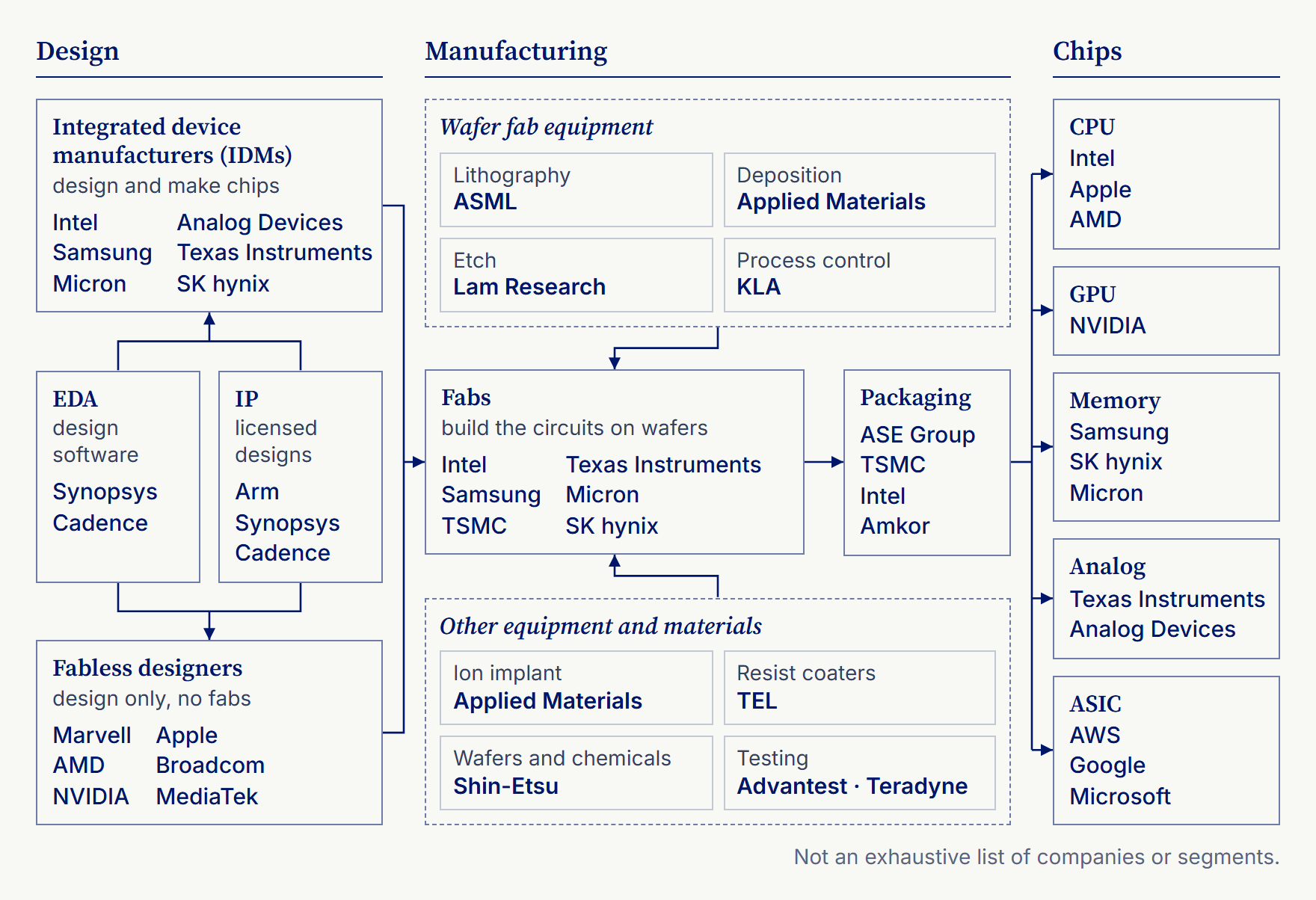
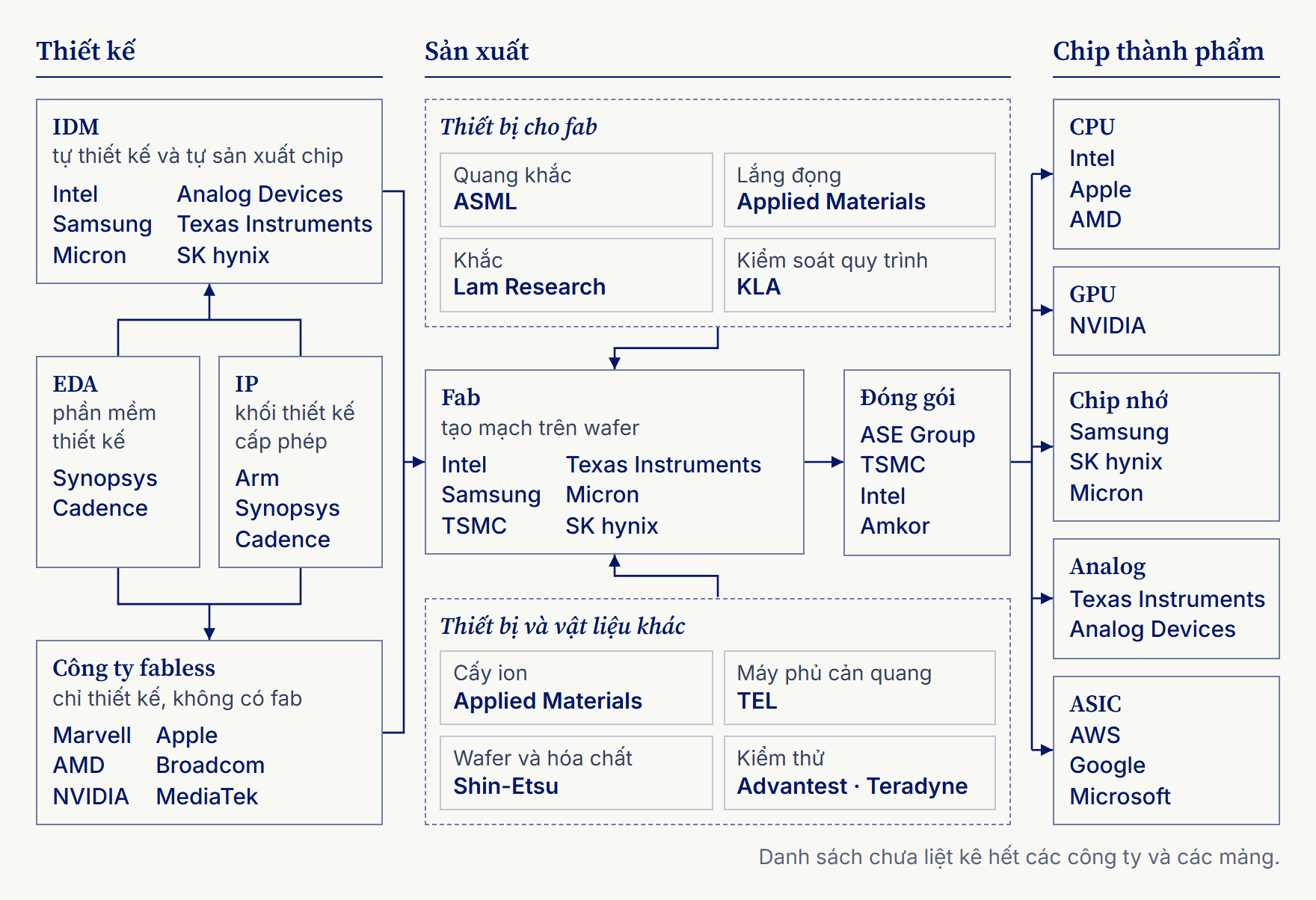
Semiconductor manufacturing works in English all over the world, and many of its terms have no exact Vietnamese equivalent. So the Vietnamese edition of this minibook keeps most technical terms in English, the way people in the industry use them. Terms with a settled Vietnamese name, such as lithography, go by that name, and a few, such as transistor, get their Vietnamese name once before the English takes over. Tap any underlined term for a short definition in both languages.
Ngành bán dẫn trên khắp thế giới làm việc bằng tiếng Anh, và nhiều thuật ngữ gần như không thể dịch trọn nghĩa sang tiếng Việt. Vì vậy, phần lớn thuật ngữ kỹ thuật trong sách được giữ nguyên tiếng Anh, đúng như cách người trong ngành vẫn dùng. Thuật ngữ nào đã có tên tiếng Việt quen thuộc thì sách gọi bằng tên đó, như quang khắc hay lắng đọng. Riêng vài từ như bóng bán dẫn (transistor) chỉ nêu tên tiếng Việt một lần, sau đó sách dùng lại tiếng Anh. Chạm vào bất kỳ thuật ngữ gạch chân nào để xem định nghĩa ngắn bằng cả hai ngôn ngữ.
The foundry is the industry's backbone
Foundry là xương sống của ngành bán dẫn
A foundry is a company whose business is manufacturing chips for others. A pure-play foundry such as TSMC does nothing else: it owns the wafer fabs, runs the processes, and manufactures the designs its customers hand over at tape-out. This split lets a designer compete without building factories of its own, and it concentrates manufacturing know-how in a few highly specialized companies. The result is that most of the world’s advanced logic chips, whoever designed them, are made by a foundry.
Foundry là công ty chuyên sản xuất chip cho doanh nghiệp khác. Pure-play foundry như TSMC chỉ làm đúng việc đó: họ sở hữu các wafer fab, vận hành các quy trình và sản xuất các thiết kế mà khách hàng bàn giao tại tape-out. Nhờ cách phân công này, một công ty thiết kế có thể cạnh tranh mà không phải tự xây nhà máy, còn bí quyết sản xuất thì dồn về một số ít công ty cực kỳ chuyên sâu. Kết quả là phần lớn chip logic tiên tiến trên thế giới, dù do ai thiết kế, đều do một foundry sản xuất.
| Business model | Designs chips | Owns fabs | Examples |
|---|---|---|---|
| Fabless | Yes | No | NVIDIA, AMD, Apple |
| IDM | Yes | Yes | Intel, Samsung, Micron |
| Pure-play foundry | No, manufactures customer designs | Yes | TSMC |
| Mô hình kinh doanh | Thiết kế chip | Sở hữu fab | Ví dụ |
|---|---|---|---|
| Fabless | Có | Không | NVIDIA, AMD, Apple |
| IDM | Có | Có | Intel, Samsung, Micron |
| Pure-play foundry | Không, sản xuất theo thiết kế của khách hàng | Có | TSMC |
How long does one chip take?
Làm ra một con chip mất bao lâu?
Quick questionThử đoán xem
How long does it take to manufacture one advanced CPU?Sản xuất một CPU tiên tiến mất bao lâu?
Show the answerXem đáp án
Four months. A processor small enough to sit on a fingertip spends a third of a year inside the fab, moving through more than a thousand processing steps, in what is often described as one of the most complex manufacturing processes on the planet. Chapter 3 follows those steps, from the first photomask to the last floor of copper wiring.
Bốn tháng. Một bộ xử lý nhỏ vừa đầu ngón tay phải nằm trong fab một phần ba năm, đi qua hơn một nghìn bước xử lý. Không lạ khi chế tạo chip được coi là một trong những quy trình sản xuất phức tạp nhất hành tinh. Chương 3 sẽ đi qua những bước ấy, từ chiếc photomask đầu tiên đến tầng dây đồng cuối cùng.