Chapter 5 of 9Chương 5/9 6 min6 phút
Lithography: printing at the atomic scaleQuang khắc: in hình mẫu ở cấp độ nguyên tử
Every chip is drawn by people at a scale they can see, and then has to be printed at a scale nobody can. Lithography is the step that crosses that gap, from human scale to atomic scale, and its limits set the limits of the whole industry.
Con chip nào cũng được con người vẽ ra ở tỉ lệ mắt thường nhìn thấy, rồi phải được in xuống silicon ở tỉ lệ không ai nhìn thấy được. Quang khắc là bước vượt qua khoảng cách ấy, từ tỉ lệ con người xuống tỉ lệ nguyên tử, nên giới hạn của quang khắc cũng là giới hạn của cả ngành.
In this chapter
Trong chương này
- How lithography prints a pattern with light, and what resolution means
- What the Rayleigh equation says, and how the light source went from mercury lamps to EUV
- How EUV light is made: a laser hitting tin droplets 50,000 times a second
- Why one EUV machine ships in three Boeing 747s and weighs 180 tons
- Quang khắc in hình mẫu bằng ánh sáng như thế nào, và độ phân giải là gì
- Phương trình Rayleigh nói gì, và nguồn sáng đã đi từ đèn thủy ngân đến EUV ra sao
- Ánh sáng EUV được tạo ra như thế nào: laser bắn vào những giọt thiếc 50.000 lần mỗi giây
- Vì sao một cỗ máy EUV phải chở bằng ba chiếc Boeing 747 và nặng 180 tấn
Lithography prints patterns with light
Quang khắc in hình mẫu bằng ánh sáng
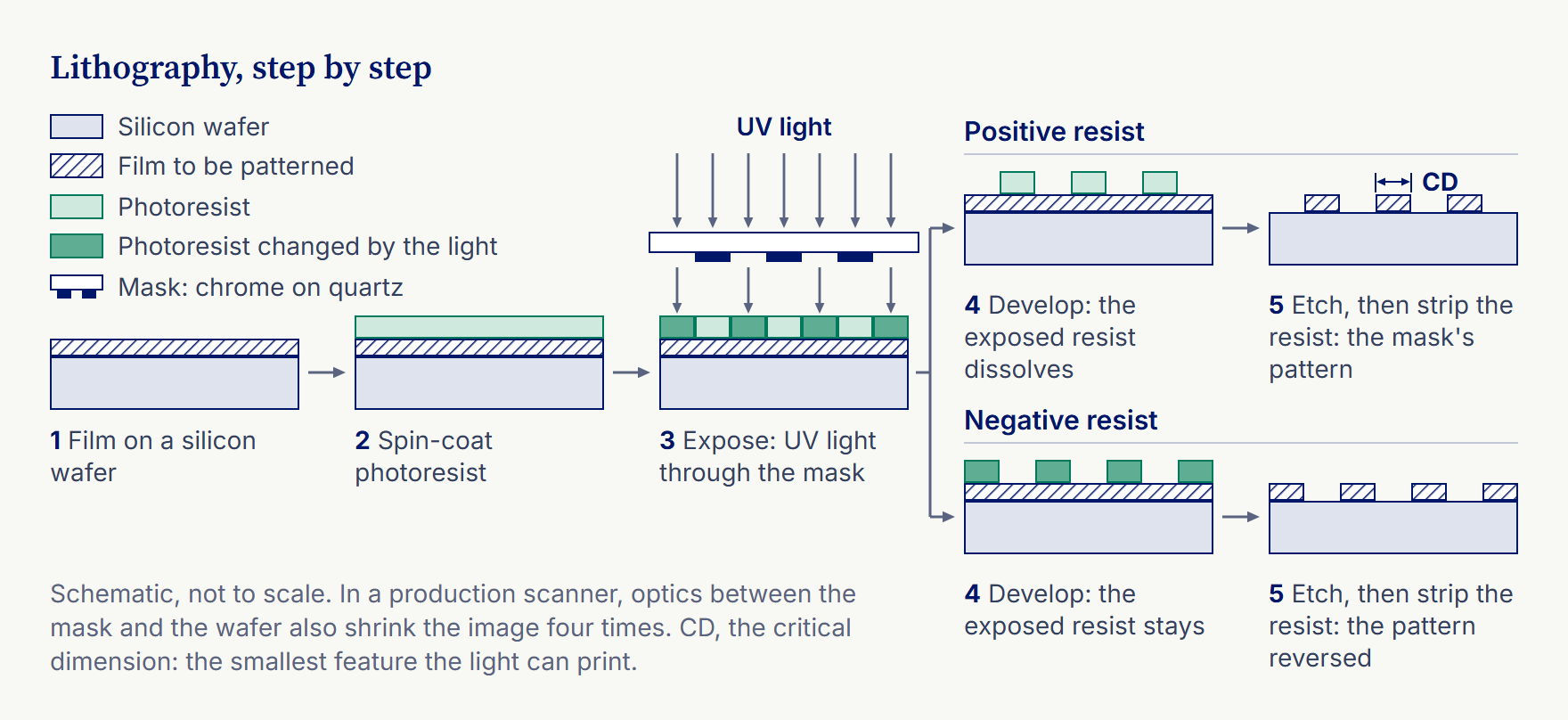
Lithography shines light through a mask. Part of the light passes through, part is blocked, and where it lands the light changes a light-sensitive coating on the wafer, the photoresist. A developer then washes away the exposed regions (or the unexposed ones), and etching carries the remaining pattern into the material below, leaving the mask’s pattern carved into the silicon. Printing, in other words: the same idea as a darkroom photograph, at a billionth of the scale.
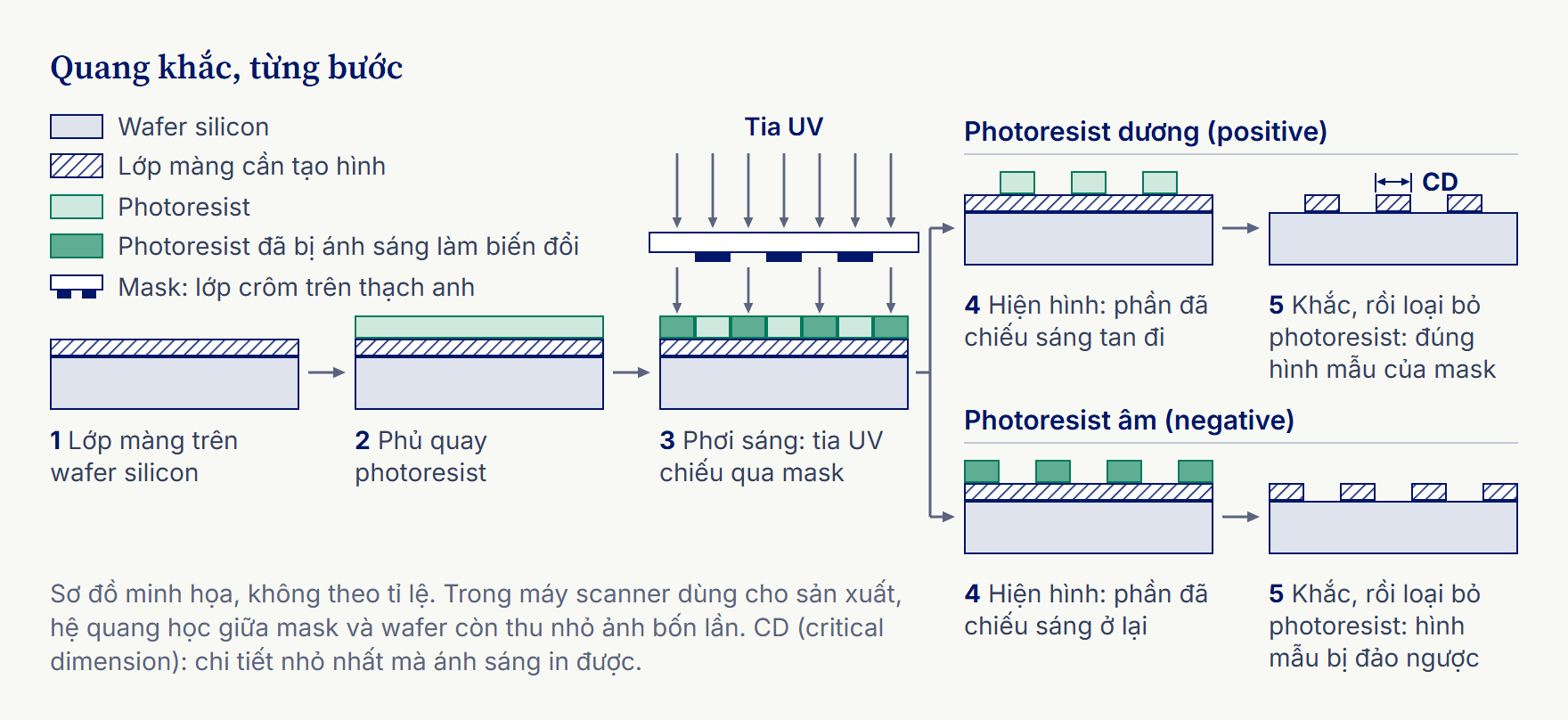
Quang khắc chiếu ánh sáng xuyên qua một mask. Một phần ánh sáng đi qua, một phần bị chặn lại, và nơi ánh sáng chạm tới sẽ làm thay đổi một lớp phủ nhạy sáng trên wafer, gọi là photoresist. Sau đó, dung dịch hiện hình (developer) rửa trôi những vùng đã được chiếu sáng (hoặc những vùng chưa được chiếu sáng), rồi công đoạn khắc (etching) chuyển hình mẫu còn lại xuống lớp vật liệu bên dưới, để mẫu của mask hằn vào silicon. Nói cách khác, đây chính là in ấn: cùng một ý tưởng như một tấm ảnh tráng trong phòng tối, nhưng ở tỉ lệ một phần tỉ.
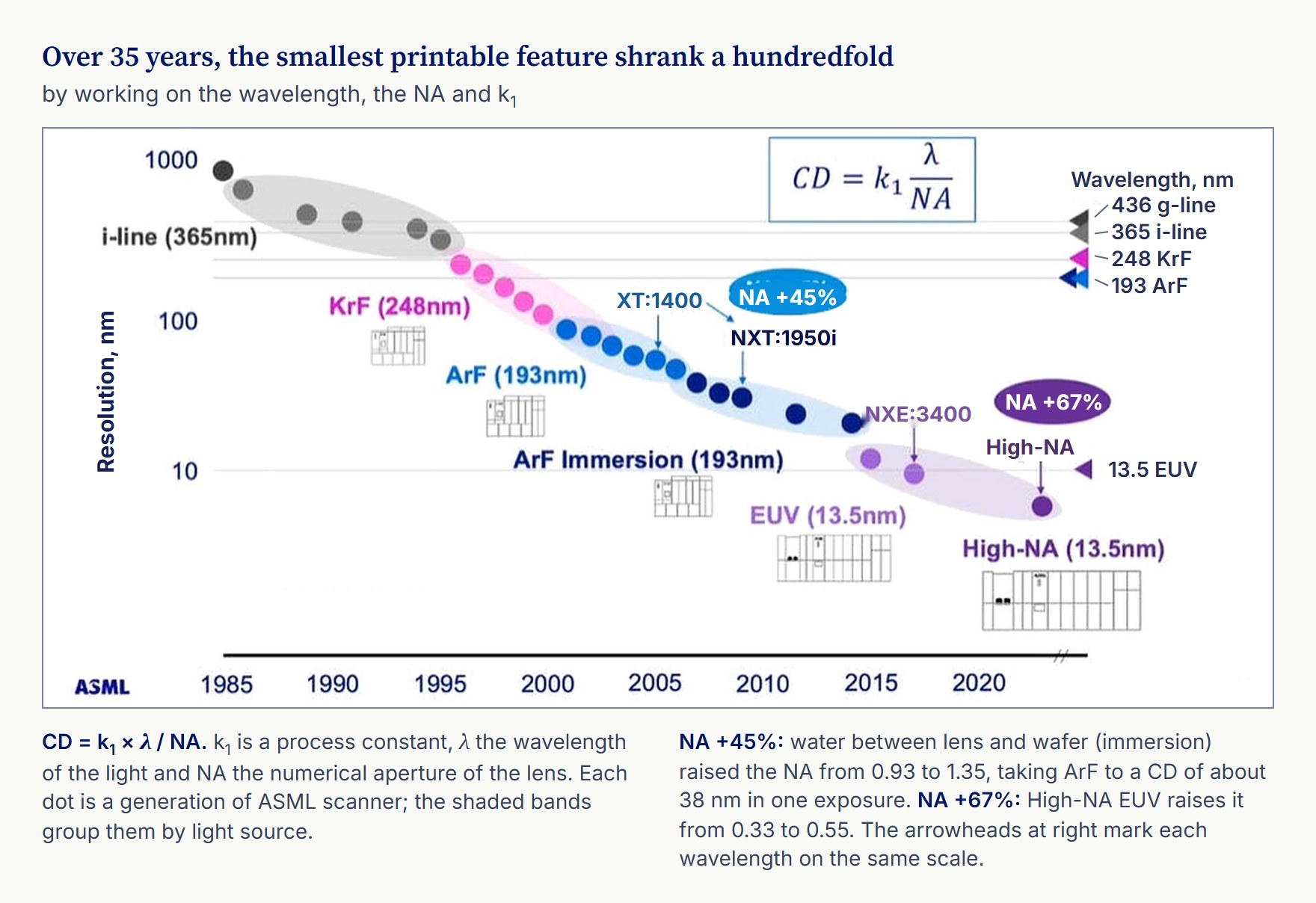
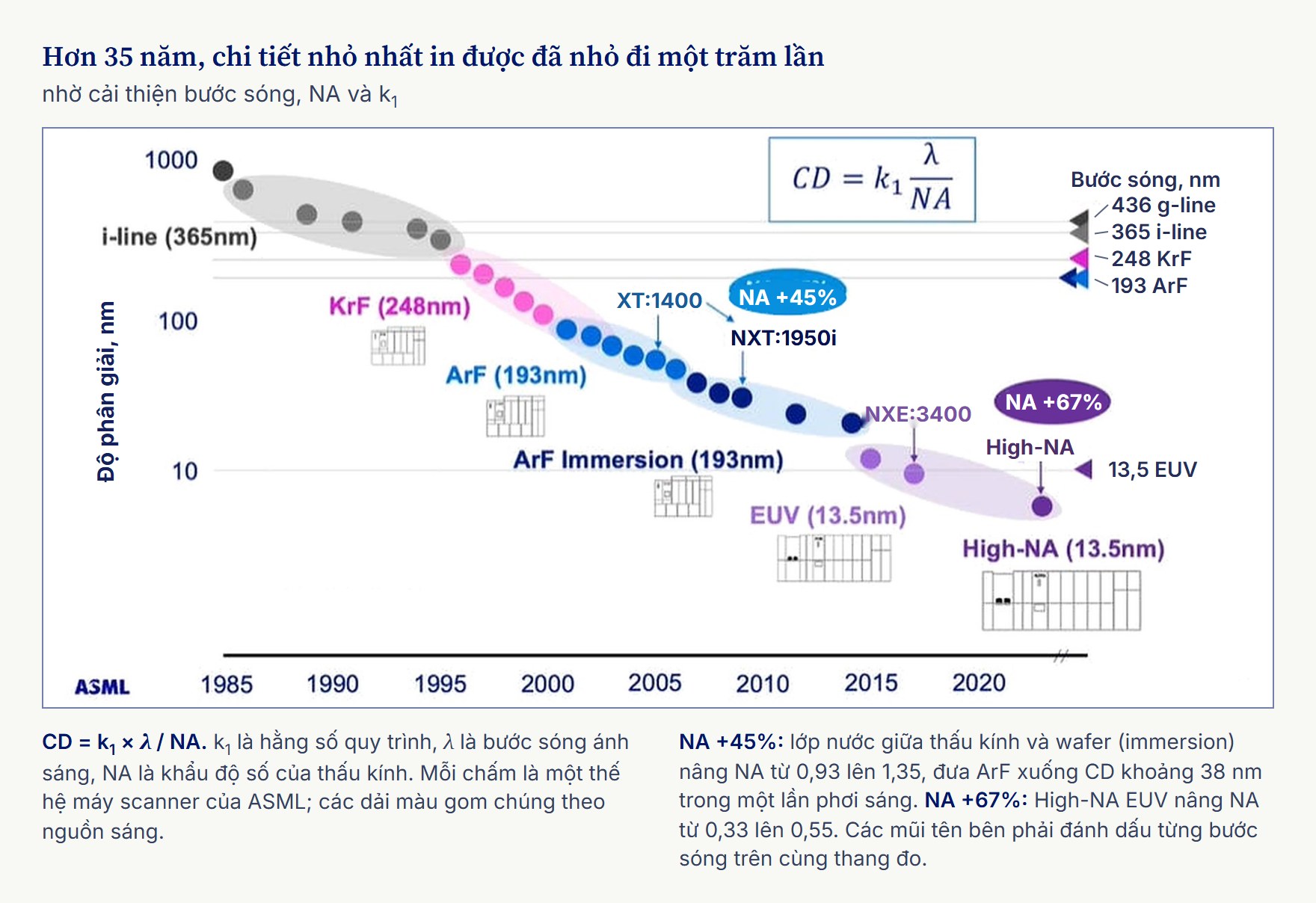
The number that rules this step is resolution: the smallest feature the light can print, called the critical dimension (CD). The Rayleigh equation puts it in one line, CD = k1 x lambda / NA: the critical dimension shrinks with a shorter wavelength (lambda), a wider lens aperture (NA), or a smaller k1, a constant that depends on how the lithography process is run. The industry has worked on all three for forty years.5.1 Mercury lamps at 436 and 365 nm printed micron-scale features. Deep ultraviolet (DUV) lasers (KrF at 248 nm, ArF at 193 nm, and ArF with water between lens and wafer) pushed critical dimensions down to about 38 nm in a single exposure. Beyond that, each layer was printed in two or more passes (multi-patterning), which carried chips as far as the 7 nm generation, before a completely new light took over.
Con số chi phối bước này là độ phân giải: chi tiết nhỏ nhất mà ánh sáng có thể in được, gọi là critical dimension (CD), tức kích thước tới hạn. Phương trình Rayleigh gói gọn điều đó trong một dòng, CD = k1 × lambda / NA: CD càng nhỏ khi bước sóng (lambda) càng ngắn, khẩu độ thấu kính (NA) càng rộng, hoặc hằng số k1 càng nhỏ, vốn phụ thuộc vào cách làm quy trình quang khắc. Suốt bốn mươi năm, ngành đã tận dụng cả ba yếu tố này.5.1 Đèn thủy ngân ở bước sóng 436 và 365 nm in ra các chi tiết cỡ micron. Laser deep ultraviolet (DUV), tức tia cực tím sâu, gồm KrF ở 248 nm, ArF ở 193 nm, và ArF có lớp nước giữa thấu kính và wafer, đẩy CD xuống còn khoảng 38 nm trong một lần phơi sáng. Để đi xa hơn, mỗi lớp được in qua hai lần trở lên (multi-patterning), cách làm đã đưa chip đến tận thế hệ 7 nm, trước khi một loại ánh sáng hoàn toàn mới thay thế.
Printing one layer sharply is only half the job. Each new mask must also land exactly on top of the layers already on the wafer, an alignment called overlay, and multi-patterning makes it harder, because every extra pass has to line up with the one before it. At the leading edge the tolerance is only a few nanometers.
In sắc nét một lớp mới chỉ là một nửa công việc. Mỗi mask mới còn phải đặt khớp chính xác lên các lớp đã có trên wafer, độ khớp này gọi là overlay, và multi-patterning khiến việc ấy khó hơn, vì mỗi lần in thêm đều phải trùng khít với lần in trước. Ở những thế hệ tiên tiến nhất, sai lệch cho phép chỉ còn vài nanomet.
EUV took more than thirty years to get working
EUV mất hơn ba mươi năm mới thành hiện thực
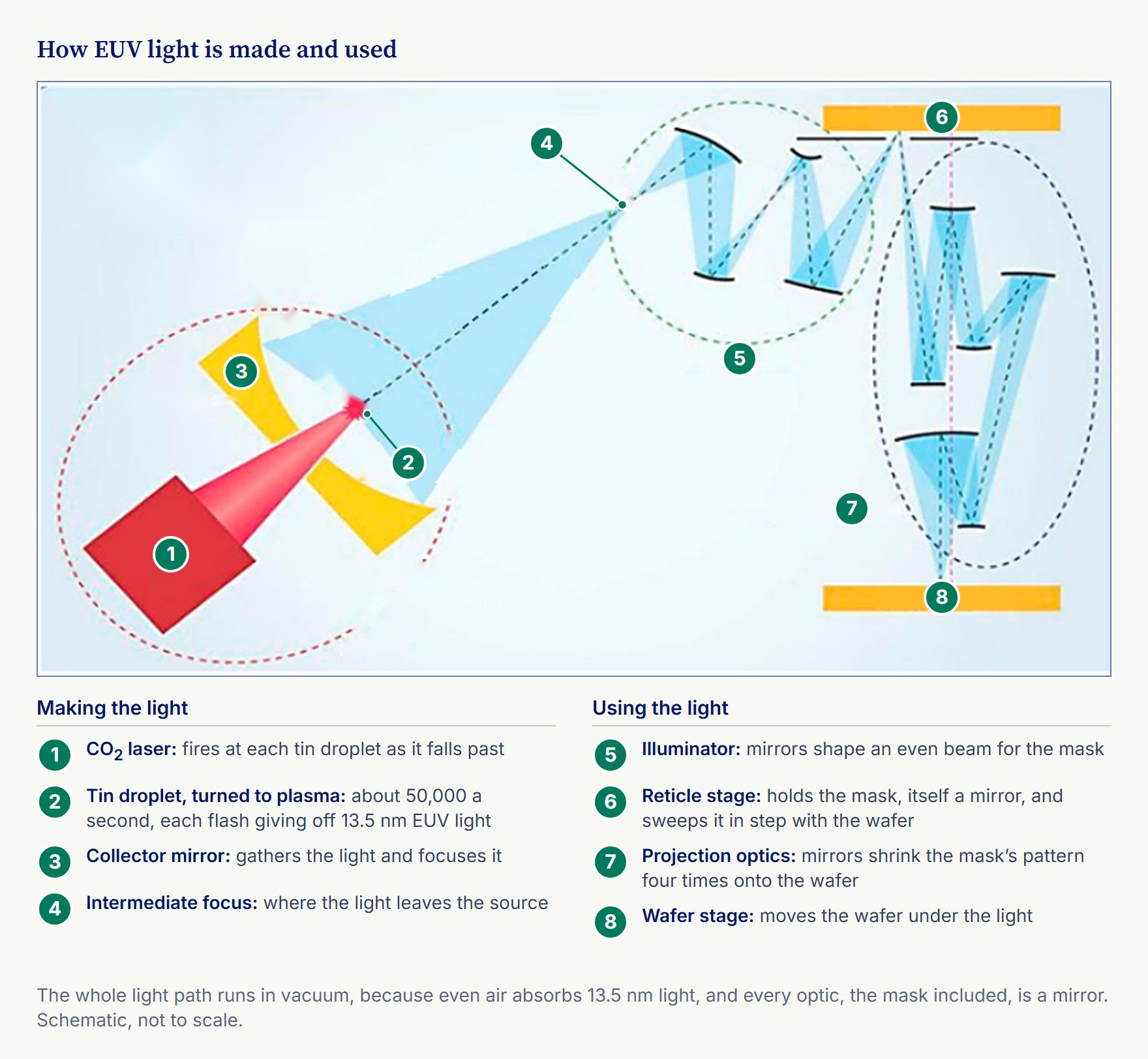
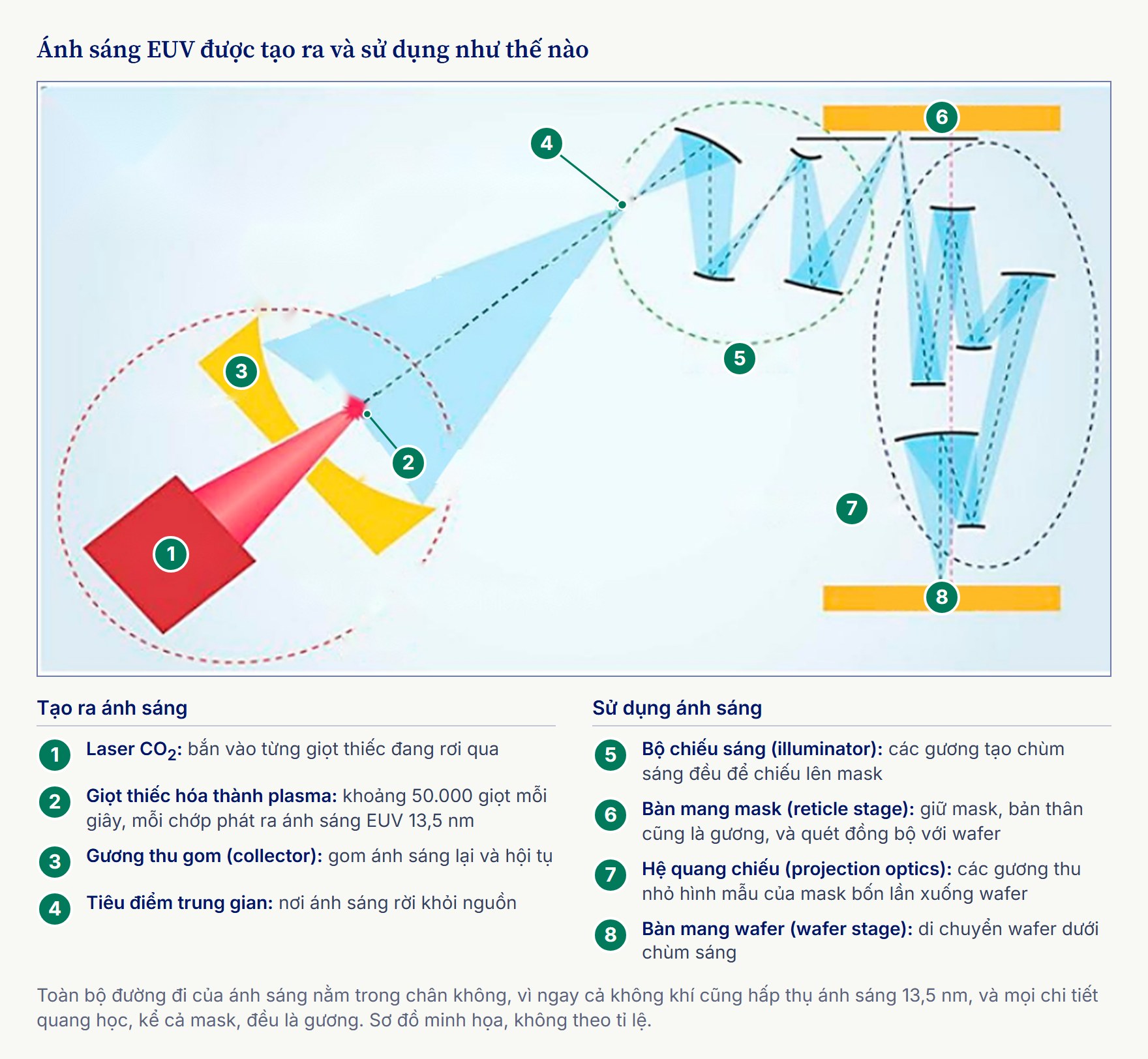
EUV lithography uses light at 13.5 nm, more than ten times shorter than ArF. Making that light is violent: a CO2 laser fires at falling droplets of molten tin, turning each droplet into a plasma flash that emits EUV light. Each flash gives off very little light, so it has to be repeated fifty thousand times every second to be useful for production. And using the light is just as hard. At 13.5 nm almost every material, even air, absorbs the light, so the machine runs in a vacuum and ordinary lenses and masks are ruled out. The entire optical path is built from mirrors instead: each one coated in about a hundred extremely thin layers with an ultra-flat surface, and even the mask becomes a mirror instead of a window.
Quang khắc EUV dùng ánh sáng ở bước sóng 13,5 nm, ngắn hơn ArF hơn mười lần. Ánh sáng đó sinh ra từ những cú bắn phá liên tục: một laser CO2 bắn vào những giọt thiếc nóng chảy đang rơi, biến mỗi giọt thành một chớp plasma phát ra ánh sáng EUV. Mỗi chớp chỉ cho rất ít ánh sáng, nên phải lặp lại năm mươi nghìn lần mỗi giây mới đủ dùng cho sản xuất. Dùng được ánh sáng đó cũng khó không kém. Ở bước sóng 13,5 nm, gần như mọi vật liệu, kể cả không khí, đều hấp thụ ánh sáng này, nên cỗ máy phải hoạt động trong chân không và không thể dùng thấu kính hay mask thông thường. Vì thế toàn bộ hệ quang học chỉ dùng gương: mỗi chiếc phủ khoảng một trăm lớp cực mỏng, bề mặt cực phẳng, và ngay cả mask cũng trở thành một chiếc gương thay vì một tấm kính.
Solving both problems took the industry more than thirty years, and exactly one company sells the machine: ASML of the Netherlands. Its EUV monopoly is why the machine appears in the news far beyond engineering circles, and why export controls decide who can buy one. EUV machines cannot be sold to China, and since 2023 the most advanced DUV immersion scanners also need an export license, so Chinese fabs rely on older DUV machines.
Ngành đã mất hơn ba mươi năm để giải quyết cả hai vấn đề, và đến nay chỉ đúng một công ty bán được cỗ máy đó: ASML của Hà Lan. Vì ASML độc quyền EUV, cỗ máy này thường xuyên lên báo, không chỉ trong giới kỹ thuật, và ai được mua nó là do các quy định kiểm soát xuất khẩu quyết định. Máy EUV bị cấm bán cho Trung Quốc; từ năm 2023, những máy scanner DUV immersion tiên tiến nhất cũng cần giấy phép xuất khẩu, nên các nhà máy sản xuất chip (fab) của Trung Quốc phải dựa vào máy DUV đời cũ hơn.
Shipping one EUV machine takes three Boeing 747s
Chở một cỗ máy EUV cần đến ba chiếc Boeing 747
The finished machine is enormous. Shipping one takes three Boeing 747 freighters; reassembling it means fitting together between one hundred thousand and one hundred and fifty thousand parts, more than forty thousand of them in the optical system alone, into a 180-ton tool. Each part has to be calibrated as it goes in, to nano-scale precision; it is not a matter of bolting the parts together and switching the machine on. There is an unconfirmed story in the industry that engineers who took apart a previous-generation DUV machine to copy it could not make it work again. Machines like these are moved and reinstalled routinely, but by teams with the maker’s procedures, parts, and calibration data. Complexity is its own copy protection.
Cỗ máy hoàn thiện khổng lồ vô cùng. Vận chuyển một chiếc cần đến ba máy bay chở hàng Boeing 747; lắp ráp lại nó nghĩa là ghép từ một trăm nghìn đến một trăm năm mươi nghìn linh kiện lại với nhau, trong đó hơn bốn mươi nghìn chi tiết chỉ riêng cho hệ quang học, thành một công cụ nặng 180 tấn. Lắp đến đâu phải hiệu chỉnh đến đó, với độ chính xác cấp nano, chứ không phải cứ vặn ốc vào là máy chạy. Trong ngành có một câu chuyện chưa được xác nhận: một cỗ máy DUV thế hệ trước bị tháo rời để sao chép, rồi không sao chạy lại được. Những cỗ máy như vậy vẫn thường xuyên được tháo ra, chuyển đi và lắp đặt lại, nhưng việc đó do những đội nắm quy trình, linh kiện và dữ liệu hiệu chỉnh của nhà sản xuất đảm nhận. Chính độ phức tạp đã là hàng rào chống sao chép.
That is also why the lithography tool is the most expensive machine in the fab, and why lithography is often called the step every other step waits for. When the video below shows the machine running, remember that the simple diagram of the EUV source above hides more than a hundred thousand parts.
Đó cũng là lý do công cụ quang khắc là cỗ máy đắt nhất trong fab, và vì sao quang khắc thường được gọi là bước mà mọi bước khác đều phải chờ. Khi xem cỗ máy vận hành trong video bên dưới, hãy nhớ rằng sơ đồ nguồn sáng EUV đơn giản ở trên che đi hơn một trăm nghìn chi tiết.
Are EUV machines steppers or scanners?Máy EUV là stepper hay scanner?
Scanners. A stepper exposes one field, the patch of wafer printed in a single exposure, then steps the wafer to the next position. A scanner also steps from field to field, but during each exposure the mask and the wafer sweep through a narrow slit of light in step, with the mask moving four times as fast as the wafer. That is how all modern EUV machines print. Stepper technology belongs to earlier generations.
Là scanner. Máy stepper phơi sáng một field, tức vùng wafer được in trong một lần phơi sáng, rồi nhích wafer sang vị trí kế tiếp. Máy scanner cũng nhích từ field này sang field khác, nhưng trong mỗi lần phơi sáng, mask và wafer quét đồng bộ qua một khe sáng hẹp, với tốc độ của mask gấp bốn lần wafer. Mọi máy EUV hiện đại đều in theo cách này. Công nghệ stepper thuộc về các thế hệ trước.
What an EUV machine looks like inside
Bên trong cỗ máy EUV trông ra sao
The video below, from ASML itself, shows the machine this chapter has been describing: the tin-droplet source, the mirror path, and the newest High-NA generation being assembled.5.2
Video dưới đây, do chính ASML thực hiện, cho thấy cỗ máy mà chương này đã mô tả: nguồn giọt thiếc, đường đi của các gương, và thế hệ High-NA mới nhất đang được lắp ráp.5.2