Chapter 2 of 10Chương 2/10 7 min7 phút
A chip that works with lightCon chip vận hành bằng ánh sáng
A complete optical link does three things in a row. It turns electricity into light, it guides and shapes that light, and it turns the light back into electricity. A photonic chip can do one of those jobs, two, or all three, and everything else on it serves one of them.
Một đường truyền quang hoàn chỉnh làm ba việc nối tiếp nhau. Nó biến điện thành ánh sáng, dẫn và xử lý ánh sáng ấy, rồi biến ánh sáng trở lại thành điện. Một con chip quang tử có thể đảm nhận một, hai hoặc cả ba việc ấy, và mọi thứ khác trên chip đều phục vụ một trong số đó.
In this chapter
Trong chương này
- How an optical system that once filled a lab bench now fits on a fingertip
- The three stages of an optical link, which a photonic chip can hold: make light, guide and shape it, detect it
- What the main parts do, from the laser and the waveguide to the modulator that writes data onto light
- How a photonic chip differs from an electronic one, and why it is a specialty of its own
- Một hệ quang học từng chiếm cả bàn thí nghiệm giờ nằm gọn trên đầu ngón tay ra sao
- Ba công đoạn của một đường truyền quang mà chip quang tử có thể đảm nhận: tạo ra ánh sáng, dẫn và xử lý nó, rồi thu nhận nó
- Các bộ phận chính làm gì, từ laser, ống dẫn sóng đến modulator ghi dữ liệu lên ánh sáng
- Chip quang tử khác chip điện tử ở đâu, và vì sao phần quang là một chuyên ngành riêng
Shrinking a lab bench onto a chip
Thu nhỏ cả một bàn thí nghiệm vào con chip
Electronics has already shown where shrinking leads. The first electronic computers switched with glass vacuum tubes, and even a slow machine filled a room.2.1 Then transistors moved onto silicon and shrank, decade after decade, until their features were only tens of nanometers across. A chip in today’s phone holds billions of them, and it does far more work on far less energy.
Điện tử học đã cho thấy việc thu nhỏ dẫn tới đâu. Những chiếc máy tính điện tử đầu tiên đóng ngắt bằng ống chân không thủy tinh, và ngay cả một cỗ máy chạy chậm cũng chiếm trọn một căn phòng.2.1 Rồi bóng bán dẫn (transistor) chuyển lên silicon và nhỏ dần qua từng thập niên, cho tới khi các chi tiết của nó chỉ còn vài chục nanomet. Một con chip trong điện thoại bây giờ chứa hàng tỷ transistor, làm được nhiều việc hơn hẳn mà lại tốn ít năng lượng hơn hẳn.
Photonics is taking the same path with light, and its version of the chip is the photonic integrated circuit (PIC), or photonic chip. An integrated circuit gathers many electronic functions onto one chip; a photonic chip gathers optical ones. Lasers, photodetectors, modulators and the guides between them are each shrunk until their key features are a few hundred nanometers across. Because the chip is built on a wafer with the same kinds of tools that make electronic chips, it can be made by the thousand instead of being assembled by hand.2.2 When the chip is made of silicon, the field is called silicon photonics.
Quang tử học (photonics) đang đi đúng con đường ấy với ánh sáng, và con chip của ngành này là chip quang tử (photonic integrated circuit), viết tắt là PIC. Một vi mạch (integrated circuit) gom nhiều chức năng điện tử lên một con chip; chip quang tử thì gom các chức năng quang. Laser, bộ tách sóng quang (photodetector), modulator (bộ điều biến quang) và các đường dẫn nối chúng lại đều được thu nhỏ cho tới khi những chi tiết then chốt chỉ còn vài trăm nanomet. Chip làm trên tấm wafer bằng cùng loại công cụ sản xuất chip điện tử, nên có thể sản xuất hàng loạt, hàng nghìn chiếc, thay vì lắp ráp bằng tay.2.2 Khi chip làm bằng silicon, lĩnh vực này có tên là silicon photonics.
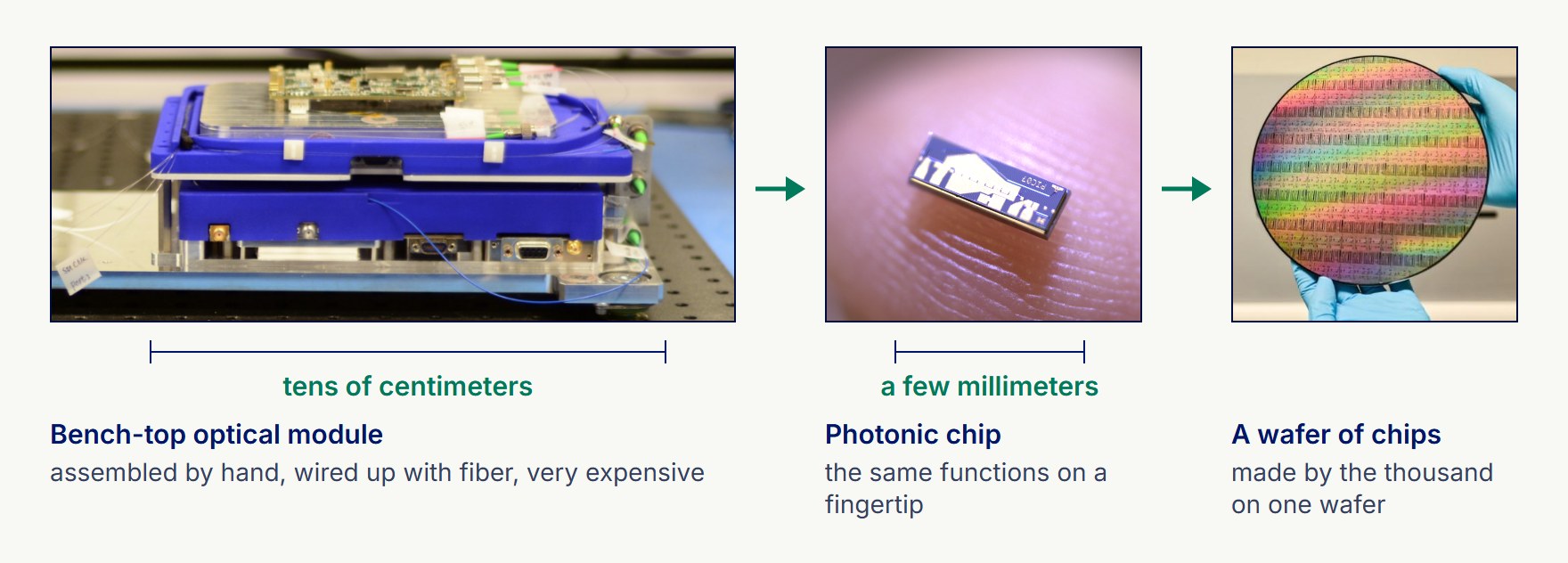
The photographs below show what that buys. On the left is an optical module of the kind that once sat on a lab bench: tens of centimeters across, wired up with fiber, and very expensive. In the middle is a chip a few millimeters long that holds the same set of functions and rests on a fingertip. On the right is a wafer, where chips like it are made by the thousand at once.
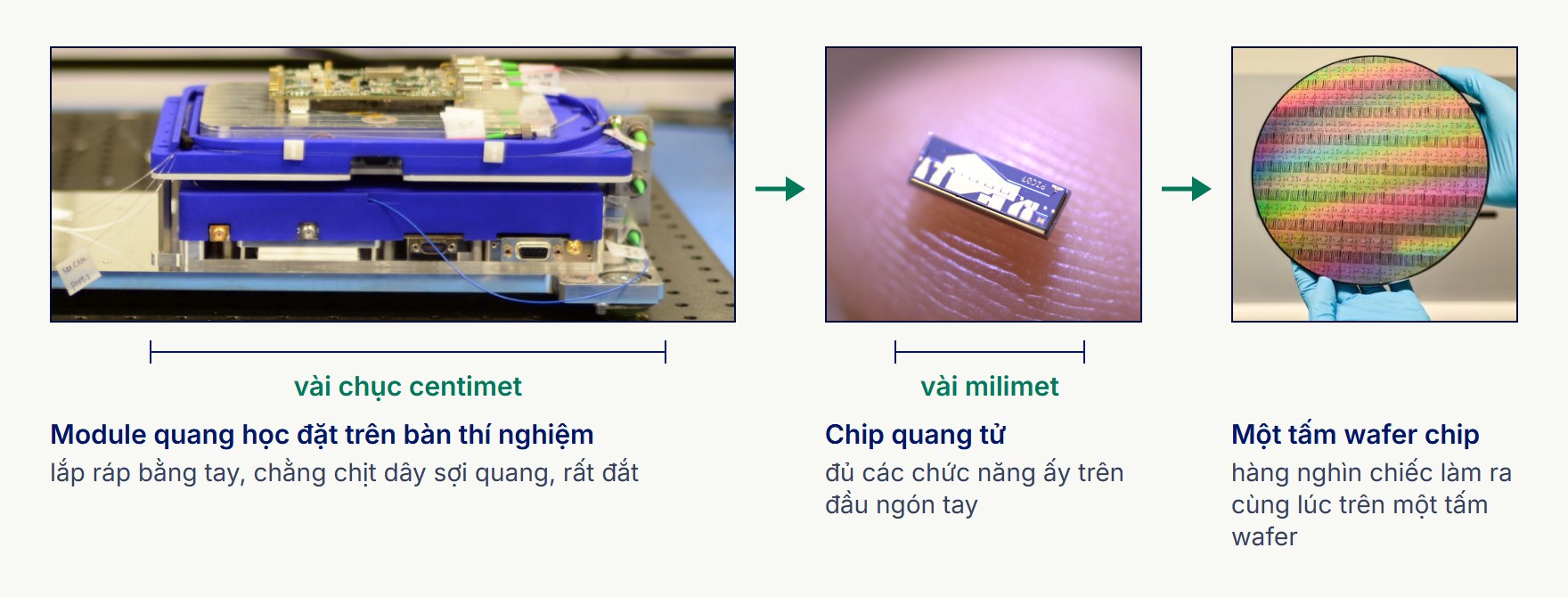
Những bức ảnh dưới đây cho thấy cái lợi ấy. Bên trái là một module quang học kiểu từng đặt trên bàn thí nghiệm: dài vài chục centimet, chằng chịt dây sợi quang, và rất đắt. Ở giữa là một con chip dài vài milimet, chứa đủ bộ chức năng ấy mà đặt vừa trên đầu ngón tay. Bên phải là một tấm wafer, nơi hàng nghìn con chip như thế được làm ra cùng lúc.
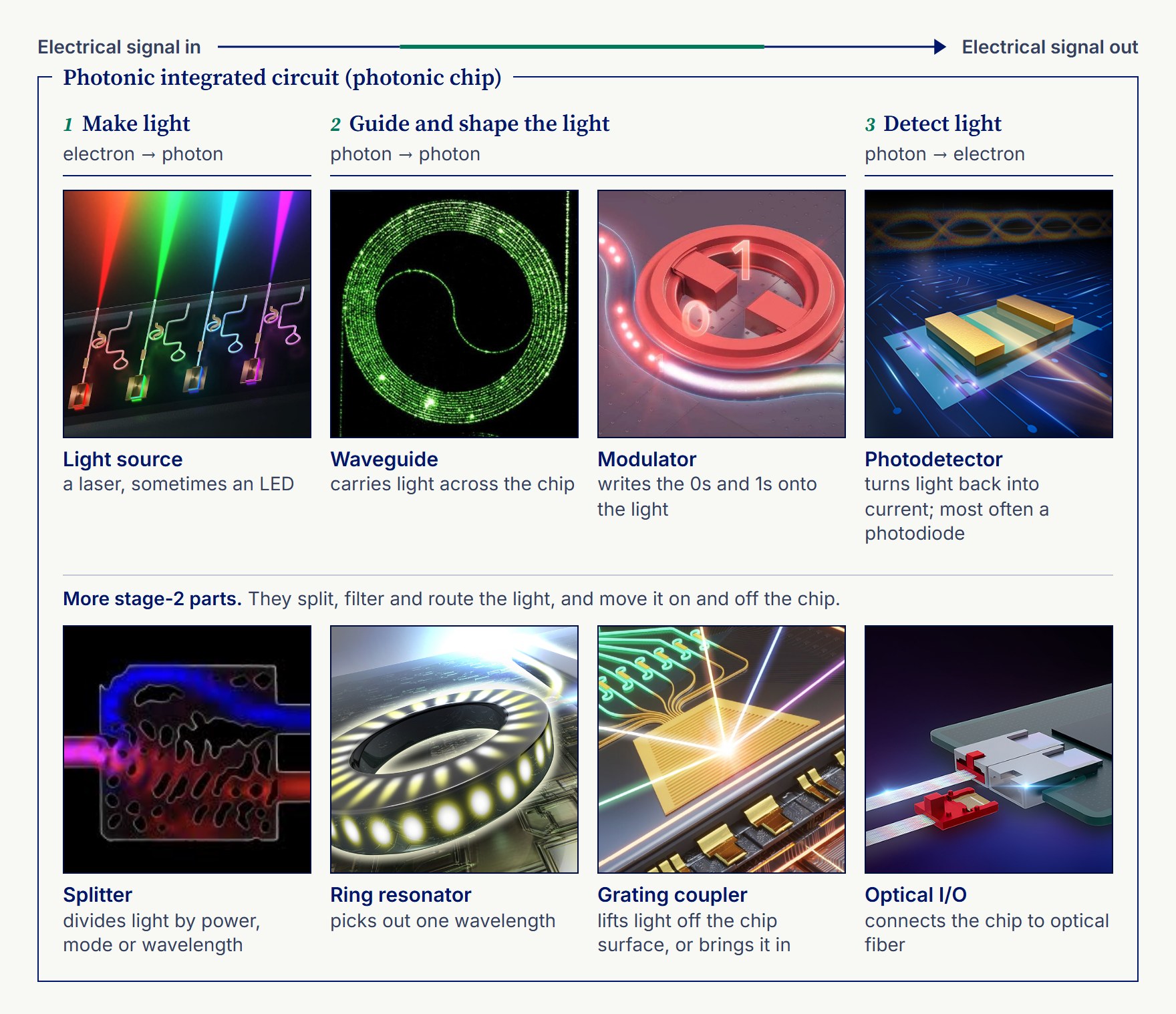
The diagram below groups the parts of a photonic chip by the three stages of an optical link.
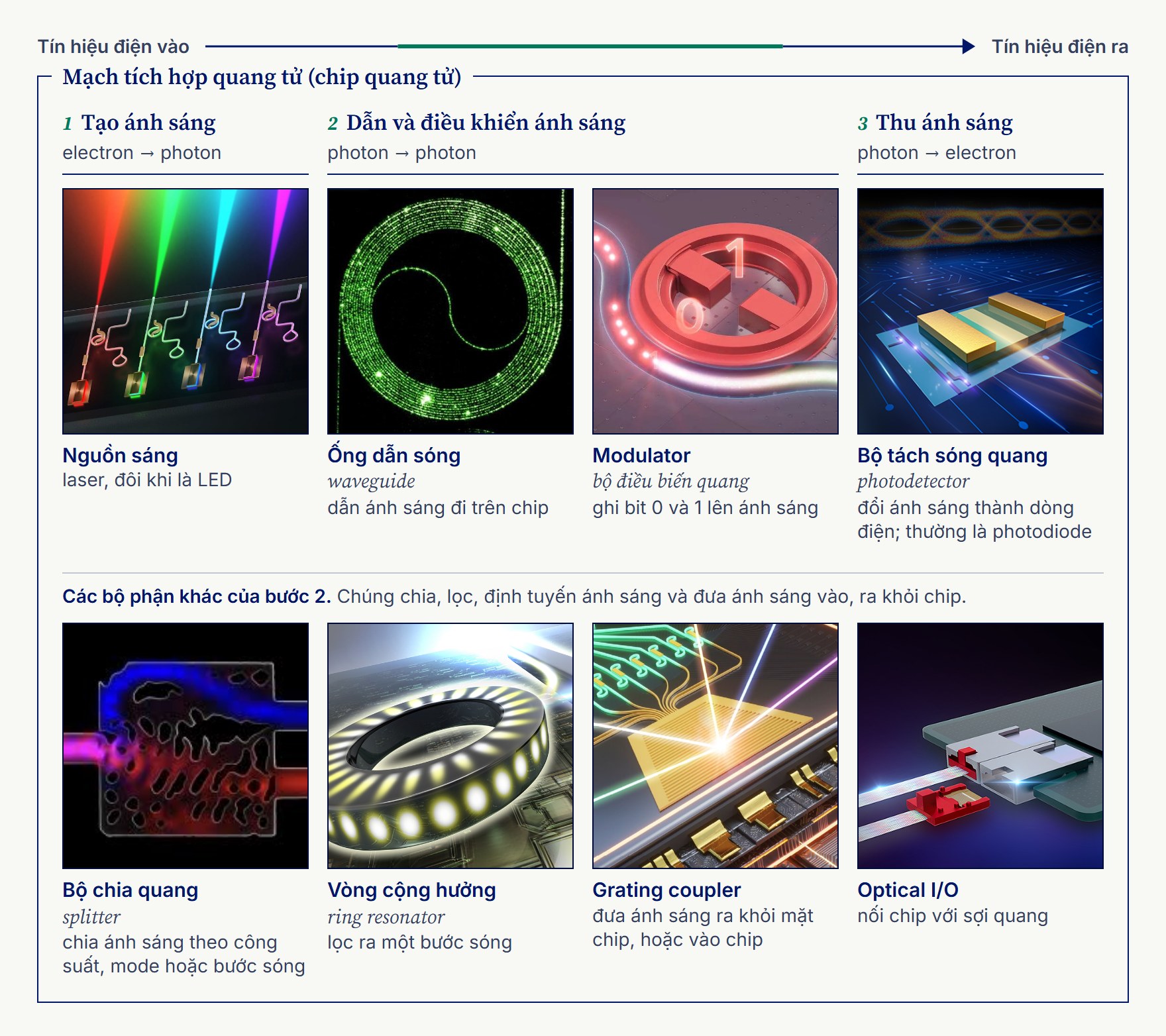
Sơ đồ dưới đây xếp các bộ phận trên chip quang tử vào ba công đoạn của một đường truyền quang.
Making light with a laser or an LED
Tạo ra ánh sáng bằng laser hoặc LED
The first stage starts from a plain fact: a chip’s input is electricity. Something has to turn a flow of electrons into photons, and that is usually a laser: built into an indium phosphide chip, joined onto a silicon one, or kept off the chip with its light fed in through a fiber. Sometimes it is a light-emitting diode (LED). Lasers are the common choice because their beam is narrow and almost a single wavelength, which is what the rest of the chip needs, and they come in many kinds, each suited to a different color and task.
Công đoạn đầu tiên xuất phát từ một điều giản dị: đầu vào của con chip là điện. Phải có thứ gì đó biến dòng electron thành photon, và thứ đó thường là laser: nằm ngay trên chip indium phosphide, được ghép lên chip silicon, hoặc đặt ngoài chip rồi đưa ánh sáng vào qua sợi quang. Đôi khi đó là LED. Người ta chuộng laser hơn vì chùm tia của nó hẹp và gần như chỉ có một bước sóng, đúng thứ mà phần còn lại của con chip cần. Laser cũng có rất nhiều loại, mỗi loại hợp với một màu ánh sáng và một việc riêng.
A close relative often sits nearby: the semiconductor optical amplifier (SOA). It is built much like a laser, but it has no mirrors to feed light back, so it never becomes a laser itself. It strengthens light that is already traveling on the chip, making up for what the other parts lose along the way. Which materials make light is the subject of chapter 4.
Gần đó thường có một “họ hàng” của laser: bộ khuếch đại quang bán dẫn (semiconductor optical amplifier, SOA). Cấu tạo của nó khá giống laser, nhưng nó không có gương phản xạ ở hai đầu nên không tự phát thành chùm laser. Nó làm mạnh thêm ánh sáng đang đi trên chip, bù lại phần mà các bộ phận khác làm hao hụt dọc đường. Vật liệu nào phát được ánh sáng là chuyện của chương 4.
Guiding and shaping the light
Dẫn và xử lý ánh sáng
Once there is light, it has to be carried, and the basic part for that is the waveguide. Think of light as water from a tap: without a pipe it spills out and is lost. A waveguide is that pipe, a narrow strip of material that holds the light inside it and leads it wherever the chip needs it. It can bend and curl, as the green spiral in the diagram does, so a long path fits in a small space.
Khi đã có ánh sáng, phải dẫn nó đi, và bộ phận cơ bản cho việc này là ống dẫn sóng (waveguide). Hãy hình dung ánh sáng như nước chảy ra từ vòi: không có ống thì nước tràn ra ngoài và mất đi. Ống dẫn sóng chính là cái ống ấy, một dải vật liệu hẹp giữ ánh sáng bên trong và đưa nó đến bất cứ chỗ nào con chip cần. Nó có thể uốn cong, cuộn tròn như hình xoắn ốc màu xanh trong sơ đồ, để một quãng đường dài nằm gọn trong một khoảng nhỏ.
The second key part is the modulator, and it is where data enters the picture. An electronic chip sends out its data as zeros and ones in an electrical signal. To send that data down a fiber, it has to be written onto the light. The modulator does exactly that: it changes the light, its brightness or its phase, in step with the electrical signal, so the light carries the same zeros and ones.2.2
Bộ phận then chốt thứ hai là modulator, và cũng là bộ phận đưa dữ liệu vào ánh sáng. Chip điện tử xuất dữ liệu ra dưới dạng những số không và số một trong tín hiệu điện. Muốn gửi dữ liệu ấy qua sợi quang, phải “ghi” nó lên ánh sáng. Modulator làm đúng việc đó: nó thay đổi độ sáng hoặc pha của ánh sáng theo nhịp tín hiệu điện, để ánh sáng mang đúng những số không và số một ấy.2.2
Around these two sit parts that split, filter and connect the light.
Quanh hai bộ phận này là những bộ phận chia, lọc và kết nối ánh sáng.
| Part | What it does |
|---|---|
| Splitter | Divides the light in one waveguide between two or more paths: by power, by mode (the pattern in which light fills the guide) or by wavelength |
| Ring resonator | A waveguide closed into a loop beside a straight one. Only wavelengths that fit a whole number of times around the ring build up inside it, so the ring can pick out or filter single colors2.3 |
| Grating coupler | A finely ruled pattern that couples light between the chip’s surface and a fiber held above it, in either direction, or sends it into open space, the way some LIDAR chips steer a beam |
| Optical I/O | The chip’s light connections to the outside world, such as a fiber attached at its edge, made so that little light is lost at the join |
| Bộ phận | Chức năng |
|---|---|
| Bộ chia quang (splitter) | Chia ánh sáng trong một ống dẫn sóng ra hai hay nhiều nhánh: theo công suất, theo mode (kiểu phân bố của ánh sáng trong ống dẫn) hoặc theo bước sóng |
| Vòng cộng hưởng (ring resonator) | Một ống dẫn sóng khép thành vòng, đặt sát một ống dẫn thẳng. Chỉ những bước sóng vừa khít một số nguyên lần quanh vòng mới tích tụ được bên trong, nên vòng có thể tách riêng hoặc lọc từng màu ánh sáng2.3 |
| Grating coupler | Một cấu trúc vạch khắc rất mịn, ghép ánh sáng giữa bề mặt chip và một sợi quang đặt phía trên, theo cả hai chiều, hoặc hắt nó ra không gian, như cách một số chip LIDAR chỉnh hướng chùm tia |
| Optical I/O | Các đường nối ánh sáng giữa con chip và thế giới bên ngoài, chẳng hạn một sợi quang gắn ở mép chip, làm sao để ánh sáng thất thoát ít nhất ở chỗ nối |
The ring’s trick, letting light build up only at the wavelengths that fit, is called resonance. A cousin of it comes back in chapter 9, where it helps some flat lenses bend light.
“Mẹo” của chiếc vòng, chỉ cho ánh sáng tích tụ ở những bước sóng vừa khít, gọi là cộng hưởng. Một hiện tượng họ hàng với nó sẽ trở lại ở chương 9, nơi nó giúp một số thấu kính phẳng bẻ cong ánh sáng.
Turning light back into electricity
Biến ánh sáng trở lại thành điện
At the far end, light has to become electricity again, or no electronic circuit could read it. That is the job of the photodetector, most often a photodiode: a piece of semiconductor that produces a current when it absorbs photons. The current follows the light’s pattern of zeros and ones, and the electronics after it decodes the data.
Ở đầu bên kia, ánh sáng phải trở lại thành điện, nếu không thì chẳng mạch điện tử nào đọc được nó. Đó là việc của bộ tách sóng quang, mà loại phổ biến nhất là photodiode: một mẩu bán dẫn sinh ra dòng điện khi hấp thụ photon. Dòng điện ấy lên xuống theo đúng nhịp số không, số một của ánh sáng, và phần điện tử phía sau giải mã ra dữ liệu.
Put all three stages on one chip and it becomes a complete small system, from sending to receiving. Its size depends on the job; the chip in the photograph earlier in this chapter is a few millimeters long. Many chips also carry other parts besides these, depending on what they are for.
Khi cả ba công đoạn nằm trên cùng một con chip, con chip ấy trở thành một hệ thống nhỏ hoàn chỉnh, từ phát đến thu. Kích thước tùy ứng dụng; con chip trong bức ảnh ở đầu chương chỉ dài vài milimet. Nhiều chip còn có thêm những bộ phận khác, tùy mục đích sử dụng.
How is a photonic chip different from an electronic one?
Chip quang tử khác gì so với chip điện tử?
The difference lies in the physics inside. From the outside a photonic chip looks like any other chip, and it is made in similar steps: design, then manufacturing, then testing and packaging, which chapters 3 and 4 follow. At the edges, where electrical signals become light and back again, the chip faces the same problems as any fast electronic circuit. Once the signal is light, other rules apply: how light travels through a guide, how it interacts with the material around it, how it spreads and distorts. That is why the optical side is a specialty of its own. The two industries also compete differently. Electronic chips have been refined for decades, and the contest there now turns largely on capital, machines and factory size; in photonics a great deal is still being invented.
Điểm khác biệt nằm ở phần vật lý bên trong. Nhìn từ bên ngoài, chip quang tử trông như mọi con chip khác, và cũng ra đời qua những bước tương tự: thiết kế, rồi sản xuất, rồi kiểm thử và đóng gói, như chương 3 và chương 4 sẽ lần theo. Ở hai đầu, nơi tín hiệu điện chuyển thành ánh sáng rồi chuyển ngược lại, con chip gặp đúng những bài toán của mọi mạch điện tử tốc độ cao. Còn khi tín hiệu đã là ánh sáng, những quy luật khác chi phối: ánh sáng đi trong ống dẫn ra sao, tương tác với vật liệu xung quanh thế nào, bị nhòe ra và méo đi thế nào. Vì thế, phần quang là một chuyên ngành riêng. Hai ngành cũng cạnh tranh theo những cách khác nhau. Chip điện tử đã được hoàn thiện qua nhiều thập niên, và giờ đây ở đó chủ yếu là cuộc đua về vốn, máy móc và quy mô nhà máy; còn ở quang tử, người ta vẫn đang phát minh ra rất nhiều thứ.
Are the analog and digital sides of an optoelectronic chip very different from those of an ordinary electronic chip?Các yếu tố analog và digital trong chip quang điện tử có khác nhiều so với chip điện tử thông thường không?
Quite different. An optoelectronic chip still has an electrical side, and where an electrical signal is turned into light, problems such as impedance matching and parasitic effects have to be solved just as in any fast circuit. Once the signal is light, the problems are about how light interacts with the chip and how it is processed. In a long fiber, for example, the different wavelengths in a pulse travel at slightly different speeds and smear it out, an effect called chromatic dispersion (chapter 5 returns to it), and digital signal processing at the receiver is needed to undo the distortion.2.4 In short, the optical side is its own field, and it has to be studied in depth.
Khác khá nhiều. Chip quang điện tử vẫn có phần điện, và ở chỗ tín hiệu điện chuyển thành ánh sáng, những bài toán như phối hợp impedance (trở kháng) hay các hiệu ứng ký sinh (parasitic) vẫn phải giải như ở mọi mạch tốc độ cao. Nhưng khi tín hiệu đã sang ánh sáng, bài toán lại xoay quanh cách ánh sáng tương tác với con chip và cách xử lý nó. Chẳng hạn, trong một sợi quang dài, các bước sóng khác nhau trong cùng một xung sáng đi với tốc độ hơi khác nhau nên làm xung bị nhòe ra, hiện tượng gọi là tán sắc (chromatic dispersion) (chương 5 sẽ trở lại chuyện này), và phải có xử lý tín hiệu số ở đầu thu để sửa lại chỗ méo ấy.2.4 Tóm lại, phần quang là một lĩnh vực riêng, và phải học cho thật sâu.
A photonic chip is built from many small parts, and the design of each one is far from settled: splitters that waste less light, rings that pick out a color more cleanly, couplers that lose less at the join. Many of these problems are still open, and many are small enough for a well-trained team to take on, whether a small company or a university group.
Một con chip quang tử ghép từ rất nhiều bộ phận nhỏ, và cách thiết kế từng bộ phận vẫn còn xa mới ngã ngũ: bộ chia quang sao cho phí ít ánh sáng hơn, vòng cộng hưởng sao cho tách màu gọn hơn, grating coupler sao cho thất thoát ít hơn ở chỗ nối. Nhiều bài toán như thế vẫn còn bỏ ngỏ, và không ít bài đủ nhỏ để một nhóm được đào tạo tốt có thể bắt tay giải quyết, dù đó là một công ty nhỏ hay một nhóm nghiên cứu ở trường đại học.