Chapter 7 of 10Chương 7/10 6 min6 phút
Inside the data centerBên trong trung tâm dữ liệu
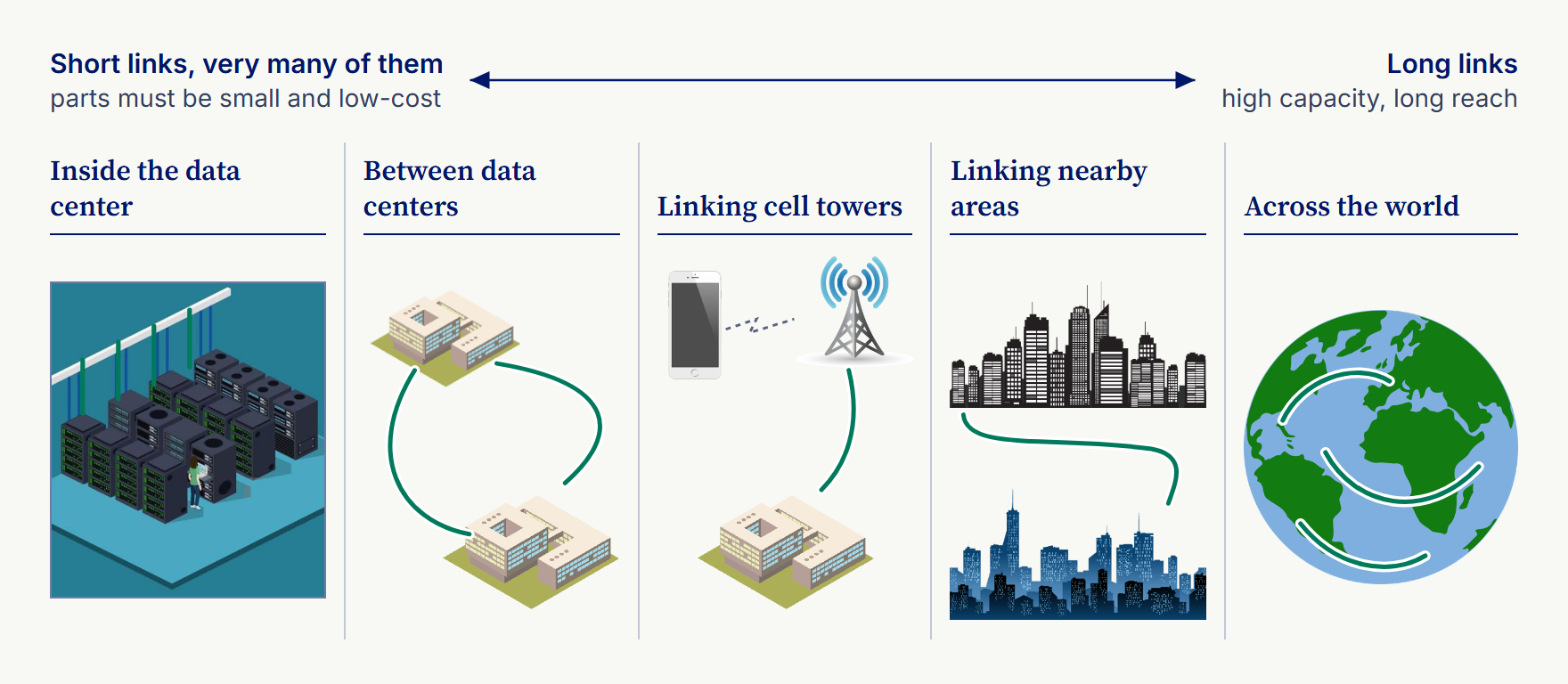
Walk down an aisle of a large data center and racks of servers line both sides, each cabinet taller than a person, their fans roaring. Through layers of switches, every one of them can reach every other. The distances run only from a few meters to a few kilometers, yet the links are beyond counting, and the speed each must carry climbs every two or three years. This chapter asks which of those wires are still copper, and why the rest have turned to light.
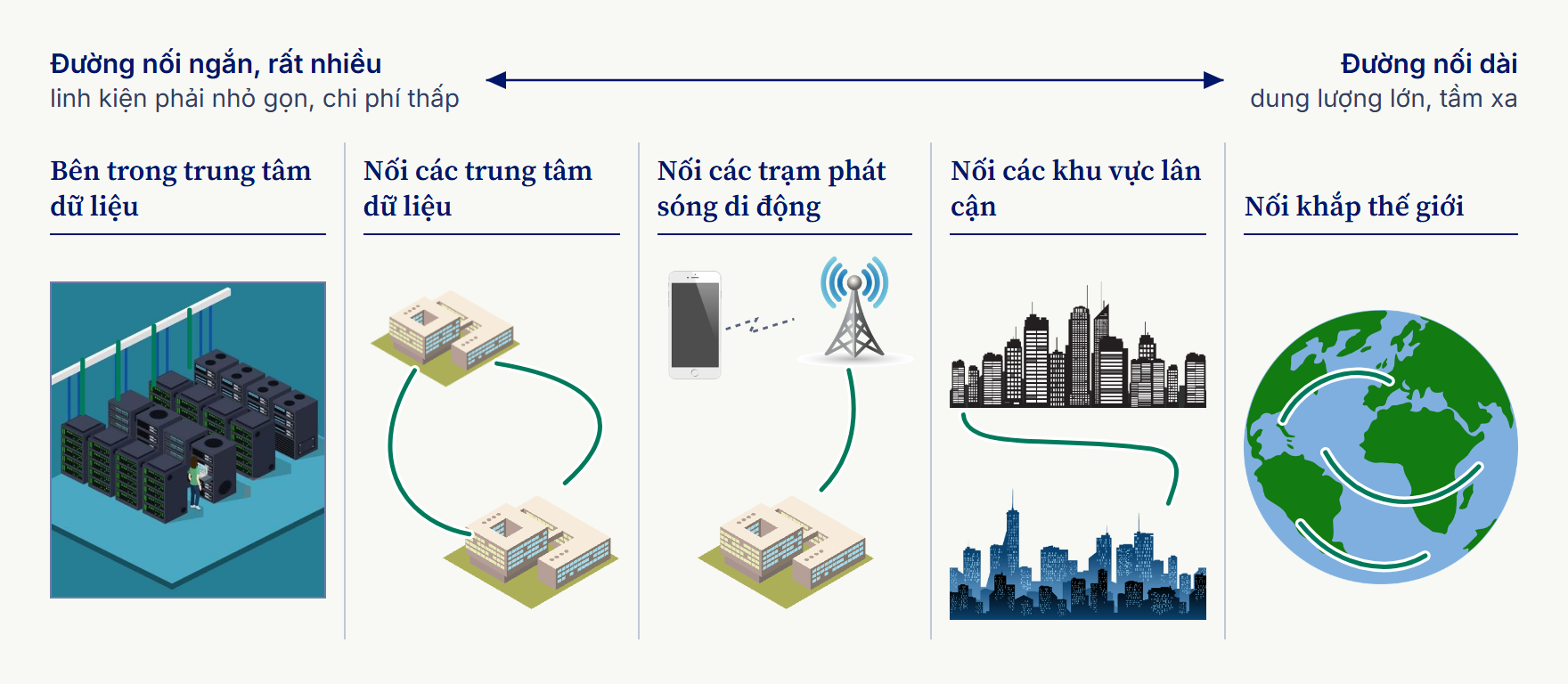
Bước dọc lối đi của một trung tâm dữ liệu (data center) lớn, hai bên là những dãy tủ máy (rack) chứa máy chủ nối tiếp nhau, tủ nào cũng cao hơn đầu người, quạt chạy ù ù. Qua nhiều lớp bộ chuyển mạch, tủ nào cũng liên lạc được với mọi tủ còn lại. Khoảng cách chỉ từ vài mét đến vài cây số, nhưng số đường nối thì nhiều không đếm xuể, và tốc độ mỗi đường phải gánh cứ hai ba năm lại tăng một bậc. Chương này tìm hiểu xem dây nào vẫn còn là dây đồng, và vì sao phần còn lại đã chuyển sang ánh sáng.
In this chapter
Trong chương này
- How Ethernet climbed from 10 megabits a second toward 1.6 terabits in about forty years
- Why the faster a link runs, the sooner it has to leave copper for fiber
- How the racks in a data center are wired together, layer by layer
- Which two kinds of fiber a data center uses, and what each is for
- Trong khoảng bốn mươi năm, Ethernet đã tăng từ 10 megabit mỗi giây lên gần 1,6 terabit ra sao
- Vì sao đường truyền càng nhanh thì càng sớm phải rời dây đồng để sang cáp quang
- Các tủ máy trong trung tâm dữ liệu được nối với nhau ra sao, từng lớp một
- Trung tâm dữ liệu dùng hai loại sợi quang nào, và mỗi loại để làm gì
For forty years, Ethernet has kept getting faster
Suốt bốn mươi năm, Ethernet ngày một nhanh hơn
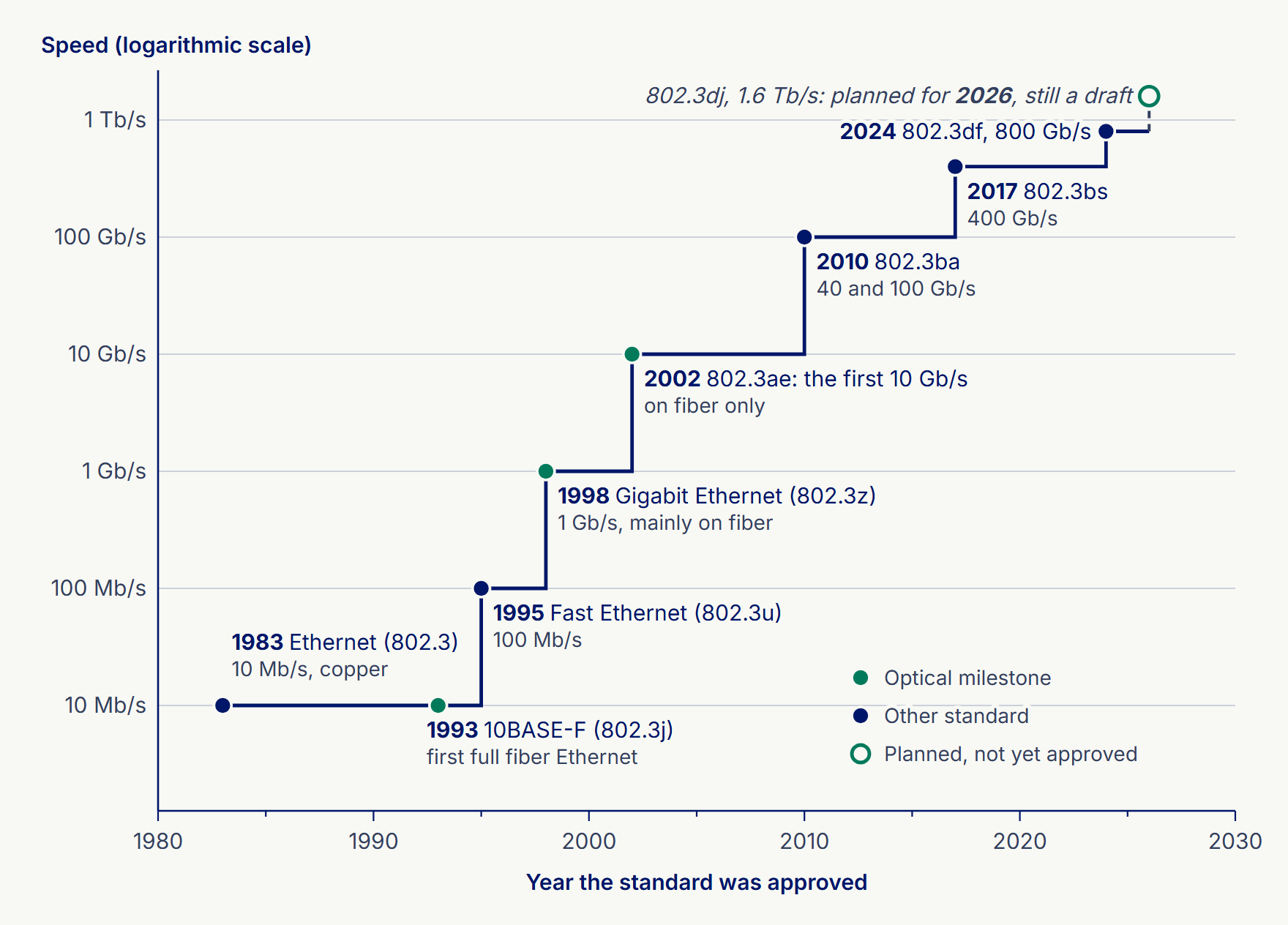
Carrying data between machines inside a data center, and between data centers, is called datacom, to set it apart from the long-distance telecom networks of the last two chapters. Most of it speaks Ethernet, the family of standards that the IEEE, the Institute of Electrical and Electronics Engineers, has published under the number 802.3 since 1983. The first version ran at 10 megabits per second over copper, and it took more than ten years to reach 100 megabits.
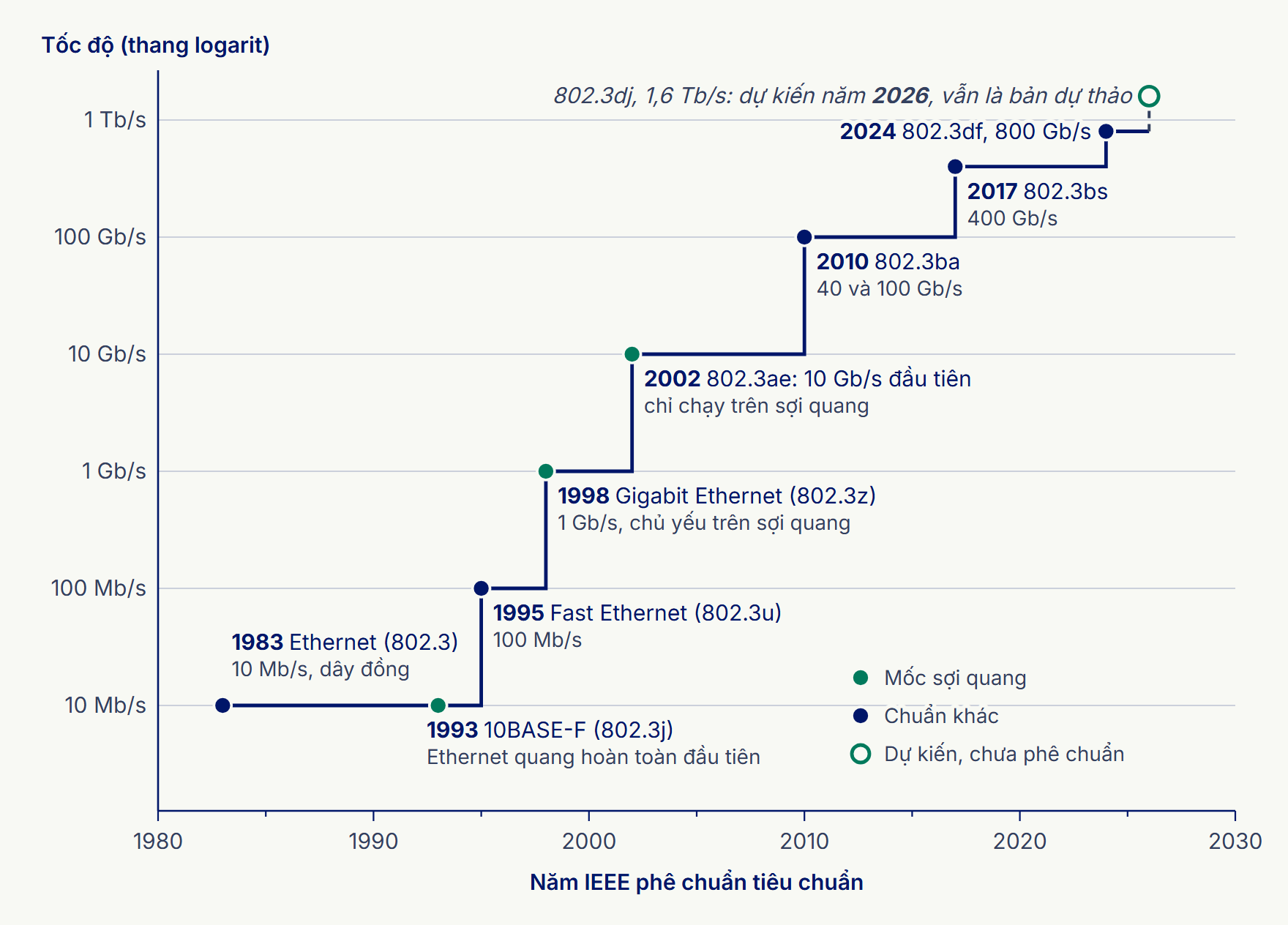
Việc truyền dữ liệu giữa các máy trong cùng một trung tâm dữ liệu và giữa các trung tâm dữ liệu với nhau được gọi là truyền dẫn dữ liệu (datacom), để phân biệt với mạng viễn thông đường dài ở hai chương trước. Phần lớn lưu lượng ấy đi theo Ethernet, họ tiêu chuẩn mà IEEE (Viện Kỹ sư Điện và Điện tử) ban hành dưới số hiệu 802.3 từ năm 1983. Phiên bản đầu tiên chạy 10 megabit mỗi giây trên dây đồng, và phải mất hơn mười năm mới lên được 100 megabit.
Fiber arrived early. 10BASE-F, the first full fiber version of Ethernet, was standardized in 1993.7.1 Gigabit Ethernet, standardized in 1998, ran mainly on optical fiber,7.2 and in 2002 the first 10 Gb/s standard, 802.3ae, ran on fiber alone.7.3 Then the pace quickened: 400 Gb/s was standardized in 2017,7.4 800 Gb/s in 2024,7.5 and 1.6 Tb/s is next: its standard, 802.3dj, was planned for 2026, but as of September 2026 the draft was still being revised in answer to reviewers’ comments.7.6, 7.7 Counting that step, Ethernet will have grown more than 100,000 times faster in about forty years, with a new generation now every two to three years, driven by AI.
Cáp quang đến với Ethernet từ khá sớm. 10BASE-F, phiên bản Ethernet đầu tiên chạy hoàn toàn trên sợi quang, được chuẩn hóa năm 1993.7.1 Gigabit Ethernet, chuẩn hóa năm 1998, chủ yếu chạy trên sợi quang,7.2 và năm 2002, chuẩn 10 Gb/s đầu tiên là 802.3ae chỉ chạy trên sợi quang.7.3 Từ đó nhịp độ ngày càng dồn dập: 400 Gb/s được chuẩn hóa năm 2017,7.4 800 Gb/s năm 2024,7.5 và kế tiếp là 1,6 Tb/s: chuẩn cho tốc độ này, 802.3dj, dự kiến hoàn tất trong năm 2026, nhưng tính đến tháng 9/2026, nhóm soạn thảo vẫn đang sửa bản dự thảo theo góp ý của các chuyên gia thẩm định.7.6, 7.7 Tính cả bậc ấy, Ethernet sẽ nhanh hơn trên 100.000 lần trong khoảng bốn mươi năm, và giờ đây cứ hai đến ba năm lại có một thế hệ mới, với AI là động lực chính.
Why speed pushes links onto light
Vì sao tốc độ đẩy đường truyền sang ánh sáng
A faster signal spreads over a wider bandwidth of frequencies, and copper loses the high ones far faster than fiber does. That is why, as chapter 5 noted, a fast copper link reaches only a few meters.
Tín hiệu càng nhanh thì trải trên băng thông tần số càng rộng, mà trong dây đồng, các thành phần tần số cao suy hao nhanh hơn trong sợi quang rất nhiều. Vì thế, như chương 5 đã nói, đường truyền đồng tốc độ cao chỉ đi được vài mét.
So light has moved step by step from long cables toward shorter links wherever high speed is needed. Homes came first. In Vietnam, as in many places, a dial-up phone line once gave a few tens of kilobits per second and ADSL a few megabits; fiber to the home now brings 1 gigabit per second or more. Then fiber spread through data centers, and at terabits per second it is moving into the switches and servers themselves.
Vì vậy ánh sáng đã từng bước đi từ những tuyến cáp dài vào các đường truyền ngắn hơn, ở bất cứ đâu cần tốc độ cao. Hộ gia đình là nơi đầu tiên. Ở Việt Nam, cũng như nhiều nơi khác, đường điện thoại quay số ngày trước chỉ cho vài chục kilobit mỗi giây, ADSL được vài megabit; nay fiber to the home (FTTH, cáp quang đến tận nhà) đưa tới 1 gigabit mỗi giây hoặc hơn. Rồi cáp quang lan khắp các trung tâm dữ liệu, và nay, ở tốc độ hàng terabit mỗi giây, nó đang tiến vào tận bên trong các bộ chuyển mạch và máy chủ.
Thousands of racks are joined through layers of switches
Hàng nghìn tủ máy được nối qua nhiều lớp bộ chuyển mạch
A data center run by a hyperscaler such as Meta, Microsoft, Google or Oracle is a campus of several buildings, each the size of several football fields. Inside, rows of racks hold the equipment: servers full of GPUs for AI, storage, and the switches that join them. A large building holds thousands of racks, each with dozens of servers.
Hyperscaler là những tập đoàn vận hành hạ tầng điện toán khổng lồ như Meta, Microsoft, Google hay Oracle. Mỗi trung tâm dữ liệu của họ là cả một khu gồm nhiều tòa nhà, mỗi tòa rộng bằng mấy sân bóng đá. Bên trong, từng dãy tủ máy đặt thiết bị: máy chủ chứa đầy GPU để chạy AI, thiết bị lưu trữ, và các bộ chuyển mạch nối chúng lại. Một tòa nhà lớn chứa hàng nghìn tủ máy, mỗi tủ có hàng chục máy chủ.
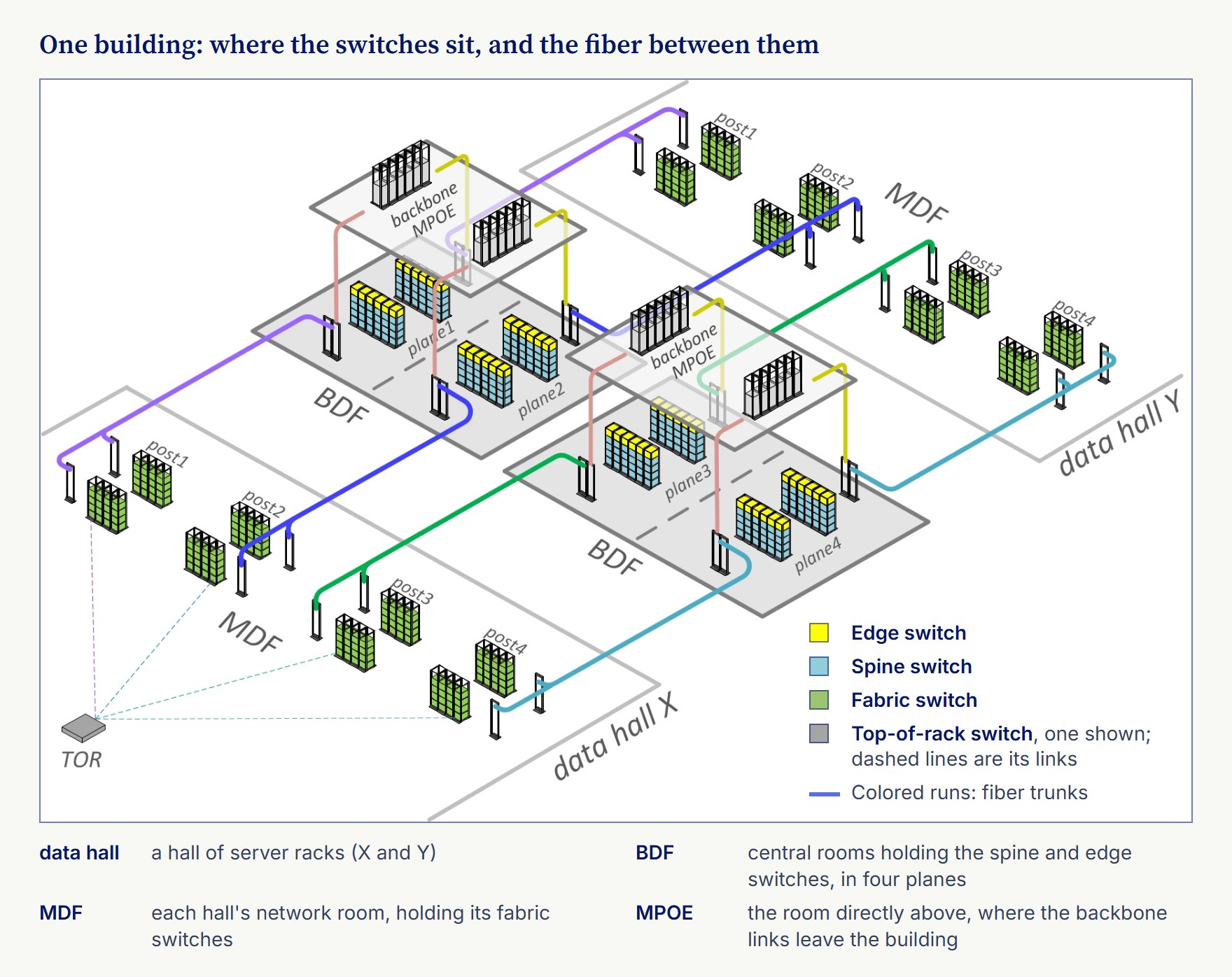
Joining them takes a great many network switches, stacked in layers. At the top of almost every rack sits a top-of-rack switch that links the servers in that rack. A layer above joins the racks of one zone, and more layers join the zones to each other and, finally, to the internet. Meta’s published design, shown below, groups 48 racks into a pod served by four fabric switches, and joins every pod through four parallel planes of spine switches.7.8
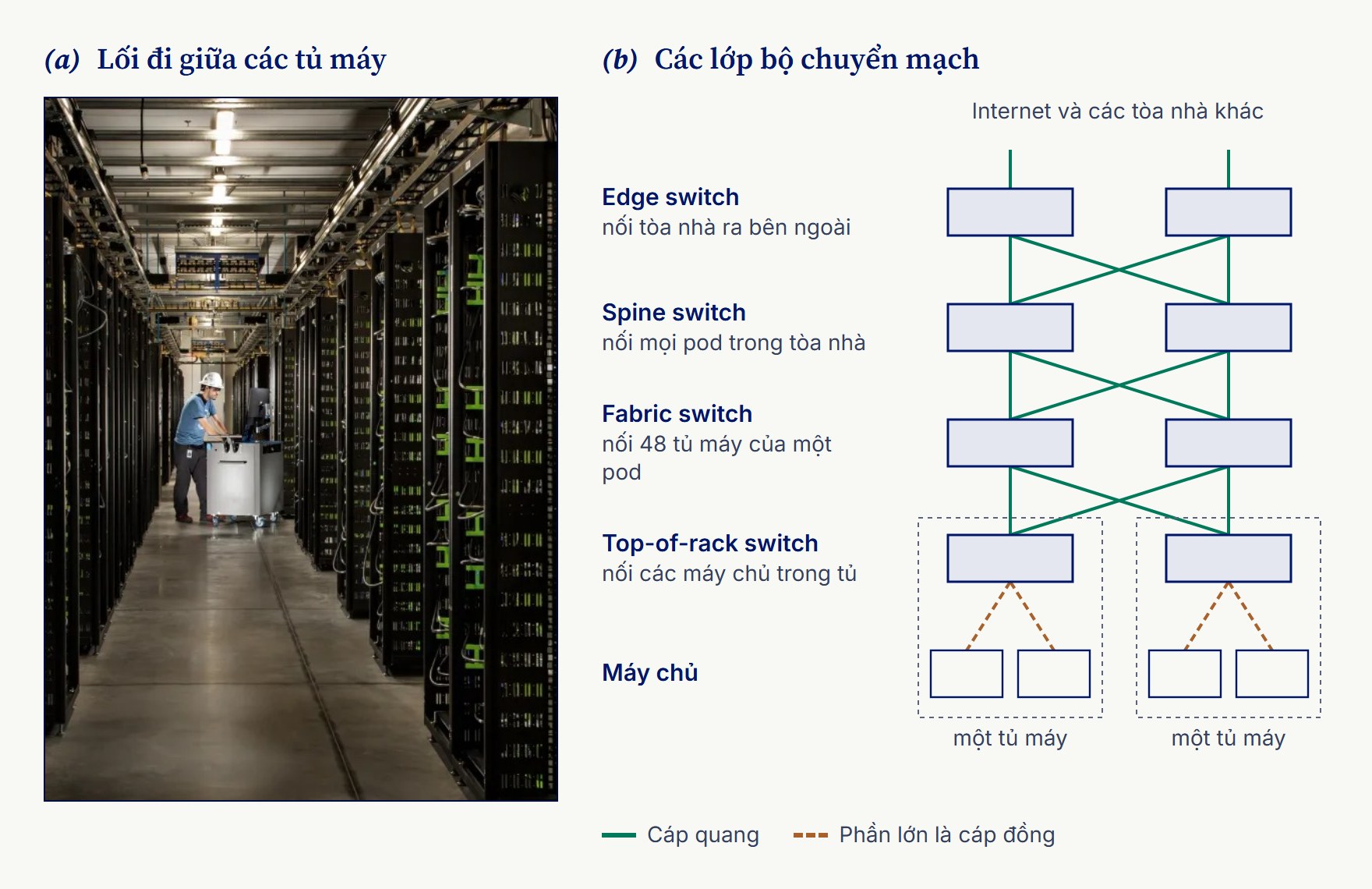
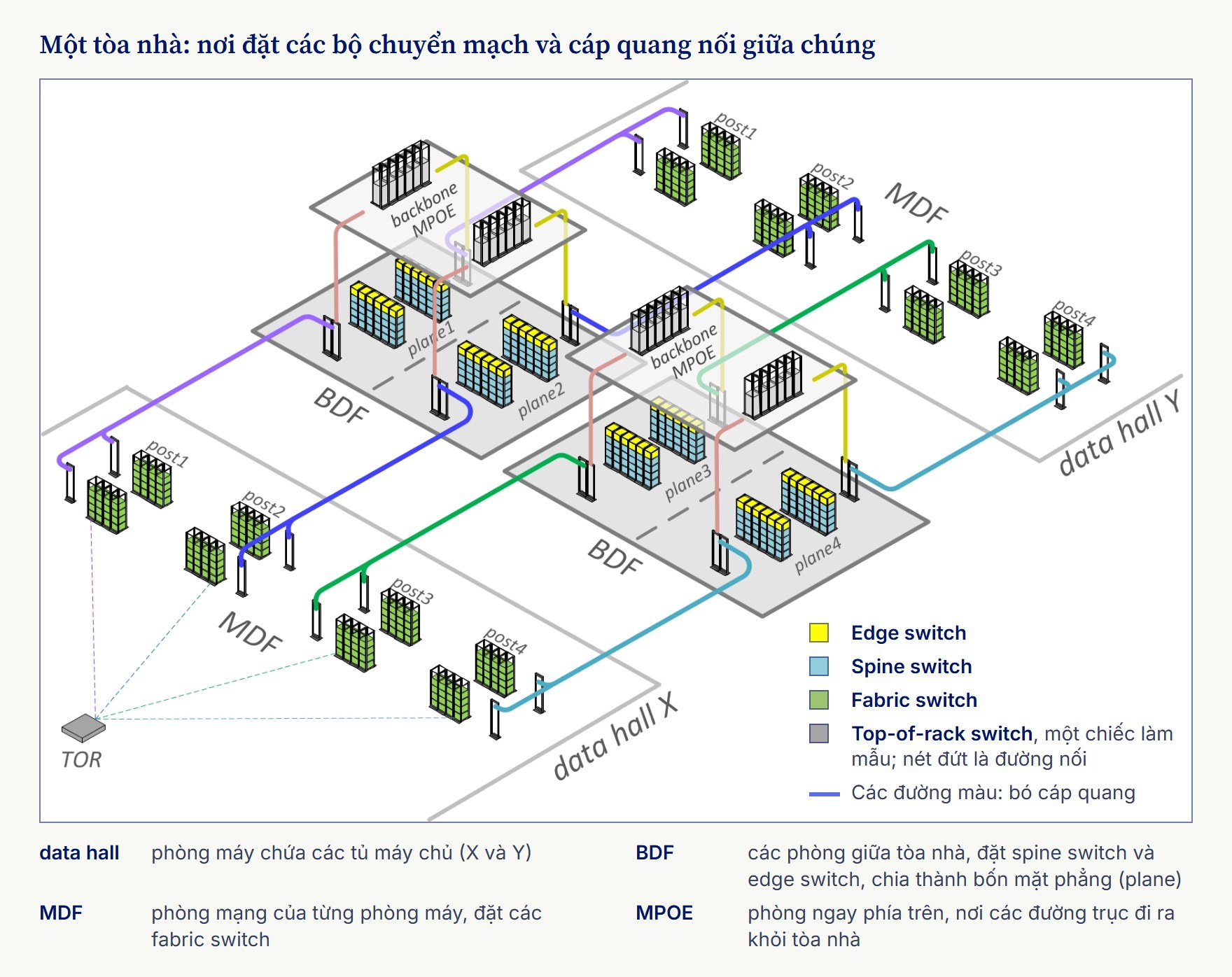
Để nối chừng ấy thiết bị cần rất nhiều bộ chuyển mạch, xếp thành nhiều lớp. Trên đỉnh gần như mọi tủ máy có một top-of-rack switch (bộ chuyển mạch đỉnh tủ) nối các máy chủ trong tủ ấy với nhau. Một lớp phía trên nối các tủ trong cùng một khu, rồi thêm những lớp nữa nối các khu với nhau và cuối cùng ra Internet. Hình dưới đây là thiết kế Meta đã công bố. Cứ 48 tủ máy gom thành một pod do bốn fabric switch phục vụ, rồi mọi pod nối với nhau qua bốn nhóm spine switch song song, độc lập với nhau, gọi là bốn mặt phẳng (plane).7.8
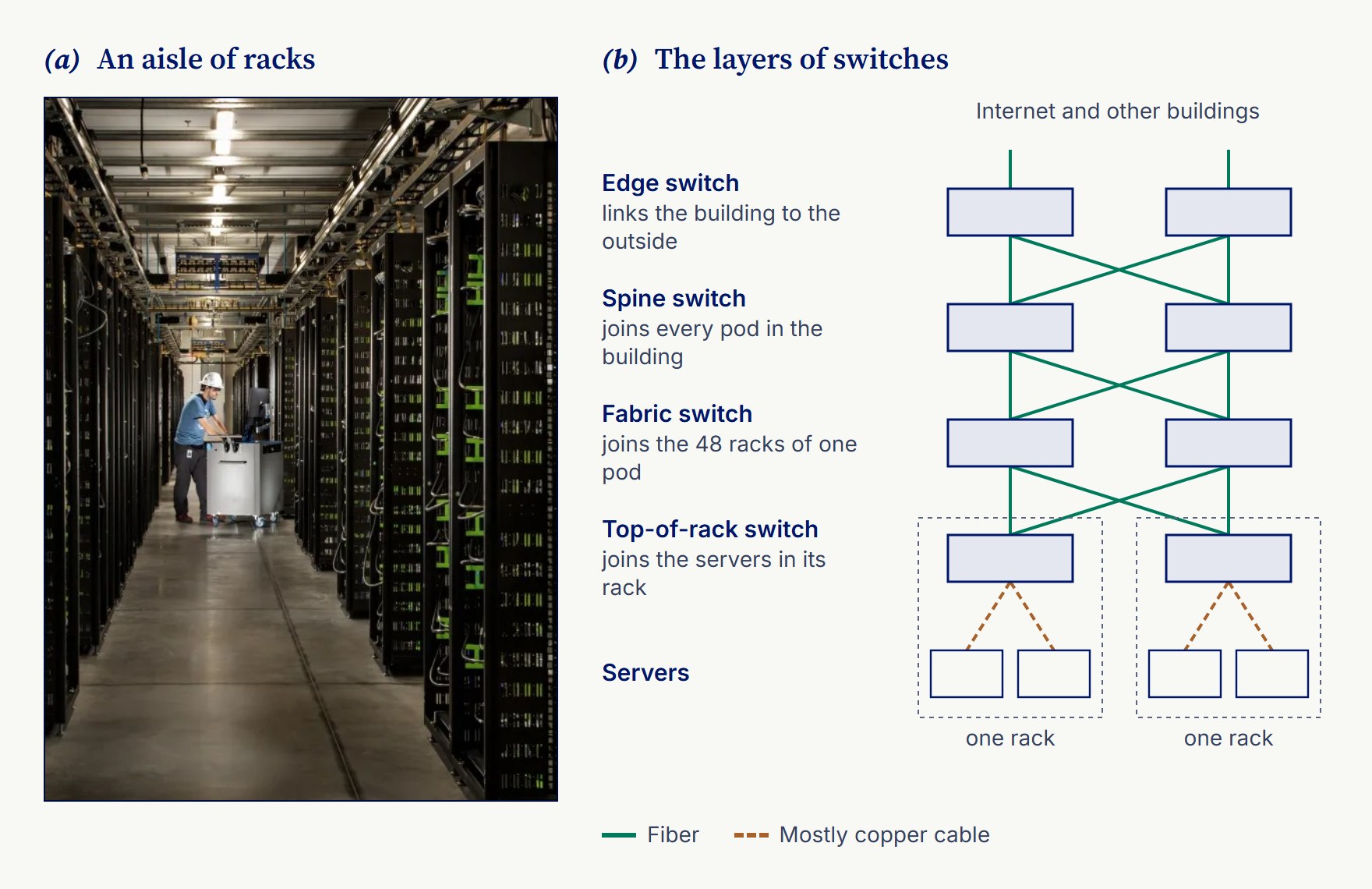
In a design like Meta’s, every link between those layers is fiber. Only inside the rack, from the top-of-rack switch down to the servers below it, does most wiring still use copper. The fiber runs are short, from a few tens of meters to a few kilometers at most, but the number of links is enormous, so a single data center holds a staggering length of fiber.
Trong một thiết kế như của Meta, mọi đường nối giữa các lớp ấy đều là cáp quang. Chỉ trong lòng tủ máy, từ top-of-rack switch xuống các máy chủ bên dưới, phần lớn dây vẫn là dây đồng. Các tuyến cáp quang không dài, từ vài chục mét đến nhiều nhất vài cây số, nhưng số đường nối thì khổng lồ, nên tổng chiều dài cáp quang trong riêng một trung tâm dữ liệu lớn đến kinh ngạc.
| Layer | What it joins | What the link runs on |
|---|---|---|
| Inside the rack | Servers to the top-of-rack switch | Mostly copper cable |
| Rack to zone | Top-of-rack switches to the fabric switches of their pod | Fiber |
| Zone to zone | Fabric switches to the spine switches of the building | Fiber |
| Out of the building | Spine and edge switches to other buildings and the internet | Fiber |
| Lớp | Nối những gì | Loại dây |
|---|---|---|
| Trong tủ máy | Máy chủ với top-of-rack switch | Phần lớn là cáp đồng |
| Từ tủ lên khu | Các top-of-rack switch với các fabric switch của pod | Cáp quang |
| Giữa các khu | Các fabric switch với các spine switch của tòa nhà | Cáp quang |
| Ra khỏi tòa nhà | Spine switch và edge switch với các tòa nhà khác và Internet | Cáp quang |
A data center uses two kinds of fiber
Trung tâm dữ liệu dùng hai loại sợi quang
Not all of that fiber is the same. Single-mode fiber is exactly the kind laid under the sea: a core only about 8 to 9 micrometers across, so the light follows a single path and can go far at high speed. Multimode fiber has a wider core that carries many rays of light at once. Its light sources and receivers are cheaper, but the rays spread out as they travel, so it serves only short runs: the current standard carries 400 Gb/s up to about 100 meters.7.9
Không phải sợi quang nào cũng như nhau. Single-mode fiber (sợi quang đơn mode) chính là loại được thả dưới đáy biển: lõi chỉ rộng khoảng 8 đến 9 micromet, nên ánh sáng đi theo một đường duy nhất và có thể đi xa ở tốc độ cao. Multimode fiber (sợi quang đa mode) có lõi rộng hơn, dẫn nhiều tia sáng cùng lúc. Nguồn sáng và bộ thu dùng cho nó rẻ hơn, nhưng các tia tản ra dần khi truyền đi, nên nó chỉ hợp với những đoạn ngắn: chuẩn hiện hành cho phép truyền 400 Gb/s trên quãng tới khoảng 100 mét.7.9
| Single-mode fiber | Multimode fiber | |
|---|---|---|
| Core | About 8 to 9 micrometers | Much wider, typically 50 micrometers |
| How the light travels | One path | Many rays at once |
| Cost of the parts at each end | Higher | Lower |
| Reach | Kilometers and far beyond | Short runs, around a hundred meters at today’s top speeds |
| Where it is used | Between buildings, across the sea, and long runs inside | Short links inside a hall |
| Sợi đơn mode | Sợi đa mode | |
|---|---|---|
| Lõi | Khoảng 8 đến 9 micromet | Rộng hơn nhiều, thường khoảng 50 micromet |
| Ánh sáng đi thế nào | Theo một đường | Nhiều tia cùng lúc |
| Giá linh kiện ở hai đầu | Cao hơn | Thấp hơn |
| Tầm xa | Nhiều km trở lên | Đoạn ngắn, khoảng một trăm mét ở tốc độ cao nhất hiện nay |
| Dùng ở đâu | Giữa các tòa nhà, xuyên đại dương, và các tuyến dài bên trong | Các đường nối ngắn trong một phòng máy |
Is InfiniBand different from Ethernet?InfiniBand có khác Ethernet không?
InfiniBand is another networking standard, built like Ethernet for moving data between machines but tuned for supercomputers and AI clusters, where every microsecond of delay counts. NVIDIA uses it widely to link servers full of its GPUs, and its fastest generation runs at 800 Gb/s end to end.7.10 At that speed, depending on the distance, a link can still be copper over a short span or fiber over a longer one.
InfiniBand là một chuẩn mạng khác, cũng dùng để chuyển dữ liệu giữa các máy như Ethernet, nhưng được tinh chỉnh cho siêu máy tính và cụm máy AI, nơi độ trễ dù chỉ một micro giây cũng đáng kể. NVIDIA dùng nó rộng rãi để nối các máy chủ chứa GPU của hãng, và thế hệ nhanh nhất của nó đạt 800 Gb/s từ đầu đến cuối đường truyền.7.10 Ở tốc độ ấy, tùy khoảng cách, đường nối vẫn có thể là dây đồng nếu ngắn, hoặc cáp quang nếu dài hơn.
Where does copper hit its limit?Giới hạn của dây đồng nằm ở đâu?
At 800 Gb/s a copper cable still works across a rack, over a meter or so; at 1.6 Tb/s and beyond its reach gets shorter still. So the faster the link, the closer the optics must sit to the chip that makes the signal, like bringing the highway right up to the house. The next chapter follows that move all the way to the switch chip.
Ở 800 Gb/s, cáp đồng vẫn dùng được trong phạm vi một tủ máy, quãng chừng một mét; từ 1,6 Tb/s trở lên, tầm xa của nó còn ngắn hơn nữa. Vì vậy đường truyền càng nhanh thì phần quang càng phải đặt sát con chip tạo ra tín hiệu, giống như đưa đường cao tốc vào tận cửa nhà. Chương sau sẽ đi tiếp con đường ấy, tới tận con chip chuyển mạch.