Chapter 1 of 10Chương 1/10 6 min6 phút
Why light?Vì sao là ánh sáng?
Light carries the internet under the oceans, unlocks a phone when it recognizes a face, and lights the room you are reading in. Most of the time nobody notices it at work, and that is the first thing worth knowing about the field this book follows: it is already everywhere.
Ánh sáng truyền tải dữ liệu Internet dưới đáy đại dương, mở khóa điện thoại khi nhận ra khuôn mặt chủ nhân, và thắp sáng căn phòng bạn đang ngồi đọc. Phần lớn thời gian chẳng ai để ý đến nó, và đó là điều đầu tiên nên biết về lĩnh vực mà cuốn sách này lần theo: nó đã có mặt ở khắp nơi.
In this chapter
Trong chương này
- Five everyday devices that run on light, including the one that carries the internet
- How three centuries of experiments settled what light is: a wave that also comes in particles
- Where visible light sits among all the electromagnetic waves, from gamma rays to radio
- Why white LED bulbs had to wait for a new semiconductor, and a Nobel Prize
- How large the field built on light has grown
- Năm thiết bị quen thuộc chạy bằng ánh sáng, trong đó có thứ truyền tải cả Internet
- Ba thế kỷ thí nghiệm đã xác định bản chất ánh sáng ra sao: vừa là sóng, vừa là hạt
- Ánh sáng nhìn thấy nằm ở đâu giữa muôn vàn sóng điện từ, từ tia gamma đến sóng vô tuyến
- Vì sao bóng đèn LED trắng phải chờ một chất bán dẫn mới và một công trình đoạt giải Nobel
- Lĩnh vực dựa trên ánh sáng đã lớn đến mức nào
Light is already in your pocket
Ánh sáng đã ở ngay trong túi bạn
Anyone with a phone relies on light all day. The science and technology of making, guiding, controlling and detecting light is called photonics. Its name comes from the photon, the particle of light, and it does with light what electronics does with electric current.
Người nào có điện thoại cũng dựa vào ánh sáng suốt cả ngày. Khoa học và công nghệ tạo ra, dẫn truyền, điều khiển và thu nhận ánh sáng có tên là quang tử học (photonics). Tên gọi này bắt nguồn từ photon, hạt của ánh sáng: điện tử học làm việc với dòng điện thế nào thì quang tử học làm việc với ánh sáng như thế.
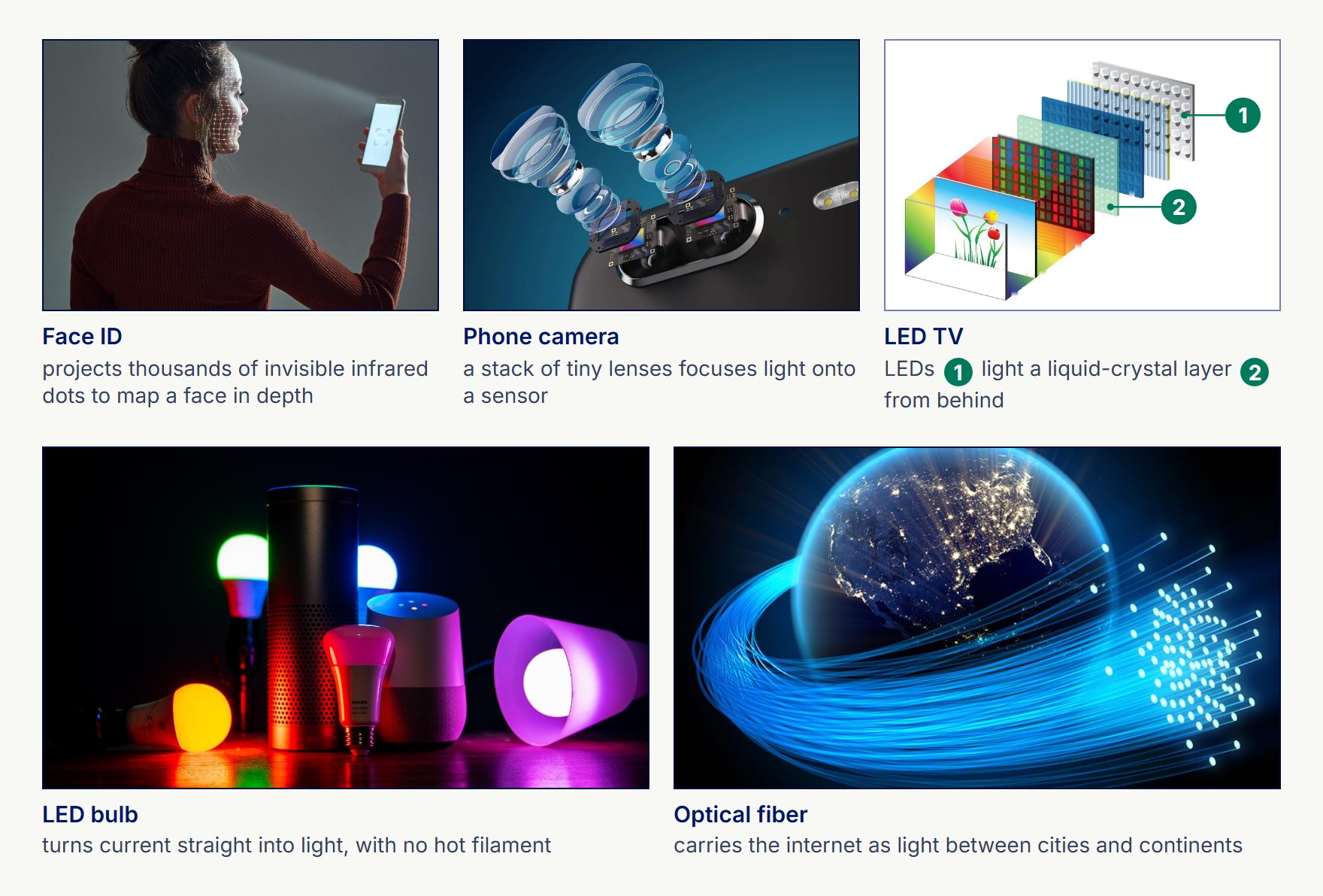
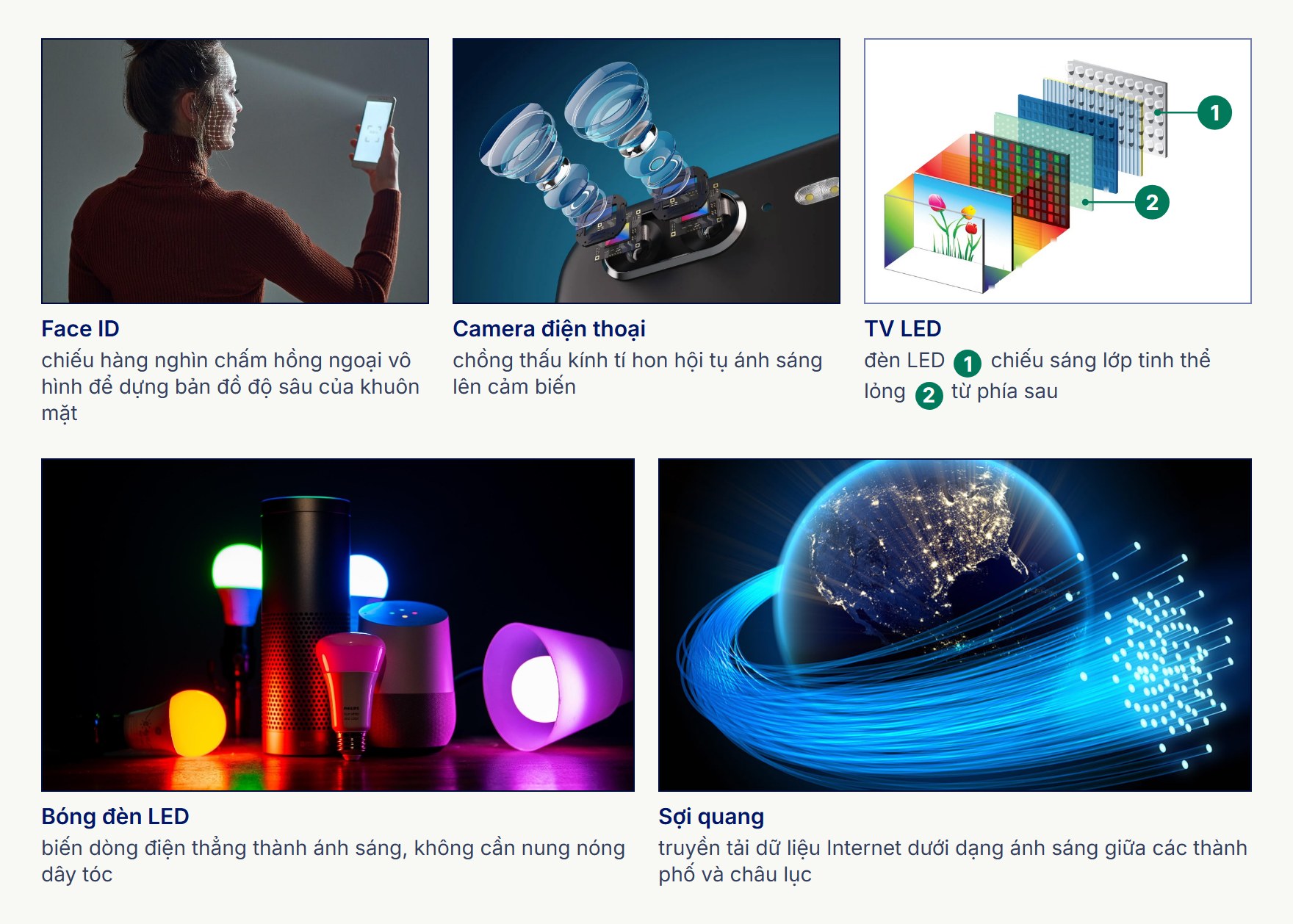
Start with the phone. Face ID unlocks an iPhone by projecting thousands of invisible dots onto a face, then reading back a map of its depth and an infrared image.1.1 Every phone camera is a stack of tiny lenses that focuses light onto a sensor, which turns the light into an electrical picture. At home, an LED TV is a liquid-crystal screen lit from behind by a panel of light-emitting diodes (LEDs), and the bulbs overhead have gone the same way. The old bulb heated a tungsten filament until it glowed; an LED bulb turns current straight into light. The fifth example is the one used most and seen least: the optical fiber that carries the internet between cities, countries and continents.
Hãy bắt đầu từ chiếc điện thoại. Face ID mở khóa iPhone bằng cách chiếu hàng nghìn chấm sáng vô hình lên khuôn mặt, rồi thu về bản đồ độ sâu và một ảnh hồng ngoại của khuôn mặt ấy.1.1 Camera nào trên điện thoại cũng là một chồng thấu kính tí hon hội tụ ánh sáng lên cảm biến, và cảm biến chuyển ánh sáng thành một bức ảnh bằng tín hiệu điện. Ở nhà, TV LED thực chất là màn hình tinh thể lỏng có một tấm đèn LED chiếu sáng từ phía sau, còn bóng đèn trên trần cũng đã chuyển sang LED. Bóng đèn ngày xưa nung nóng sợi tóc wolfram cho đến khi nó phát sáng; bóng đèn LED biến dòng điện thẳng thành ánh sáng. Ví dụ thứ năm là thứ người ta dùng nhiều nhất mà lại ít ai nhìn thấy nhất: sợi quang, thứ truyền tải dữ liệu Internet giữa các thành phố, các quốc gia và các châu lục.
That last example is a good place to test an instinct.
Ví dụ cuối cùng ấy đáng để bạn thử đoán một chút.
Quick questionThử đoán xem
What is the optical fiber used in telecommunications made of?Cáp quang viễn thông được làm từ vật liệu gì?
Show the answerXem đáp án
Glass or clear plastic, and for long-distance links, very pure glass. A standard telecom fiber is only 125 micrometers across, an eighth of a millimeter, about the thickness of a human hair.1.2 No electricity flows along it. The data travels as light, held inside the glass all the way, and chapter 5 shows how.
Thủy tinh hoặc nhựa trong suốt, và với các tuyến truyền dẫn đường dài thì là thủy tinh rất tinh khiết. Một sợi quang viễn thông tiêu chuẩn chỉ dày 125 micromet, tức một phần tám milimet, cỡ một sợi tóc.1.2 Không có dòng điện nào chạy dọc sợi ấy. Dữ liệu đi dưới dạng ánh sáng, được giam trong lòng sợi thủy tinh suốt quãng đường, và chương 5 sẽ giải thích cách nó diễn ra.
Light is both a wave and a particle
Ánh sáng vừa là sóng, vừa là hạt
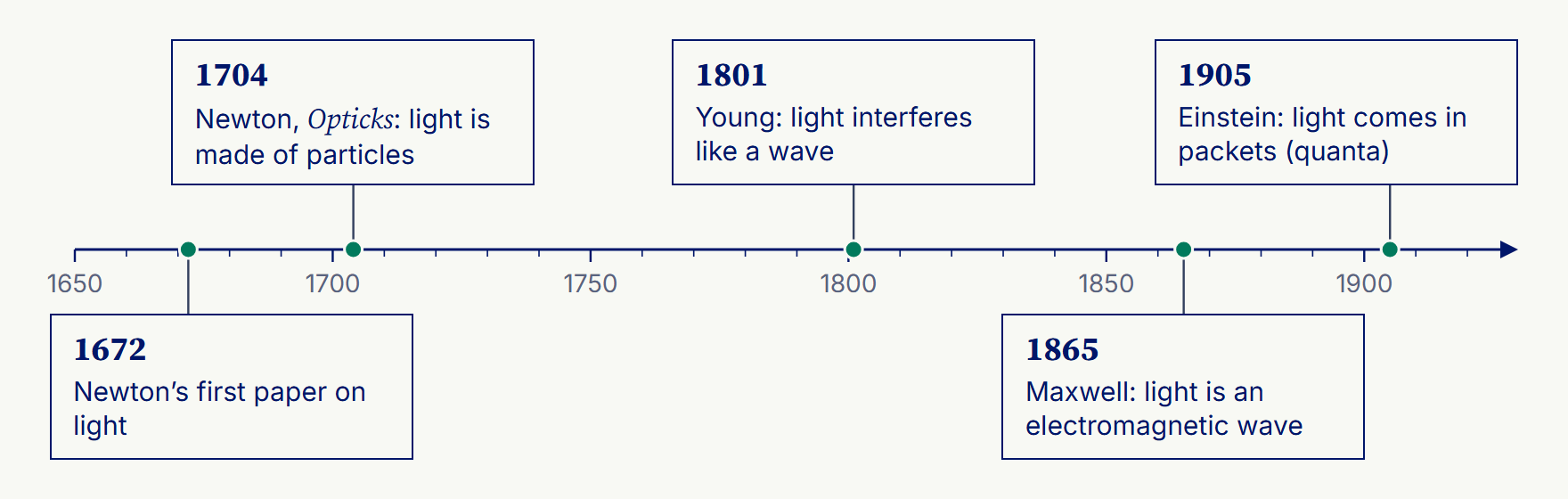
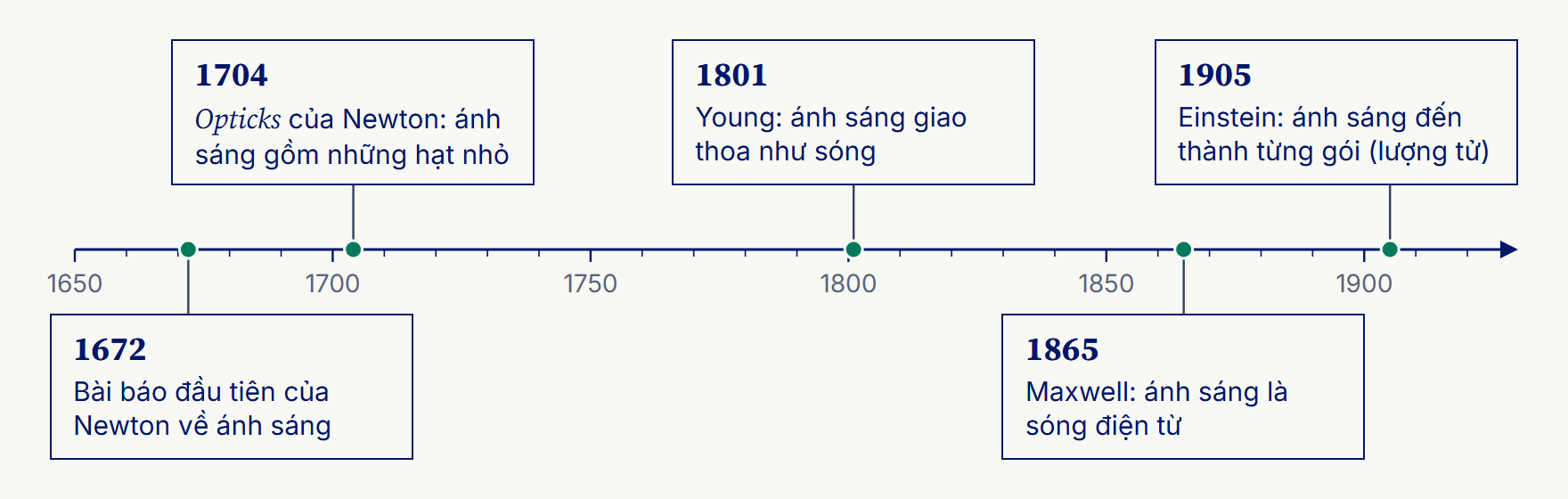
People argued for centuries over whether light is a wave or a stream of particles, and the answer turned out to be stranger than either side expected. Isaac Newton began publishing on light in 1672, with a paper on how a prism splits white light into colors, and in his book Opticks (1704) he argued that light is made of tiny particles.1.3
Suốt nhiều thế kỷ, người ta tranh luận xem ánh sáng là sóng hay là dòng hạt, và câu trả lời cuối cùng lạ lùng hơn cả những gì hai phe từng nghĩ. Isaac Newton bắt đầu công bố nghiên cứu về ánh sáng từ năm 1672, với một bài báo về cách lăng kính tách ánh sáng trắng thành các màu. Đến cuốn Opticks (1704), ông cho rằng ánh sáng gồm những hạt vô cùng nhỏ.1.3
A century later the wave view came back. In 1801 Thomas Young showed that light interferes like a wave: where two beams overlap they can add up to brightness or cancel into darkness, the way ripples on a pond do.1.4 In 1865 James Clerk Maxwell showed that light is an electromagnetic wave, an electric field and a magnetic field oscillating together as they travel through space.1.5
Một thế kỷ sau, quan điểm sóng quay trở lại. Năm 1801, Thomas Young chỉ ra rằng ánh sáng giao thoa giống như sóng. Ở chỗ hai chùm sáng chồng lên nhau, chúng có thể cộng lại thành vệt sáng hoặc triệt tiêu nhau thành vệt tối, như những gợn sóng trên mặt ao.1.4 Năm 1865, James Clerk Maxwell chứng minh ánh sáng là sóng điện từ: một điện trường và một từ trường cùng dao động khi lan đi trong không gian.1.5
Then, in 1905, Albert Einstein proposed that light also comes in packets, or quanta, each carrying a fixed amount of energy. The idea explained how light knocks electrons out of a metal, the photoelectric effect, and it is the discovery his 1921 Nobel Prize names.1.6 Those packets are now called photons.
Rồi đến năm 1905, Albert Einstein cho rằng năng lượng ánh sáng còn được chia thành từng “gói”, hay lượng tử, mỗi gói mang một lượng năng lượng xác định. Ý tưởng này giải thích vì sao ánh sáng bứt được electron ra khỏi kim loại, tức hiệu ứng quang điện. Giải Nobel năm 1921 được trao cho ông chính vì phát hiện này.1.6 Ngày nay, người ta gọi những gói ánh sáng ấy là photon.
So light is both. It travels as a wave and arrives as particles, a double nature physicists call wave-particle duality. For this book the particle side matters most: a photon is to light what an electron is to electric current. Electronics moves electrons around; photonics moves photons.
Vậy ánh sáng là cả hai. Nó lan đi như sóng và đến nơi thành từng hạt, bản chất kép mà các nhà vật lý gọi là lưỡng tính sóng hạt. Với cuốn sách này, mặt hạt quan trọng hơn cả: photon đối với ánh sáng cũng như electron đối với dòng điện. Điện tử học điều khiển electron, còn quang tử học điều khiển photon.
The human eye sees only a narrow band of the spectrum
Mắt người chỉ thấy một dải hẹp trong phổ điện từ
Maxwell’s result put light into a much larger family, and the human eye sees only a narrow band of it. Radio waves, microwaves, infrared, visible light, ultraviolet, X-rays and gamma rays are all electromagnetic waves, and they differ only in their wavelength, the distance from one crest of the wave to the next. Lined up by wavelength they form the electromagnetic spectrum. At one end gamma rays have the shortest wavelengths and the most energy; at the other, radio waves run from the length of a football to wider than the Earth.1.7, 1.8
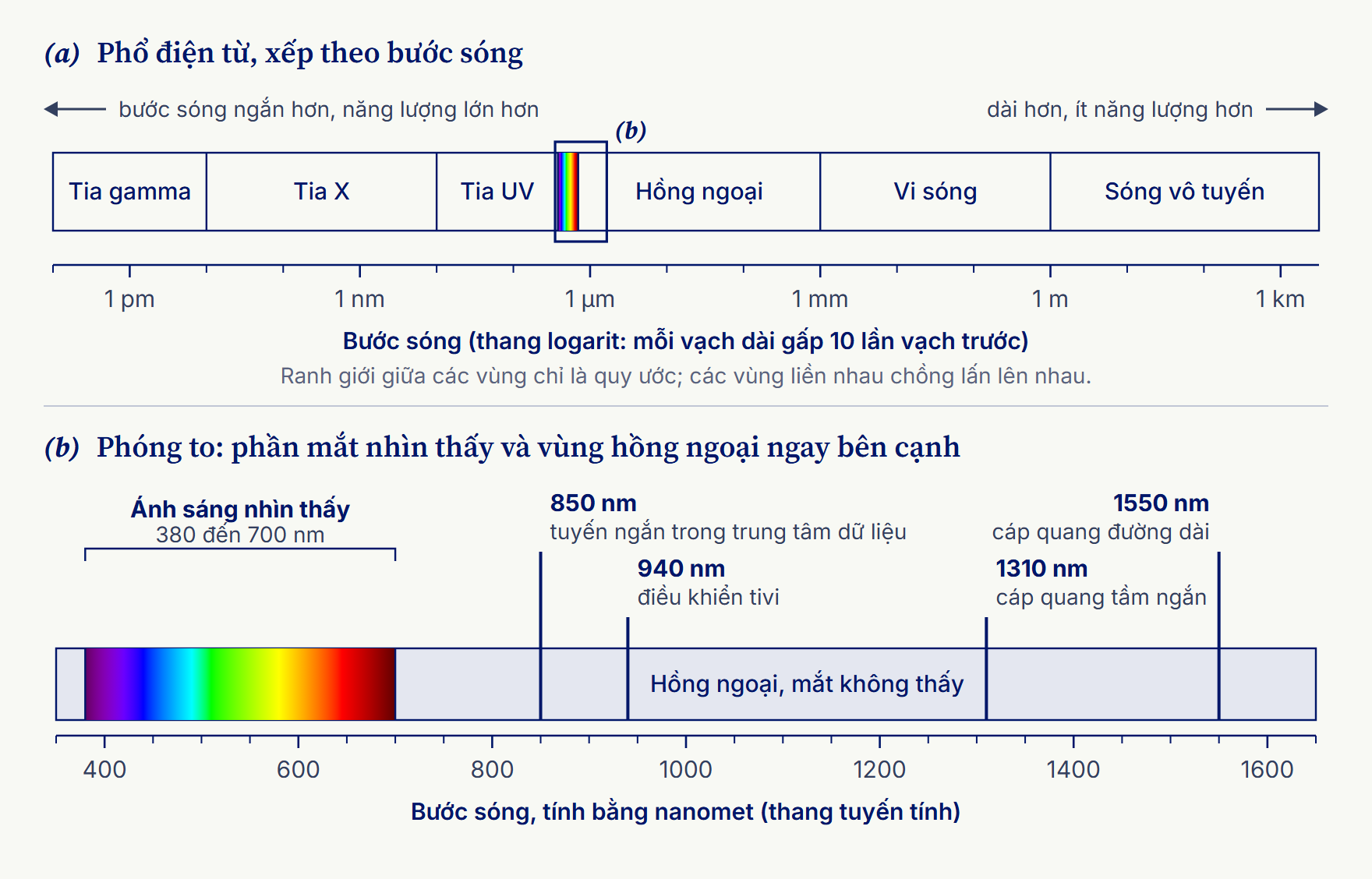
Kết quả của Maxwell xếp ánh sáng vào một “đại gia đình” lớn hơn nhiều, và mắt người chỉ thấy được một dải hẹp trong đó. Sóng vô tuyến, vi sóng, hồng ngoại, ánh sáng nhìn thấy, tử ngoại, tia X và tia gamma đều là sóng điện từ, chỉ khác nhau ở bước sóng, tức khoảng cách giữa hai đỉnh sóng liền nhau. Xếp theo bước sóng, chúng tạo thành phổ điện từ. Ở một đầu là tia gamma, với bước sóng ngắn nhất và năng lượng lớn nhất. Ở đầu kia là sóng vô tuyến, bước sóng dài từ cỡ một quả bóng đến lớn hơn cả Trái Đất.1.7, 1.8
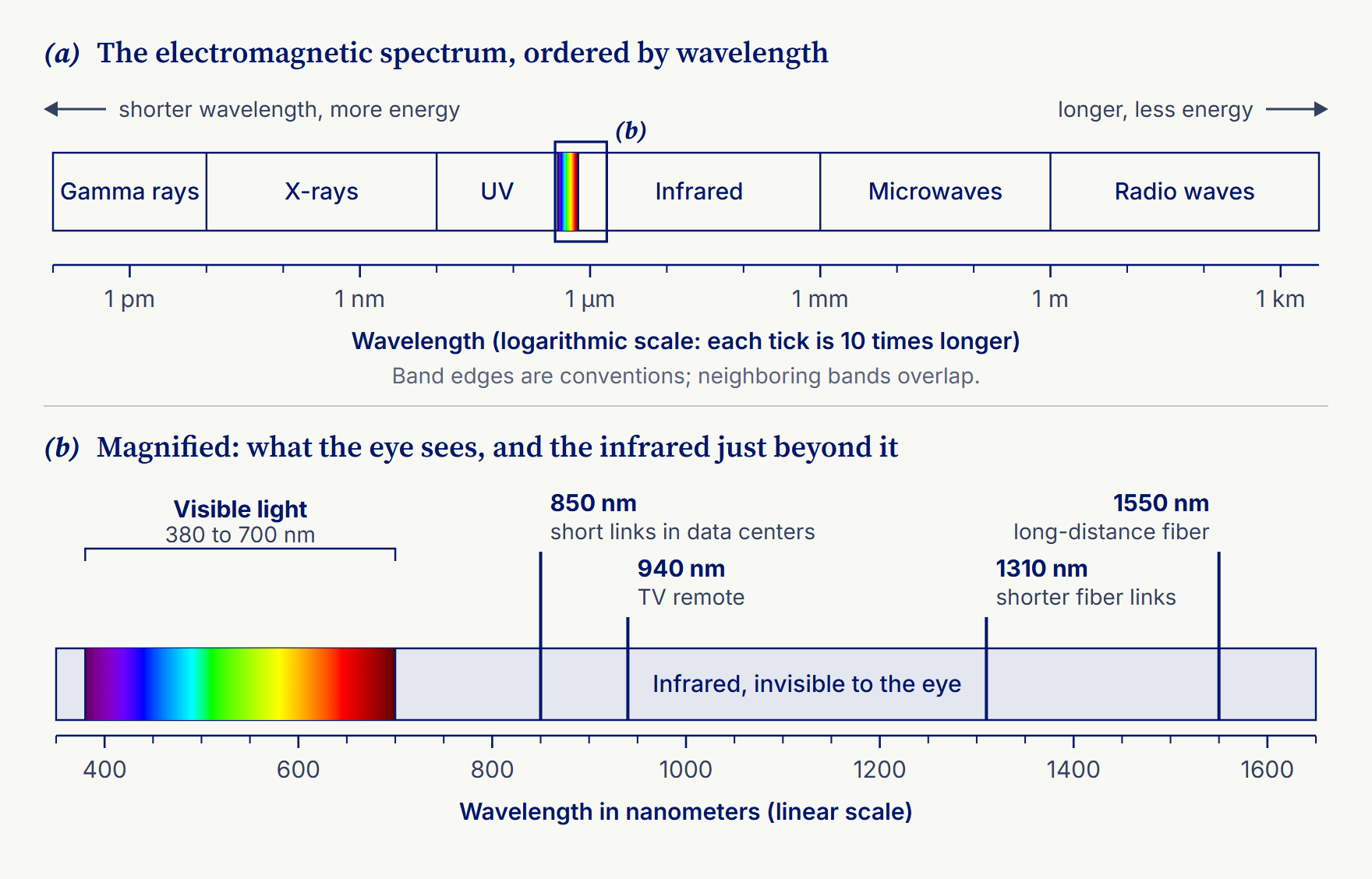
The eye’s slice covers wavelengths from about 380 to 700 nanometers (billionths of a meter). Inside the slice, wavelength is color: violet is the shortest and red the longest.1.9 The shorter the wavelength, the more energy each photon carries.
Phần mắt người thấy được là các bước sóng từ khoảng 380 đến 700 nanomet (một nanomet bằng một phần tỷ mét). Trong khoảng ấy, bước sóng chính là màu sắc: tím có bước sóng ngắn nhất, đỏ dài nhất.1.9 Bước sóng càng ngắn thì mỗi photon mang càng nhiều năng lượng.
Much of photonics works just outside that slice. A TV remote talks to the set in infrared, at about 940 nanometers,1.10 and Face ID’s dots are infrared too. So is the light inside an optical fiber. It comes from a laser, a source that gives a narrow beam of almost a single wavelength, and the internet runs on infrared wavelengths chosen for a reason chapter 5 explains.
Phần lớn các ứng dụng quang tử lại nằm ngay bên ngoài khoảng ấy. Chiếc điều khiển từ xa “nói chuyện” với tivi bằng tia hồng ngoại ở bước sóng khoảng 940 nanomet,1.10 và các chấm sáng của Face ID cũng là hồng ngoại. Ánh sáng bên trong sợi quang cũng vậy. Nó đến từ laser, nguồn sáng cho một chùm tia hẹp gần như chỉ có một bước sóng, và Internet chạy trên những bước sóng hồng ngoại được chọn vì một lý do mà chương 5 sẽ giải thích.
Color also explains one of the long puzzles of modern lighting. Red and green LEDs had been around for decades, but white light needs blue as well, and for about thirty years nobody could make a bright blue LED.1.11
Màu sắc cũng lý giải một bài toán từng làm khó ngành chiếu sáng hiện đại suốt nhiều năm. LED đỏ và LED xanh lục đã có từ nhiều thập niên. Nhưng muốn có ánh sáng trắng thì phải có cả màu xanh lam, và suốt chừng ba mươi năm không ai làm nổi một con LED xanh lam đủ sáng.1.11
Quick questionThử đoán xem
So which semiconductor are the white LED bulbs in your home made of?Vậy bóng đèn LED trắng trong nhà bạn được làm từ chất bán dẫn nào?
Show the answerXem đáp án
GaN, or gallium nitride. In the early 1990s Isamu Akasaki, Hiroshi Amano and Shuji Nakamura made the first efficient blue LEDs from it, work that won the 2014 Nobel Prize in Physics. A white LED bulb uses that blue light to make a phosphor coating glow yellow, or red and green, and the colors mix into white. Sapphire is a fair guess, since GaN is often grown on a sapphire base, but the sapphire itself makes no light.1.11 Silicon and germanium, the classic chip materials, give off light very poorly.1.12
GaN, tức gallium nitride (GaN). Đầu những năm 1990, Isamu Akasaki, Hiroshi Amano và Shuji Nakamura làm ra những con LED xanh lam hiệu suất cao đầu tiên từ vật liệu này, và nhờ đó nhận giải Nobel Vật lý năm 2014. Bóng đèn LED trắng dùng chính ánh sáng xanh lam ấy kích thích một lớp phosphor phát ra màu vàng, hoặc màu đỏ và xanh lục, rồi các màu hòa vào nhau thành ánh sáng trắng. Chọn sapphire cũng có lý, vì người ta thường nuôi GaN trên một lớp đế sapphire, nhưng bản thân sapphire không phát ra ánh sáng.1.11 Còn silicon và germanium, hai vật liệu làm chip kinh điển, phát sáng rất kém.1.12
Photonics is bigger than it looks
Ngành quang tử lớn hơn ta tưởng
Beyond the phone and the living room, photonics runs through industrial machines that cut and weld with lasers, medical and biological instruments, food and nutrition testing, security and defense, quantum technology and the sensors of self-driving cars. Above all, it runs through telecommunications.
Ngoài chiếc điện thoại và phòng khách, quang tử học còn có mặt trong máy móc công nghiệp cắt và hàn bằng laser, trong thiết bị y tế và sinh học, trong kiểm nghiệm thực phẩm và dinh dưỡng, trong an ninh quốc phòng, công nghệ lượng tử và hệ thống cảm biến của xe tự lái. Và trên hết, nó có mặt trong ngành viễn thông.
Put a price on all of it and the figure depends on who is counting, but every count is large. The Photonics21 industry platform put the world photonics market at about $865 billion in 2022, close to a trillion US dollars a year, after growth of about 7% a year since 2019.1.13
Nếu định giá tất cả những thứ đó, con số sẽ tùy vào cách mỗi bên thống kê, nhưng cách nào cũng cho ra một con số lớn. Theo nền tảng công nghiệp Photonics21, năm 2022 thị trường quang tử thế giới đạt khoảng 865 tỷ đô la, gần một nghìn tỷ đô la Mỹ mỗi năm. Từ năm 2019 đến 2022, thị trường này tăng trung bình khoảng 7% mỗi năm.1.13
Chips are where the field is heading. For more than sixty years electronics has packed ever more transistors onto a sliver of silicon. Photonics is now doing the same with light, building lasers, light guides and photodetectors side by side on one chip. The next chapter opens one up.
Chip là hướng đi của ngành này. Hơn sáu mươi năm qua, điện tử học đã nhồi ngày càng nhiều bóng bán dẫn (transistor) lên một mẩu silicon nhỏ. Giờ đây quang tử học đang làm điều tương tự với ánh sáng: đặt laser, đường dẫn sáng và bộ tách sóng quang (photodetector) cạnh nhau trên cùng một con chip. Chương sau sẽ mở một con chip như thế ra xem.