Chapter 8 of 10Chương 8/10 8 min8 phút
Light meets the switch chipÁnh sáng gặp chip chuyển mạch
One switch in an AI data center can move 51.2 terabits of data every second. That data is born as electricity inside the switch chip and leaves as light in a fiber, but on the way it still has to cross a stretch of copper. At today’s speeds that short stretch costs a surprising amount of power, and the newest switches are rebuilt around getting rid of it.
Một bộ chuyển mạch trong trung tâm dữ liệu (data center) AI có thể chuyển 51,2 terabit dữ liệu mỗi giây. Dữ liệu ấy sinh ra dưới dạng điện bên trong con chip chuyển mạch và rời đi dưới dạng ánh sáng trong sợi quang, nhưng dọc đường vẫn phải đi qua một đoạn dây đồng. Ở tốc độ ngày nay, đoạn ngắn ấy tốn điện đến bất ngờ, và những bộ chuyển mạch mới nhất được thiết kế lại chính là để loại bỏ nó.
In this chapter
Trong chương này
- What a pluggable optical module does, and why its trip across the circuit board is the problem
- Where the power goes, and why saving it pays twice
- How co-packaged optics moves the light right next to the switch chip
- The two problems still open: the light source and the heat
- Why radio waves cannot take fiber’s place inside a data center
- Module quang cắm rời làm gì, và vì sao quãng đường băng qua bo mạch của nó lại là vấn đề
- Điện năng đi đâu, và vì sao tiết kiệm được nó lại có hiệu quả kép
- Co-packaged optics đưa ánh sáng đến sát chip chuyển mạch như thế nào
- Hai bài toán vẫn còn bỏ ngỏ: nguồn sáng và nhiệt
- Vì sao sóng vô tuyến không thể thay cáp quang trong trung tâm dữ liệu
The module sits at the board's edge, far from the switch chip
Module quang cắm ở mép bo mạch, xa chip chuyển mạch
The part that turns electrical data into light and back is an optical transceiver. In most of today’s data centers it comes as pluggable optics: a module the size of a finger that slides into a port on the front panel of a network switch. At its heart is the modulator met in chapter 2, which writes the zeros and ones onto the light. The switch’s own brain is an application-specific integrated circuit (ASIC), a chip built to do one job, here forwarding data, and it sits in the middle of the circuit board. Between the two runs a trace of copper tens of centimeters long.
Bộ phận biến dữ liệu điện thành ánh sáng và ngược lại là bộ thu phát quang (optical transceiver). Trong phần lớn các trung tâm dữ liệu ngày nay, nó có dạng pluggable optics (module quang cắm rời): một module cỡ ngón tay cắm vào cổng ở mặt trước của bộ chuyển mạch. “Trái tim” của nó là modulator đã gặp ở chương 2, bộ phận ghi các số 0 và 1 lên ánh sáng. Còn “bộ não” của bộ chuyển mạch là một ASIC (application-specific integrated circuit), loại chip chuyên cho một nhiệm vụ, ở đây là chuyển tiếp dữ liệu, và nó nằm giữa bo mạch. Nối hai thứ ấy với nhau là một đường dây đồng dài vài chục centimet.
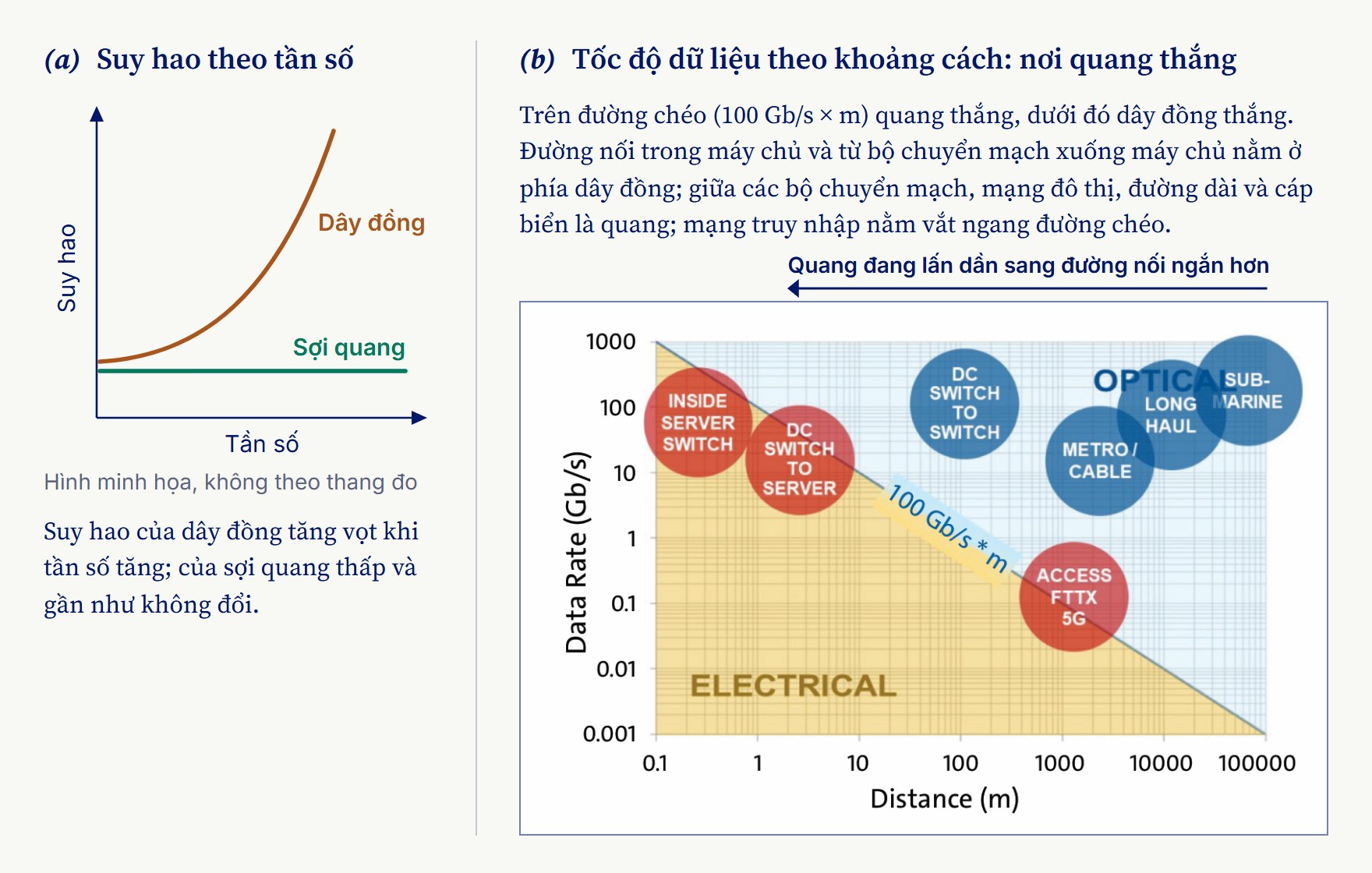
A few tens of centimeters sounds harmless, but, as chapter 7 showed, the faster the signal, the shorter the distance copper can carry it cleanly. The chart below puts that in one picture: the higher the data rate and the longer the distance, the sooner optics beat copper.8.1 Links inside a server and from a switch to the servers in its rack still sit on copper’s side of the line; everything longer has crossed to light.
Vài chục centimet nghe có vẻ vô hại, nhưng như chương 7 đã cho thấy, tín hiệu càng nhanh thì quãng đường dây đồng truyền được mà tín hiệu không bị méo càng ngắn. Biểu đồ dưới đây gói gọn điều đó trong một hình: tốc độ dữ liệu càng cao và khoảng cách càng xa thì ánh sáng càng sớm thắng dây đồng.8.1 Các đường nối bên trong máy chủ, và từ bộ chuyển mạch xuống các máy chủ trong cùng tủ, vẫn nằm ở phía của dây đồng; mọi đường dài hơn đều đã chuyển sang ánh sáng.
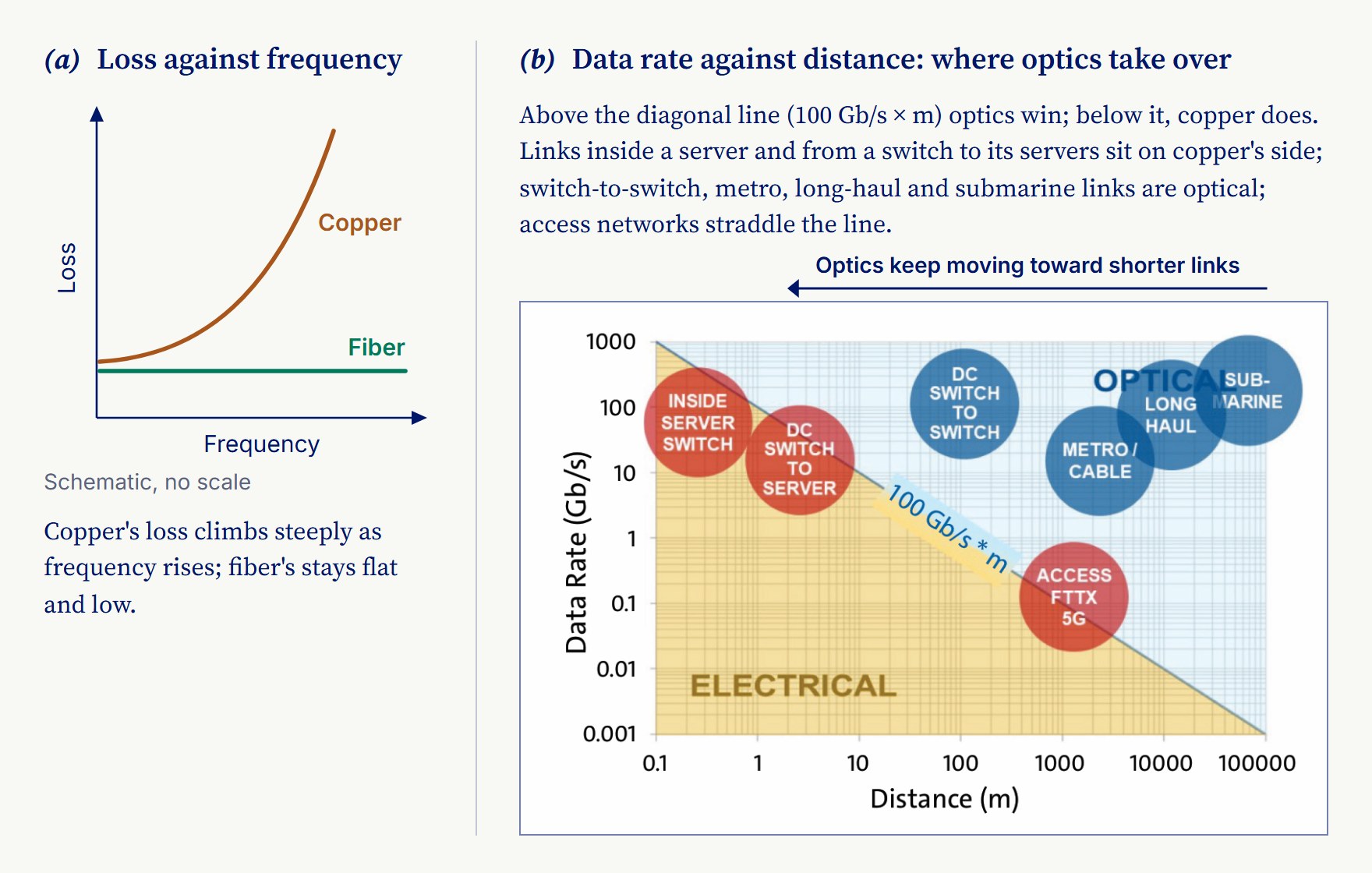
Slide the rate up below and watch copper’s reach collapse while fiber’s hardly moves. Each copper figure comes from a named cable type and its IEEE standard.
Hãy kéo tốc độ lên ở hình dưới đây và xem tầm xa của dây đồng tụt hẳn xuống, trong khi của cáp quang gần như không nhúc nhích. Mỗi con số của dây đồng đều gắn với một loại cáp cụ thể và chuẩn IEEE của nó.
| Data rateTốc độ | Copper reachTầm xa dây đồng | Fiber reachTầm xa cáp quang |
|---|---|---|
| 10 Gb/s | 100 m10GBASE-T, twisted-pair copper (Cat6a)10GBASE-T, cáp xoắn đôi bằng đồng (Cat6a) · IEEE 802.3an, 2006 | many kilometers, barely changes with speedhàng chục ki-lô-mét - gần như không đổi theo tốc độ |
| 100 Gb/s | 5 m100GBASE-CR4, passive copper twinax100GBASE-CR4, cáp đồng song trục thụ động · IEEE 802.3bj, 2014 | many kilometers, barely changes with speedhàng chục ki-lô-mét - gần như không đổi theo tốc độ |
| 400 Gb/s | 2 m400GBASE-CR8, passive copper twinax (minimum reach)400GBASE-CR8, cáp đồng song trục thụ động (tầm xa tối thiểu) · IEEE 802.3bs, 2017 | many kilometers, barely changes with speedhàng chục ki-lô-mét - gần như không đổi theo tốc độ |
| 800 Gb/s | well under 2 mdưới 2 m khá nhiều800GBASE-CR8, passive copper twinax800GBASE-CR8, cáp đồng song trục thụ động · IEEE 802.3df, 2024 - no single reach figure set | many kilometers, barely changes with speedhàng chục ki-lô-mét - gần như không đổi theo tốc độ |
| 1.6 Tb/s | shorter stillcòn ngắn hơn nữathe next copper generationthế hệ cáp đồng kế tiếp · IEEE 802.3dj - draft, not yet ratified | many kilometers, barely changes with speedhàng chục ki-lô-mét - gần như không đổi theo tốc độ |
So by the time the electrical signal reaches the front panel, it has already been blurred. Before the module can turn it into light, a digital signal processor (DSP) inside the module has to rebuild it, and it also prepares the signal for the optical side. Many modules are also still assembled from separate optical parts, which makes them large and hungry for power.
Vì vậy khi tín hiệu điện tới được mặt trước, nó đã bị méo. Trước khi module biến nó thành ánh sáng, một bộ xử lý tín hiệu số (DSP) bên trong module phải tái tạo lại tín hiệu, đồng thời chuẩn bị tín hiệu cho phía quang. Nhiều module còn lắp từ những linh kiện quang rời, nên vừa cồng kềnh vừa ngốn điện.
Where the power goes
Điện năng đi đâu
In a pluggable transceiver, the DSP that cleans up the electrical signal can use 40 to 50 percent of the module’s power.8.2 One module draws only a modest amount, but a large data center uses up to millions of them. And the faster the link, the harder the DSP has to work, or the harder the switch has to drive the signal, to get it across the board intact.
Trong một bộ thu phát quang cắm rời, riêng DSP làm sạch tín hiệu điện có thể dùng tới 40 đến 50 phần trăm điện năng của module.8.2 Mỗi module chỉ tốn một lượng điện vừa phải, nhưng một trung tâm dữ liệu lớn dùng đến hàng triệu module như thế. Đường truyền càng nhanh thì DSP càng phải làm việc vất vả hơn, hoặc bộ chuyển mạch càng phải phát tín hiệu mạnh hơn, để tín hiệu băng qua bo mạch mà vẫn nguyên vẹn.
Go back to that 51.2 Tb/s switch, the top speed of its generation; chips twice as fast began shipping in 2025.8.3 The power figures below are for the 51.2 Tb/s generation. Fitted with pluggable optics, the whole system draws around 2 kilowatts, and about half of that goes to the transceivers.8.4 That figure is for the whole box with its fans and power supplies; the switch chip itself is only part of it.
Quay lại với bộ chuyển mạch 51,2 Tb/s ở đầu chương, loại nhanh nhất cùng thế hệ; những chip nhanh gấp đôi đã bắt đầu xuất xưởng từ năm 2025.8.3 Các con số điện năng dưới đây là của thế hệ 51,2 Tb/s. Khi lắp các module quang cắm rời, cả hệ thống tiêu thụ khoảng 2 kilowatt, trong đó chừng một nửa dành cho các bộ thu phát quang.8.4 Con số ấy tính cho cả thiết bị, kể cả quạt và bộ nguồn; bản thân con chip chuyển mạch chỉ chiếm một phần.
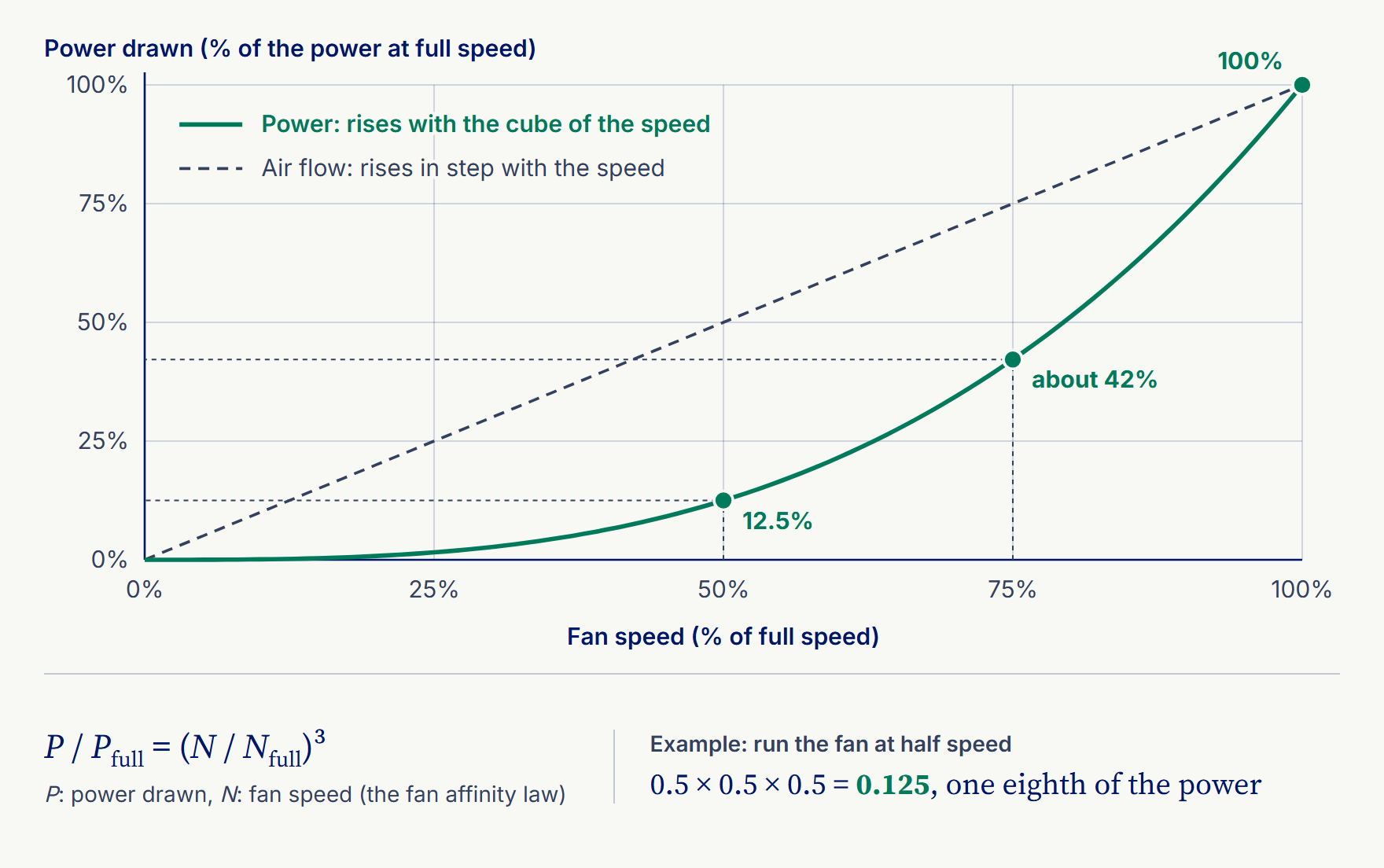
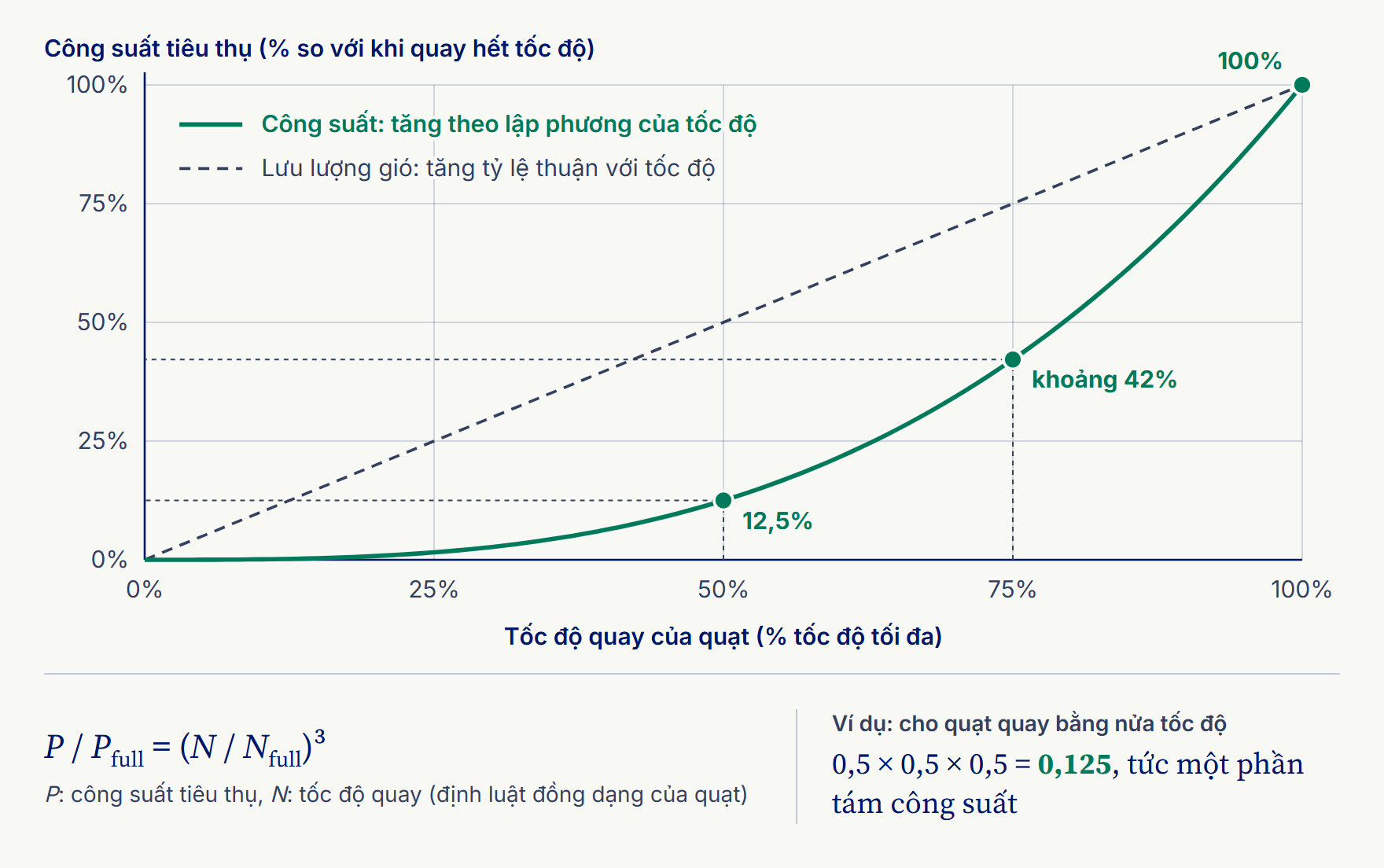
Saving that power pays twice. Every watt a module no longer draws is also a watt of heat that no longer has to be carried away, and cooling is a large bill of its own. Fans show why: their power rises with the cube of their speed, so a fan that can slow down saves far more than it seems.8.5
Tiết kiệm được phần điện ấy mang lại hiệu quả kép. Mỗi watt module không còn tiêu thụ cũng là một watt nhiệt không còn phải thải ra ngoài, mà làm mát vốn đã là một khoản chi lớn. Chiếc quạt cho thấy rõ vì sao: công suất của quạt tăng theo lập phương tốc độ quay, nên cho quạt quay chậm lại sẽ tiết kiệm hơn người ta tưởng rất nhiều.8.5
| Fan speed | Power it draws |
|---|---|
| Full speed | 100% |
| Three quarters | About 42% |
| Half | About 12.5%, one eighth |
| Tốc độ quạt | Công suất tiêu thụ |
|---|---|
| Tối đa | 100% |
| Ba phần tư | Khoảng 42% |
| Một nửa | Khoảng 12,5%, tức một phần tám |
Step by step, the light moves next to the chip
Ánh sáng từng bước tiến đến sát con chip
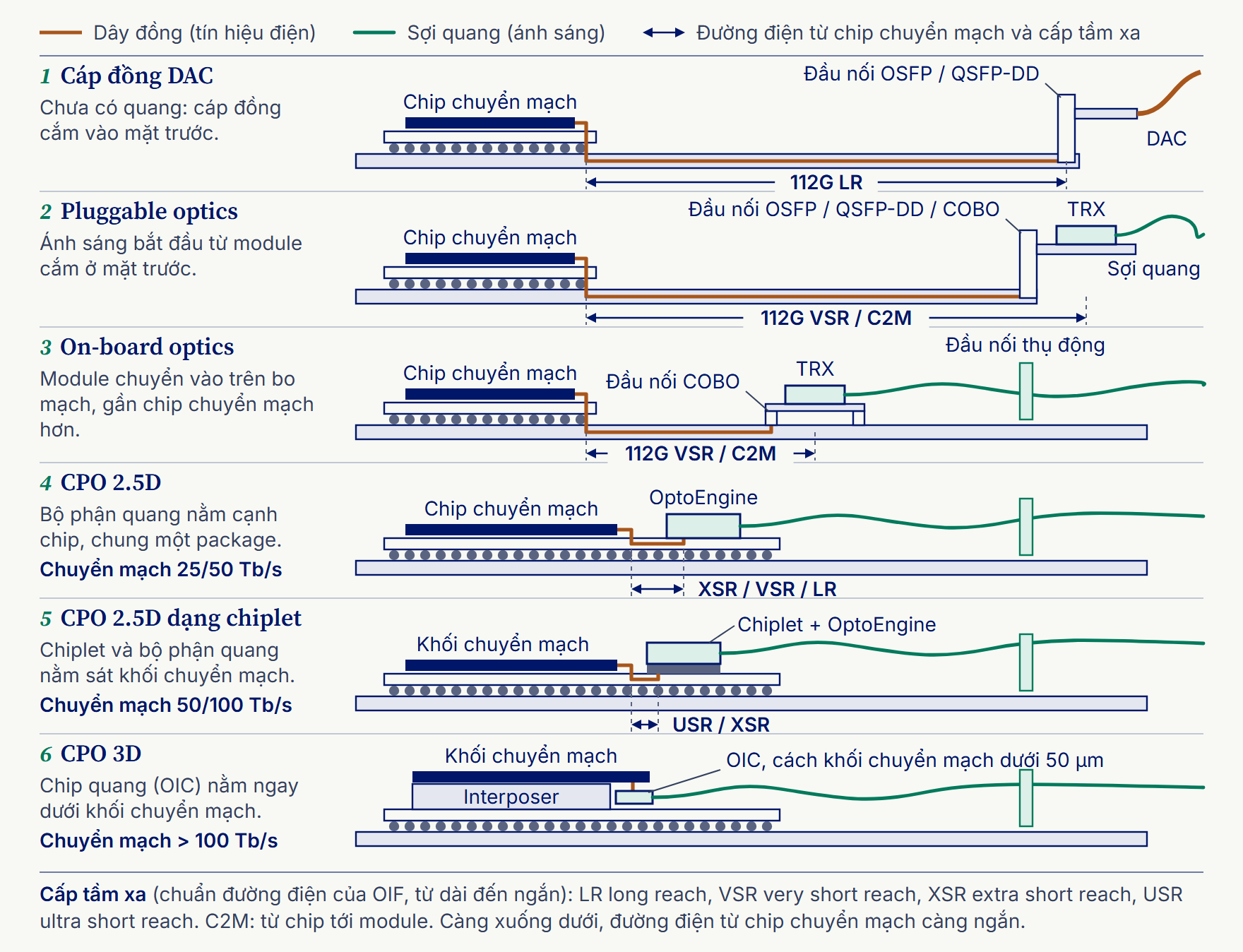
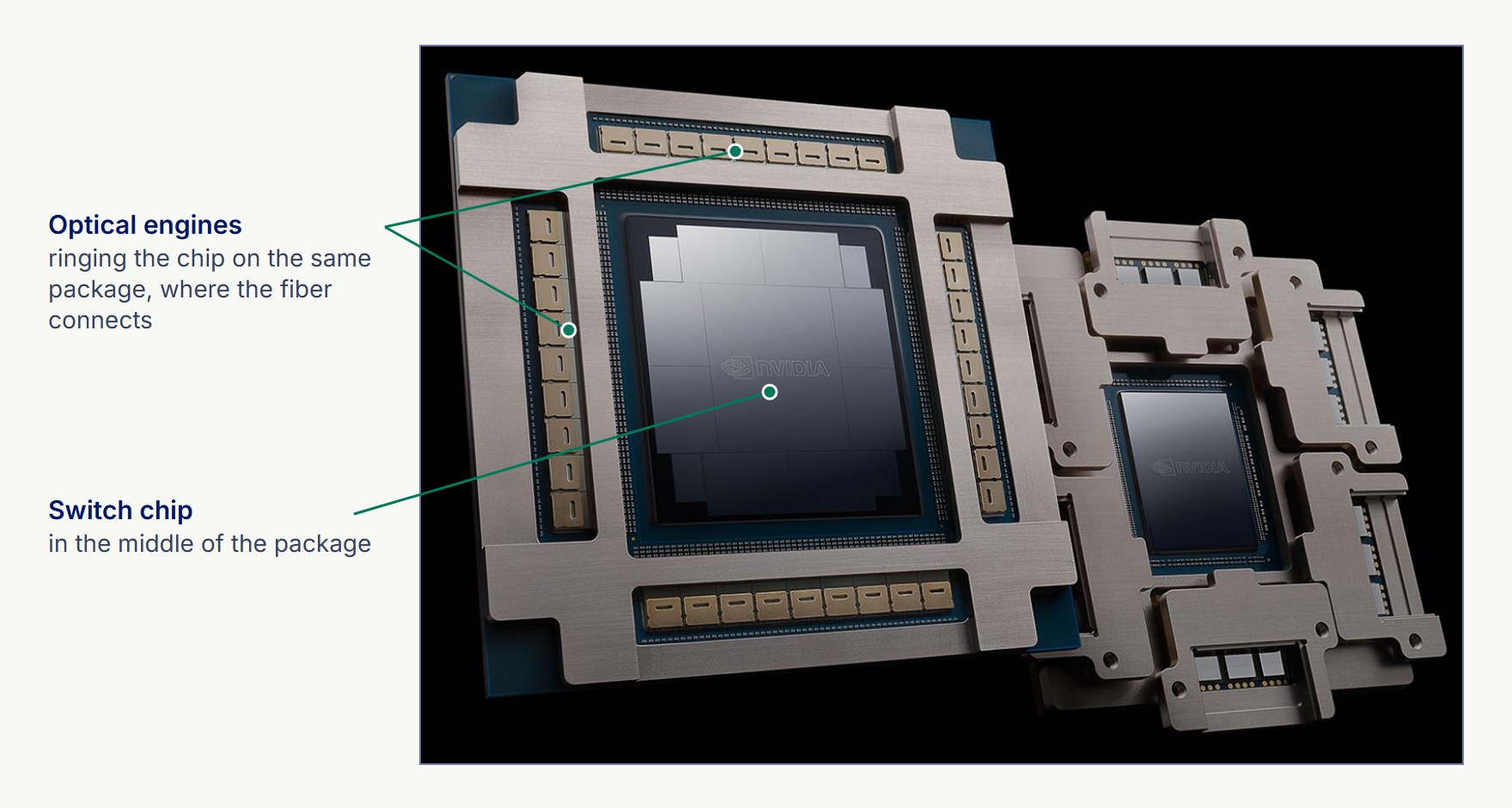
The fix is to shorten the copper until the signal no longer needs rebuilding, and then to drop the DSP altogether. That has happened in steps. On-board optics moved the module from the front panel onto the board, closer to the switch chip. Co-packaged optics (CPO) takes the last step: the optical engine sits in the same package as the switch chip, a few millimeters away, and a small driver chip beside it drives the modulator directly. With silicon photonics that engine is a small photonic chip, so many of them fit around one switch and more data can leave it. This is where photonics reaches the chip itself.
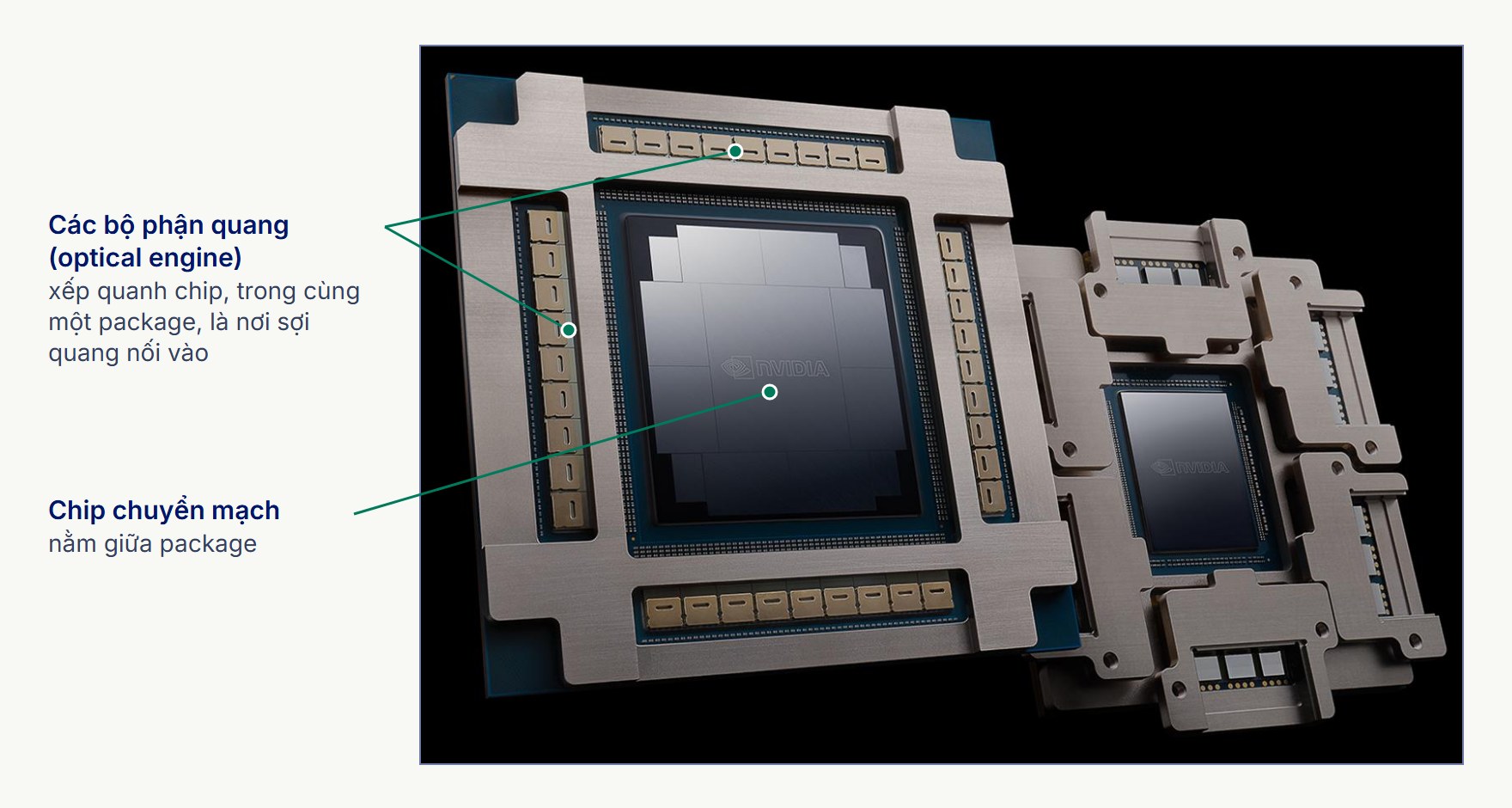
Cách khắc phục là rút ngắn đoạn dây đồng cho đến khi tín hiệu không cần tái tạo nữa, rồi bỏ hẳn DSP. Việc này diễn ra từng bước. On-board optics (quang trên bo mạch) chuyển module từ mặt trước vào hẳn trên bo mạch, gần chip chuyển mạch hơn. Co-packaged optics (CPO) tiến thêm bước cuối: bộ phận quang nằm chung một package (phần đóng gói của chip) với chip chuyển mạch, cách nó vài milimet, và một chip điều khiển (driver) nhỏ đặt ngay cạnh trực tiếp cấp tín hiệu cho modulator. Với silicon photonics, bộ phận ấy là một chip quang tử (photonic integrated circuit) nhỏ, nên quanh một chip chuyển mạch đặt được nhiều chip như vậy, và dữ liệu ra vào được nhiều hơn. Đây là chỗ quang tử học (photonics) chạm tới chính con chip.
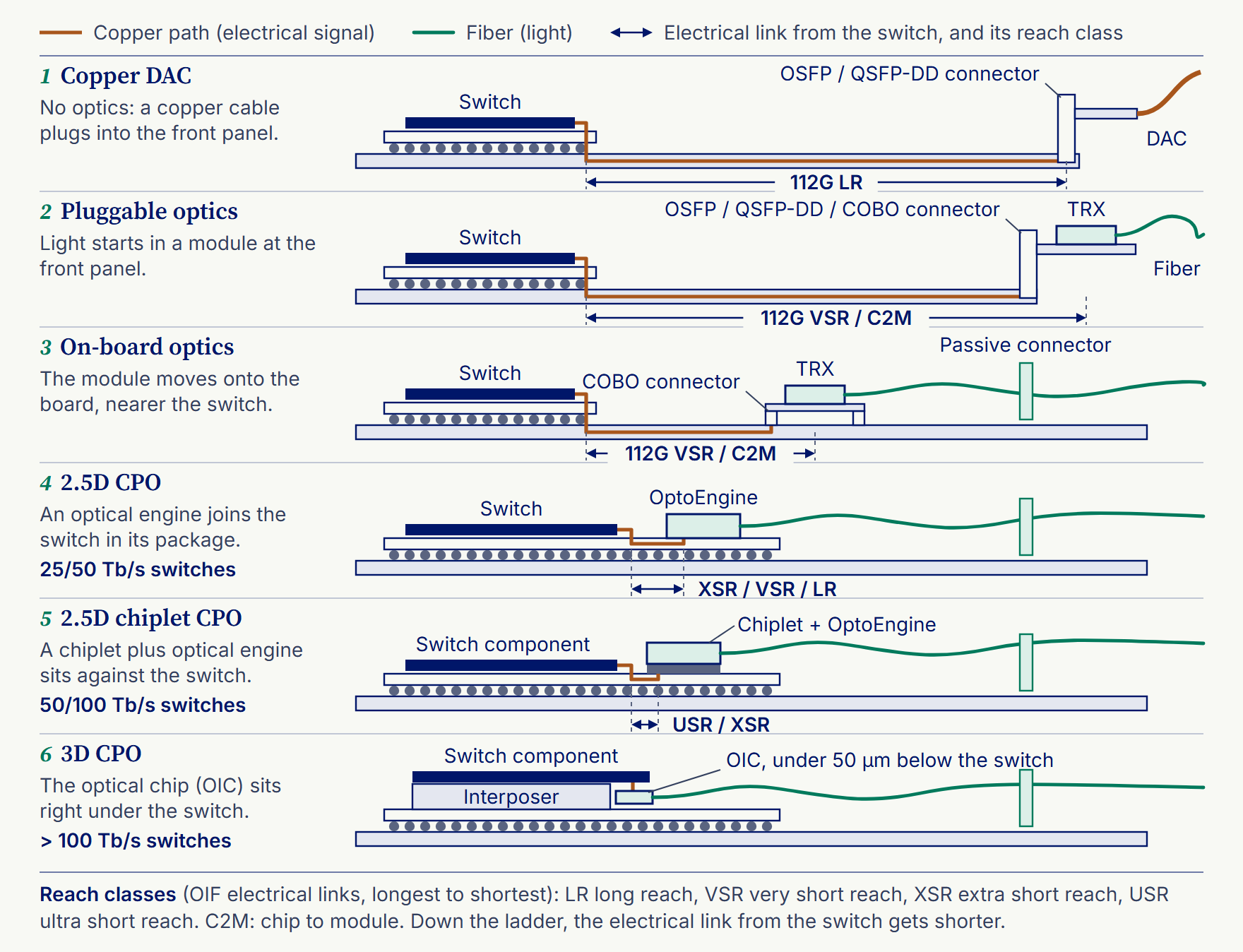
| Stage | Where the light starts | Copper path from the switch chip |
|---|---|---|
| Copper cable | No light: a copper cable plugs into the front panel | Across the board, then along the cable |
| Pluggable optics | A module in the front panel | Across the whole board |
| On-board optics | A module on the board near the chip | Shorter, across only part of the board |
| 2.5D co-packaged optics | An optical engine beside the chip, in its package | A few millimeters |
| 2.5D chiplet co-packaged optics | A chiplet and optical engine beside the switch parts | Shorter still |
| 3D co-packaged optics | An optical chip stacked with the switch | Almost none |
| Bậc | Ánh sáng bắt đầu từ đâu | Đoạn dây đồng từ chip chuyển mạch |
|---|---|---|
| Cáp đồng | Không có ánh sáng: cáp đồng cắm vào mặt trước | Băng qua bo mạch, rồi chạy dọc sợi cáp |
| Pluggable optics | Module ở mặt trước | Băng qua cả bo mạch |
| On-board optics | Module trên bo mạch, gần chip | Ngắn hơn, chỉ qua một phần bo mạch |
| Co-packaged optics 2.5D | Bộ phận quang cạnh chip, trong cùng package | Vài milimet |
| Co-packaged optics 2.5D dạng chiplet | Chiplet và bộ phận quang cạnh các khối chuyển mạch | Còn ngắn hơn nữa |
| Co-packaged optics 3D | Chip quang xếp chồng cùng chip chuyển mạch | Gần như không còn |
The savings are real. A switch system built on Broadcom’s first co-packaged-optics chip, carrying 51.2 Tb/s, cut total power by more than 40 percent in its maker’s tests.8.6 In March 2025 NVIDIA announced its own co-packaged-optics switches, Quantum-X Photonics for InfiniBand, with 800 Gb/s ports, and Spectrum-X Photonics for Ethernet, announced at up to 1.6 Tb/s per port, with a claimed 3.5 times better power efficiency.8.7 As of mid-2026 the Ethernet switches, now called Spectrum-X Ethernet Photonics, were in production.8.8 Analysts were careful about the pace. In February 2025, Scott Wilkinson of Cignal AI saw positive signs for deploying co-packaged optics by 2026, but judged that large-scale deployment would need investment from motivated industry players such as the hyperscalers or NVIDIA.8.9
Khoản tiết kiệm là có thật. Một hệ thống chuyển mạch dùng chip co-packaged optics đầu tiên của Broadcom, xử lý 51,2 Tb/s, giảm được hơn 40 phần trăm tổng điện năng trong thử nghiệm của nhà sản xuất.8.6 Tháng 3/2025, NVIDIA công bố các bộ chuyển mạch co-packaged optics của riêng mình: Quantum-X Photonics cho InfiniBand với các cổng 800 Gb/s, và Spectrum-X Photonics cho Ethernet, công bố tới 1,6 Tb/s mỗi cổng, kèm hiệu quả điện năng mà hãng nêu là tốt hơn 3,5 lần.8.7 Tính đến giữa năm 2026, các bộ chuyển mạch Ethernet, nay mang tên Spectrum-X Ethernet Photonics, đã đi vào sản xuất.8.8 Giới phân tích thì thận trọng về tốc độ phổ biến. Tháng 2/2025, Scott Wilkinson của Cignal AI thấy đã có dấu hiệu tích cực cho việc triển khai co-packaged optics vào năm 2026. Tuy nhiên, theo ông, muốn triển khai trên diện rộng thì phải có những bên trong ngành đủ động lực, như các hyperscaler hay NVIDIA, bỏ vốn đầu tư.8.9
The same idea is being tried one level down, between chips inside a single package. When a processor is split into chiplets, small dies joined by advanced packaging, an optical chiplet could carry its data out as light. Intel showed one in 2024: an optical I/O chiplet carrying 4 Tb/s in both directions, packaged with a concept CPU.8.10 For switches, co-packaged optics is now in production; for the links between chiplets it is still a research demonstration.
Cùng ý tưởng ấy đang được đem thử ở cấp nhỏ hơn nữa, giữa các con chip bên trong một package. Khi một bộ xử lý được chia thành nhiều chiplet, tức những die (mảnh chip) nhỏ ghép lại bằng đóng gói tiên tiến (advanced packaging), một chiplet quang có thể đưa dữ liệu ra ngoài dưới dạng ánh sáng. Intel đã trình diễn một chiplet như vậy năm 2024: chiplet optical I/O truyền 4 Tb/s theo cả hai chiều, đóng gói chung với một CPU mẫu.8.10 Với bộ chuyển mạch, co-packaged optics nay đã đi vào sản xuất; còn với đường nối giữa các chiplet, đây mới dừng ở mức trình diễn nghiên cứu.
The light source and the heat are still open problems
Nguồn sáng và nhiệt vẫn là hai bài toán còn bỏ ngỏ
The architecture is simple to draw. Building it is another matter, and two problems stand out.
Kiến trúc này vẽ ra thì đơn giản. Làm được nó lại là chuyện khác, và có hai bài toán nổi bật.
The first is the light source. Co-packaged optics needs lasers that fit its new layout, for example a single laser that emits many wavelengths at once, and lasers of that kind are still being developed. NVIDIA’s own design sets out to use four times fewer lasers.8.7 Many designs keep the lasers out of the hot package altogether, in replaceable modules at the front panel. Placing the chips and fibers precisely enough for the light to line up is also new work.
Thứ nhất là nguồn sáng. Co-packaged optics cần những con laser hợp với kiến trúc mới này, chẳng hạn một laser duy nhất phát ra nhiều bước sóng cùng lúc, và loại laser như vậy vẫn đang được phát triển. Chính thiết kế của NVIDIA cũng tìm cách giảm số laser cần dùng đi bốn lần.8.7 Nhiều thiết kế còn đặt hẳn laser ra ngoài package vốn rất nóng, trong những module thay được ở mặt trước. Căn chỉnh các con chip và sợi quang chính xác đến mức ánh sáng khớp nhau cũng là việc mới.
The second is heat. The switch chip runs very hot, and co-packaged optics puts the photonic chip right beside it, where optical parts that are sensitive to temperature must keep working to specification. Both chips, and the package that holds them, must stay reliable for years in a data center, often five or more, while heating and cooling as the load changes. Mechanical strain in that small package is part of the same problem. These questions are why co-packaged optics was still largely at the trial stage when the first switches were announced in 2024 and 2025.
Thứ hai là nhiệt. Chip chuyển mạch vốn rất nóng, và co-packaged optics đặt chip quang tử ngay bên cạnh nó, nơi các linh kiện quang vốn nhạy với nhiệt độ vẫn phải hoạt động đúng thông số. Cả hai con chip và phần đóng gói chứa chúng phải bền bỉ suốt nhiều năm trong trung tâm dữ liệu, thường từ năm năm trở lên, trong khi nóng lên nguội đi theo tải. Ứng suất cơ học trong package nhỏ ấy cũng là một phần của bài toán. Chính những câu hỏi này khiến co-packaged optics phần lớn vẫn ở giai đoạn thử nghiệm khi những bộ chuyển mạch đầu tiên được công bố vào năm 2024 và 2025.
Light on the board, or radio instead of cables?
Đưa ánh sáng vào bo mạch, hay dùng sóng vô tuyến thay cáp?
For the switch, light has moved onto the board in steps, first near the chip with on-board optics and then into its package with co-packaged optics; radio, by contrast, cannot take fiber’s place inside a data center. Moving data, inside and between data centers, remains the largest use of photonic chips, though not the only one.
Với bộ chuyển mạch, ánh sáng đã tiến vào bo mạch từng bước, trước hết đến gần con chip nhờ on-board optics, rồi vào hẳn package của nó nhờ co-packaged optics. Còn sóng vô tuyến thì không thể thay cáp quang trong trung tâm dữ liệu. Truyền dữ liệu, bên trong và giữa các trung tâm dữ liệu, vẫn là ứng dụng lớn nhất của chip quang tử, dù không phải là ứng dụng duy nhất.
Could most of a circuit board's data links be made optical?Có thể chuyển phần lớn các đường dữ liệu trên một bo mạch sang quang được không?
In principle, yes, and co-packaged optics is exactly that step for a switch. Optical links travel in separate fibers, so they hardly disturb each other. Copper traces on a board are harder to tame. On top of the loss described at the start of this chapter, neighboring traces pick up each other’s signals, and each trace’s impedance has to be matched along its whole length.
Về nguyên tắc là được, và co-packaged optics chính là bước đó đối với bộ chuyển mạch. Các đường truyền quang đi trong những sợi quang riêng, nên gần như không làm nhiễu lẫn nhau. Đường dây đồng trên bo mạch khó xử lý hơn. Ngoài chuyện suy hao đã nói ở đầu chương, các đường dây nằm cạnh nhau còn gây nhiễu xuyên kênh (crosstalk) cho nhau, và impedance (trở kháng) của mỗi đường phải giữ khớp trên suốt chiều dài của nó.
Could millimeter-wave radio replace fiber inside a data center?Sóng milimet có thể thay cáp quang trong trung tâm dữ liệu không?
Not for this job. Millimeter-wave radio carries a lot of data, but it needs line of sight: the transmitting and receiving antennas must see each other. Its links are short, because the signal spreads out and weakens fast with distance. Walls, people and rain block it, and at some frequencies, around 60 GHz, the oxygen in the air absorbs it too.8.11 A data center has millions of links between different machines, and they cannot all share the air. Density matters too: a single port on a co-packaged-optics switch can carry up to 1.6 Tb/s,8.7 and radio cannot pack links that tightly.
Với việc này thì không. Sóng milimet (millimeter wave) truyền được nhiều dữ liệu, nhưng cần line of sight (tầm nhìn thẳng): ăng-ten phát và ăng-ten thu phải “nhìn thấy” nhau. Đường truyền của nó ngắn, vì tín hiệu tỏa rộng và yếu đi rất nhanh theo khoảng cách. Tường, người và mưa đều chặn được nó, và ở một số tần số, quanh 60 GHz, oxy trong không khí còn hấp thụ nó.8.11 Một trung tâm dữ liệu có hàng triệu đường nối giữa các thiết bị khác nhau, và chúng không thể cùng dùng chung một môi trường truyền sóng. Mật độ cũng là vấn đề: một cổng trên bộ chuyển mạch co-packaged optics có thể truyền tới 1,6 Tb/s,8.7 và sóng vô tuyến không thể xếp các đường nối dày đặc đến thế.
Building co-packaged-optics switches from scratch is out of reach for a newcomer: the companies that lead have decades of experience and very large budgets. But a change of architecture this big resets part of the field. It needs new custom parts, such as lasers that emit many wavelengths at once and ways to place chips and fibers precisely, and no one has long experience of making them. It also needs packaging and testing that keep two hot chips working side by side for years. Packaging and testing are the most open doors, and a small team that picks the right problem can start there.
Tự xây dựng từ đầu những bộ chuyển mạch co-packaged optics là việc quá sức với người đi sau: các công ty dẫn đầu đã có hàng chục năm kinh nghiệm và ngân sách rất lớn. Nhưng khi kiến trúc thay đổi lớn đến vậy, một phần lợi thế cũ cũng mất đi. Kiến trúc mới cần những linh kiện làm theo yêu cầu riêng, như laser phát nhiều bước sóng cùng lúc hay cách đặt chip và sợi quang thật chính xác, và chưa ai có nhiều kinh nghiệm chế tạo chúng. Nó còn cần đóng gói (packaging) và kiểm thử (testing) đủ tốt để hai con chip nóng nằm cạnh nhau vẫn chạy ổn định suốt nhiều năm. Đóng gói và kiểm thử là những cánh cửa rộng mở nhất, và một nhóm nhỏ chọn đúng bài toán hoàn toàn có thể bắt đầu từ đó.