Chapter 6 of 10Chương 6/10 9 min9 phút
The chips inside a digital stethoscopeChiếc ống nghe số và những con chip bên trong
The second case in this book is a small device with several chips inside it: a digital stethoscope that records the sound of the heart, its electrical signal and the pulse in a fingertip, all at once. It comes from a university lab, the BKIC Integrated Circuit Laboratory at Hanoi University of Science and Technology (HUST), built for doctors who teach. Chapters 4 and 5 went deep into one chip; this chapter stays at the start of chapter 2’s design flow, where a need becomes a specification and then a plan of blocks. It follows one heartbeat through every block, from the chest to a phone, and each block draws on a different course.
Tình huống thứ hai của cuốn sách là một thiết bị nhỏ có nhiều chip bên trong: chiếc ống nghe số ghi cùng lúc tiếng tim, tín hiệu điện của tim và mạch đập ở đầu ngón tay. Thiết bị ra đời ở phòng thí nghiệm BKIC của Đại học Bách khoa Hà Nội, và được làm ra để phục vụ các bác sĩ đứng lớp. Chương 4 và 5 đã đi sâu vào một con chip; chương này dừng ở những bước đầu của quy trình thiết kế (design flow) ở chương 2, nơi một nhu cầu trở thành yêu cầu kỹ thuật (specification) rồi thành sơ đồ các khối. Chương đi theo một nhịp tim qua từng khối, từ lồng ngực tới điện thoại, và khối nào cũng cần đến một môn học riêng.
In this chapter
Trong chương này
- Why a doctor who teaches needed a new kind of stethoscope
- What the heart’s sounds, its electrical signal and the fingertip pulse show, and how they line up in time
- How each signal travels from a sensor to a phone
- Which course each block of the device draws on
- Why chip-design courses come late in a general electronics degree
- Vì sao một bác sĩ đứng lớp cần một kiểu ống nghe mới
- Tiếng tim, tín hiệu điện của tim và mạch ở đầu ngón tay cho biết gì, và chúng khớp nhau về thời gian ra sao
- Mỗi tín hiệu đi từ cảm biến đến điện thoại như thế nào
- Mỗi khối của thiết bị cần đến môn học nào
- Vì sao trong chương trình đào tạo điện tử thông thường, các môn thiết kế chip lại nằm ở cuối
A doctor's problem
Bài toán mà một bác sĩ đặt ra
An ordinary stethoscope is acoustic: the chest piece picks up the sound, and air-filled tubes carry it to the doctor’s ears.6.1 Only the person wearing it hears anything. For a doctor who also teaches at a medical university, that was the problem. The lecturer could hear every sound of a patient’s heart, the normal ones and the unusual ones, but the students could not hear what the lecturer heard, and a sound is hard to put into words for someone who has never heard it.
Chiếc ống nghe quen thuộc là loại âm học: đầu nghe áp lên ngực thu lấy âm thanh, rồi các ống rỗng chứa không khí đưa âm thanh ấy tới tai bác sĩ.6.1 Chỉ người đeo ống nghe mới nghe thấy. Với một bác sĩ đồng thời là giảng viên ở một trường đại học y, đó chính là cái khó. Người thầy nghe rõ từng âm thanh trong tim người bệnh, cả âm bình thường lẫn âm bất thường, nhưng sinh viên thì không nghe được điều thầy nghe. Một âm thanh lại rất khó tả bằng lời cho người chưa từng nghe thấy nó.
The answer was to turn the sound into an electrical signal, which can be amplified and shared, so that a lecturer and a whole class can listen to the same heartbeat at the same moment. That is what an electronic stethoscope does; a digital one, like the device in this chapter, also turns the signal into numbers. In 2022, two fourth-year students at HUST set out to build one in the BKIC lab, and tested it at Hanoi Medical University; its main purpose is teaching auscultation, the skill of diagnosing by listening to the body.6.2, 6.3
Lời giải là biến âm thanh thành tín hiệu điện, thứ có thể được khuếch đại và chia sẻ, để thầy và cả lớp cùng nghe một nhịp tim vào cùng một lúc. Đó là việc một ống nghe điện tử làm được; ống nghe số, như thiết bị trong chương này, còn biến tín hiệu ấy thành các con số. Năm 2022, hai sinh viên năm thứ tư của Đại học Bách khoa Hà Nội bắt tay làm một chiếc như thế tại phòng thí nghiệm BKIC, rồi đem thử nghiệm ở Trường Đại học Y Hà Nội. Mục đích chính của thiết bị là dạy thính chẩn, tức kỹ năng nghe âm thanh trong cơ thể để chẩn đoán.6.2, 6.3
A doctor who hears something unusual usually sends the patient to another room for an electrocardiogram (ECG), so listening and measuring happen apart. Yet the heart’s sounds and its electrical signal are tied closely together in time, as has long been known. The later version of the device, the one shown in this chapter, records the ECG and the pulse in a fingertip as well, so all three signals can be read on one time axis. That helps teaching, and it gives a doctor more to go on in a diagnosis.
Khi nghe thấy điều gì bất thường, bác sĩ thường gửi người bệnh sang một phòng khác để đo điện tâm đồ (ECG), nên việc nghe và việc đo diễn ra ở hai nơi. Thế nhưng tiếng tim và tín hiệu điện của tim gắn chặt với nhau về thời gian, điều y học đã biết từ lâu. Phiên bản sau của thiết bị, cũng là phiên bản được giới thiệu trong chương này, ghi thêm ECG và mạch ở đầu ngón tay, để cả ba tín hiệu hiện trên cùng một trục thời gian. Nhờ vậy việc dạy học tốt hơn, và bác sĩ cũng có thêm căn cứ khi chẩn đoán.
Each heartbeat is tracked through three signals
Mỗi nhịp tim được theo dõi qua ba tín hiệu
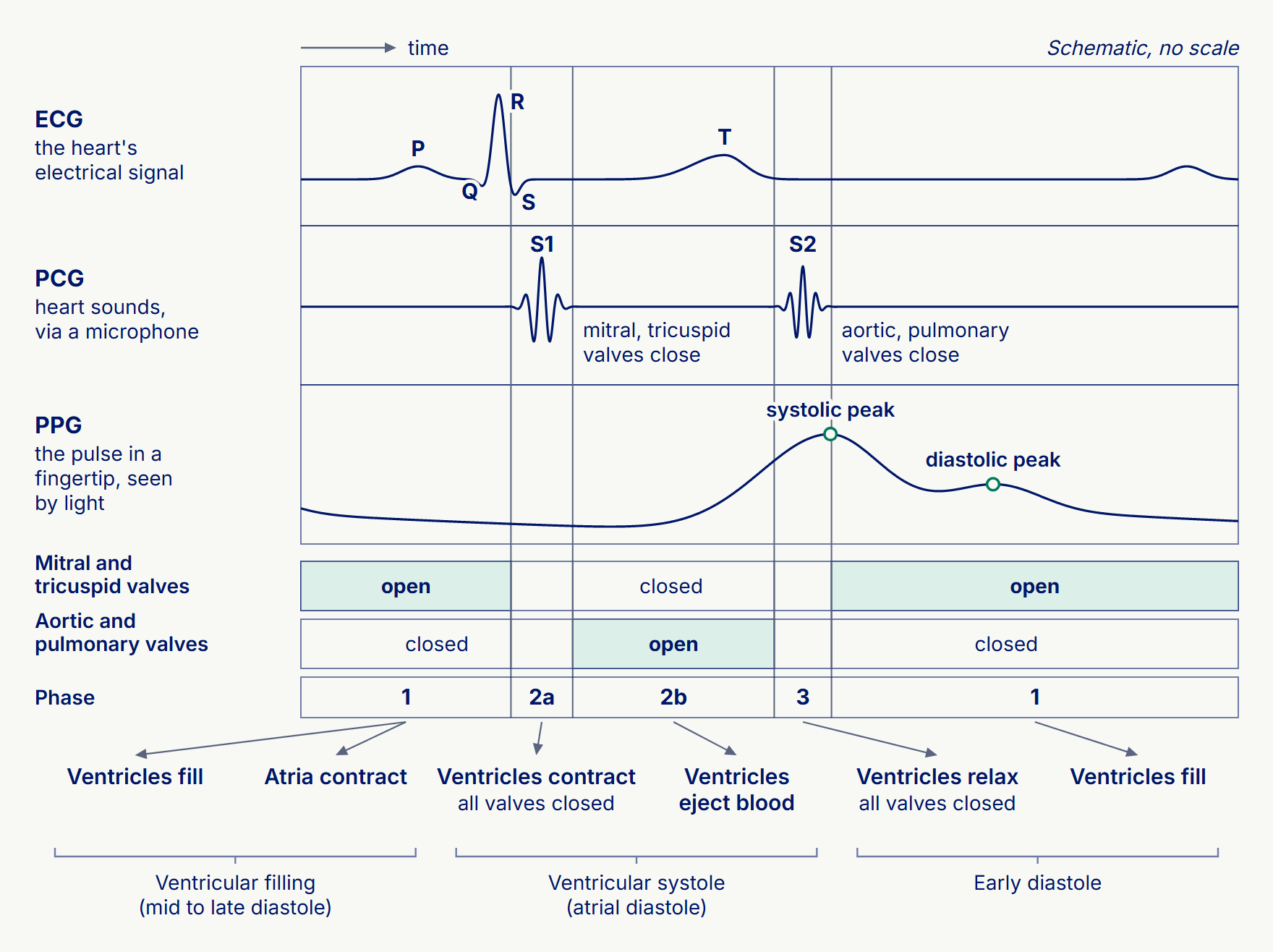
Each beat is one turn of the cardiac cycle. Blood passes from the upper chambers, the atria, into the lower ones, the ventricles; the ventricles contract and push blood out to the body and the lungs, then relax and fill again. The device follows that cycle three ways:
Mỗi nhịp đập là một vòng của chu kỳ tim. Máu từ tâm nhĩ ở trên chảy xuống tâm thất ở dưới; tâm thất co lại, đẩy máu đi khắp cơ thể và lên phổi, rồi giãn ra để lại được đổ đầy. Thiết bị theo dõi chu kỳ ấy theo ba cách:
- The electrocardiogram records the heart’s electrical activity through electrodes on the skin. Its waves are named P, QRS and T: the QRS is the electrical signal that sets the ventricles contracting, and the T wave is their recovery.
- The phonocardiogram (PCG) records the heart sounds, the ones a doctor hears through a stethoscope.
- Photoplethysmography (PPG) follows the pulse with light, at a fingertip.
- Điện tâm đồ ghi hoạt động điện của tim qua các điện cực đặt trên da. Các sóng của nó được gọi là P, QRS và T: phức bộ QRS là tín hiệu điện khiến tâm thất co lại, còn sóng T ứng với lúc tâm thất hồi phục.
- Tâm thanh đồ (PCG) ghi tiếng tim, thứ âm thanh bác sĩ vẫn nghe qua ống nghe.
- Tín hiệu quang thể tích (PPG) ghi mạch đập ở đầu ngón tay, đo bằng ánh sáng.
The two heart sounds, S1 and S2, are valves closing. S1 is heard as the valves between the atria and the ventricles close, when the ventricles begin to contract, just after the ECG’s QRS. S2 is heard as the valves at the ventricles’ exits close, when the ventricles relax, at the end of the T wave.6.4, 6.5, 6.6 So the sounds and the electrical waves come in the same order in every beat, and a doctor who reads them side by side can check one against the other.
Hai tiếng tim, S1 và S2, là tiếng các van tim đóng lại. S1 vang lên khi các van giữa tâm nhĩ và tâm thất đóng lại, lúc tâm thất bắt đầu co, ngay sau phức bộ QRS trên điện tâm đồ. S2 vang lên khi các van ở lối ra của tâm thất đóng lại, lúc tâm thất giãn, ở cuối sóng T.6.4, 6.5, 6.6 Vì thế tiếng tim và các sóng điện luôn xuất hiện theo cùng một trình tự trong mỗi nhịp, và khi đặt chúng cạnh nhau, bác sĩ có thể dùng tín hiệu này để đối chiếu tín hiệu kia.
PPG shines light into the fingertip and reads what comes back as each pulse swells the vessels. Comparing red and infrared light gives the blood’s oxygen saturation, SpO2, the figure a fingertip pulse oximeter shows beside the pulse rate; green light is often used for the pulse rate alone.6.5, 6.7
PPG chiếu ánh sáng vào đầu ngón tay rồi đọc phần ánh sáng dội lại, vốn thay đổi theo mỗi lần mạch đập làm các mạch máu căng lên. So sánh ánh sáng đỏ với ánh sáng hồng ngoại cho biết độ bão hòa oxy trong máu, SpO2, con số mà chiếc máy kẹp đầu ngón tay vẫn hiển thị bên cạnh nhịp mạch; ánh sáng xanh lục thì thường được dùng riêng để đo nhịp mạch.6.5, 6.7
Each signal travels from a sensor to a phone
Tín hiệu đi từ cảm biến đến điện thoại
Under the device are the PCG chest piece and four ECG electrode pads; on top, a notch holds a fingertip over the PPG sensor. One hand presses the device to the chest, a finger rests on top, and three sensors work at once. The chest piece acts like a microphone, turning sound into an electrical signal; the electrodes pick up the heart’s own electrical signal from the skin; and the PPG sensor lights the fingertip and measures the light that returns.
Mặt dưới thiết bị có đầu nghe PCG và bốn miếng điện cực ECG; mặt trên có một khe để đặt đầu ngón tay lên cảm biến PPG. Một tay áp thiết bị lên ngực, một ngón tay đặt lên trên, và ba cảm biến cùng làm việc. Đầu nghe hoạt động như một micro, biến âm thanh thành tín hiệu điện. Các điện cực thu tín hiệu điện của chính trái tim từ bề mặt da, còn cảm biến PPG chiếu sáng đầu ngón tay và đo lượng ánh sáng dội về.
What comes out of the sensors is very weak. So the first block after them is the analog front end, which amplifies each signal and filters out the noise mixed into it, with its own amplifier and filter for each of the three. The next block, the analog-to-digital converter (ADC), turns the smooth analog signal into numbers. Its input is analog and its output digital, and some ADCs correct their own errors digitally, by calibration. This is where a design becomes mixed-signal, analog and digital in one circuit. From there on the data are digital: digital signal processing (DSP) handles the numbers, and a radio turns them into a 2.4 GHz signal and sends them out.6.8
Tín hiệu ra khỏi các cảm biến rất yếu. Vì vậy khối đầu tiên sau cảm biến là khối tiền xử lý tín hiệu tương tự (analog front end), có nhiệm vụ khuếch đại từng tín hiệu và lọc bỏ nhiễu lẫn vào; mỗi tín hiệu trong ba có mạch khuếch đại và mạch lọc riêng. Khối tiếp theo là ADC (bộ chuyển đổi tương tự sang số), biến tín hiệu tương tự thay đổi liên tục thành các con số. Đầu vào của ADC là tín hiệu tương tự, đầu ra là tín hiệu số, và một số ADC tự bù sai số của mình bằng phương pháp số, gọi là calibration (hiệu chuẩn). Đến đây thiết kế trở thành mixed-signal, tức phần tương tự và phần số nằm chung trong một mạch. Từ đó trở đi dữ liệu đã ở dạng số: các con số đi qua khâu xử lý tín hiệu số (DSP), rồi khối vô tuyến biến chúng thành tín hiệu 2,4 GHz và phát đi.6.8
The data leave by Bluetooth Low Energy, the usual radio for a battery-powered wearable, built to draw very little power.6.9 They go to a phone and, from it, to a server. What arrives there is still a raw signal: nothing in it yet says whether the heart is normal. On the phone and the server, signal processing separates the three signals, which share one converter and one data stream, normalises them and extracts their features, the measurements a doctor needs: the P, QRS and T waves of the ECG, the strength and spacing of S1 and S2. Once many recordings have been collected, machine learning can help sort the normal from the abnormal.
Dữ liệu được gửi đi bằng Bluetooth Low Energy, chuẩn truyền thông không dây thường dùng cho thiết bị đeo chạy pin, được thiết kế để tiêu thụ rất ít điện.6.9 Chúng tới điện thoại, rồi từ điện thoại lên server, và lúc đến nơi vẫn chỉ là tín hiệu thô, chưa cho biết tim bình thường hay bất thường. Trên điện thoại và server, khâu xử lý tín hiệu tách riêng ba tín hiệu, vốn đi chung một bộ ADC và một luồng dữ liệu, rồi chuẩn hóa chúng. Sau đó là bước trích xuất đặc trưng, tức lấy ra những số đo bác sĩ cần: các sóng P, QRS, T của điện tâm đồ, độ lớn của S1, S2 và khoảng cách giữa hai tiếng. Khi đã có nhiều bản ghi, machine learning có thể giúp phân biệt ca bình thường với ca bất thường.
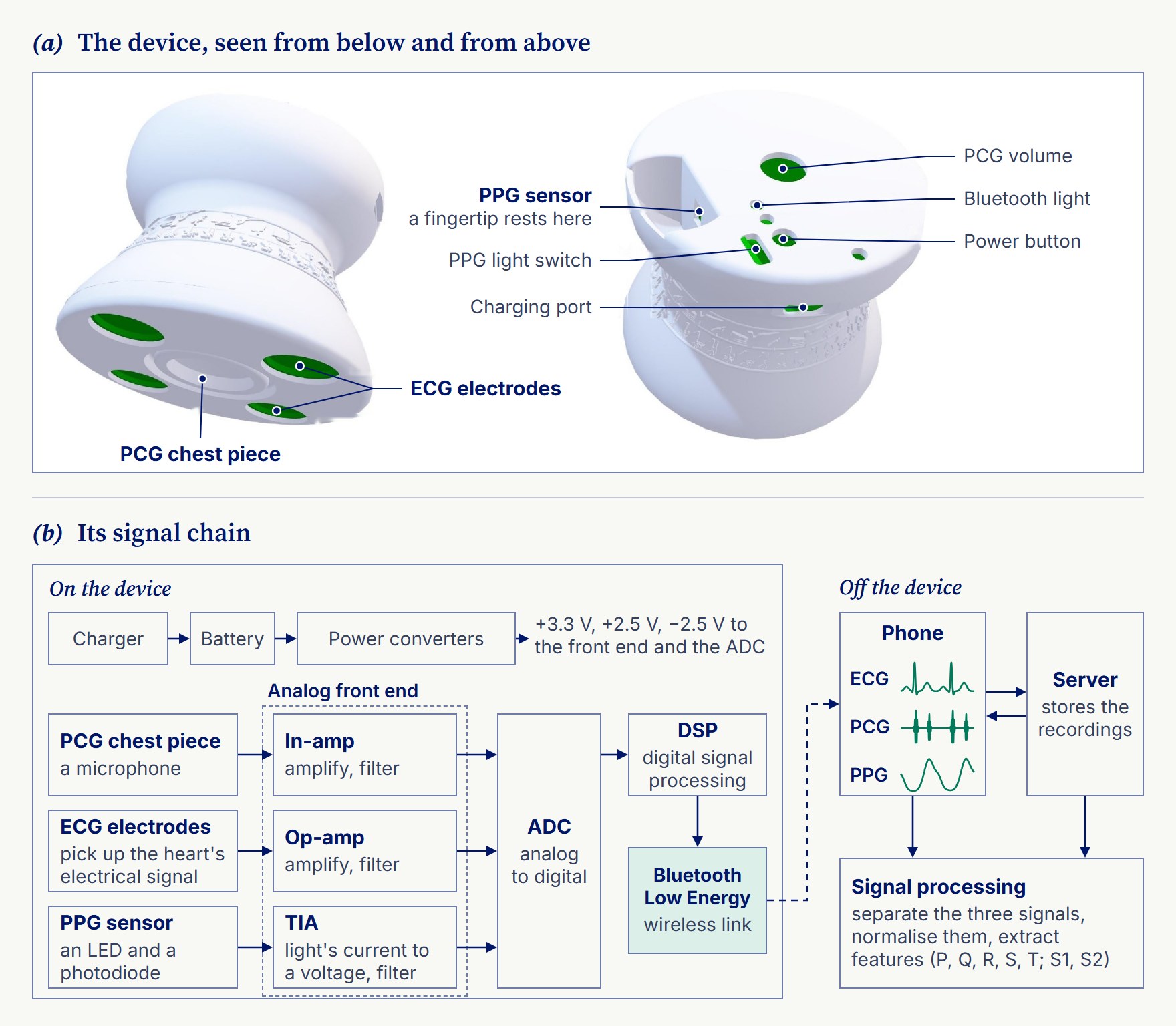
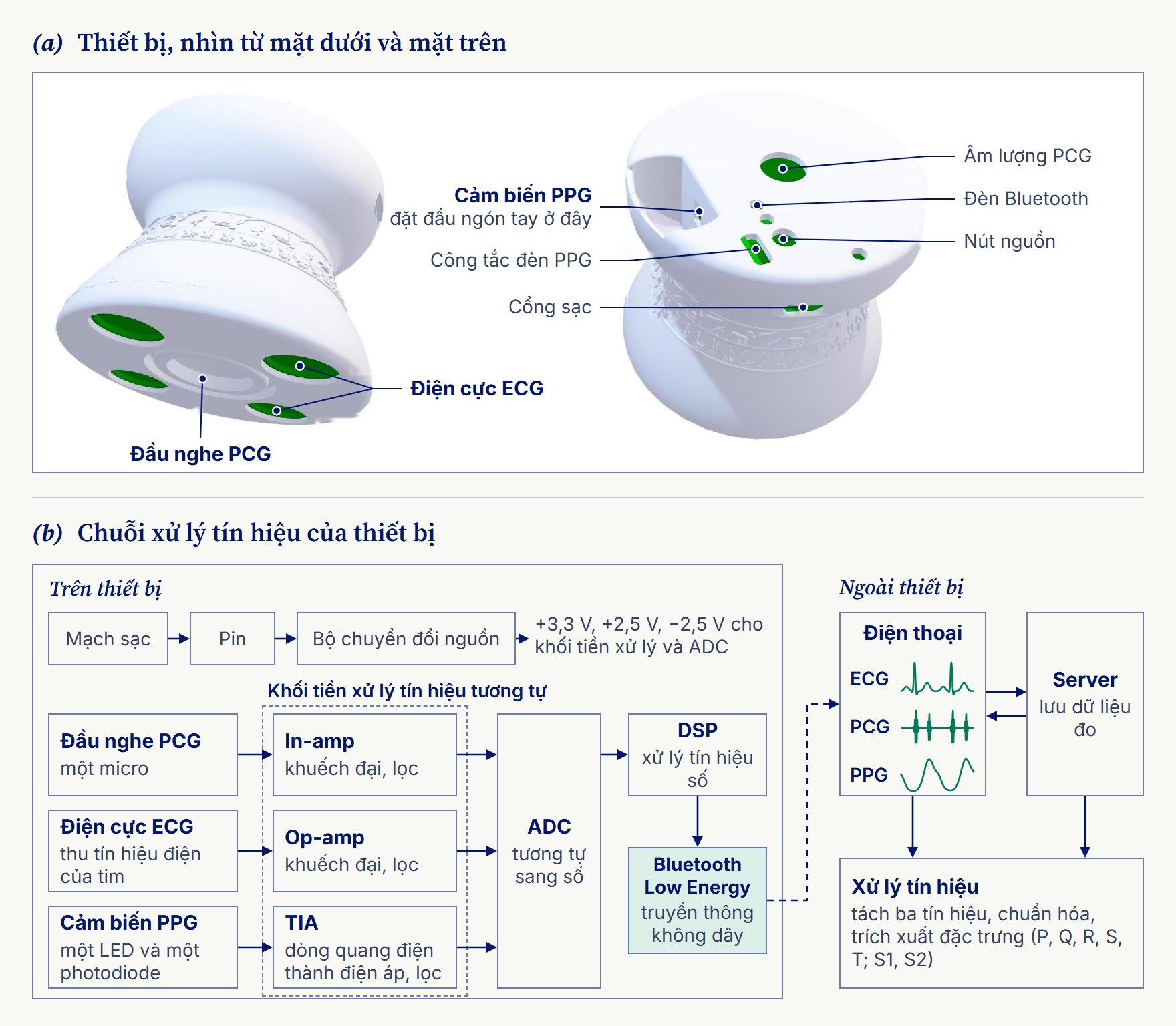
Two more parts sit outside the signal’s path. A power block, made of a charger, a battery and power converters, supplies the +3.3 V, +2.5 V and −2.5 V the circuits run on: the job chapter 4 gives a power-management chip (PMIC), on a far smaller scale. And a case holds everything. A device pressed to a patient’s chest cannot be a board trailing wires: it has to be safe to touch, and a nervous patient’s heart beats faster, which changes the very signal being measured. Designing the case and making it, by moulding or 3D printing, is work for mechanical engineers.
Còn hai phần nằm ngoài đường đi của tín hiệu. Khối nguồn, gồm mạch sạc, pin và các bộ chuyển đổi nguồn, tạo ra các mức +3,3 V, +2,5 V và −2,5 V cho các mạch hoạt động: đúng việc mà chương 4 giao cho một chip quản lý năng lượng (PMIC), ở quy mô nhỏ hơn rất nhiều. Và một cái vỏ chứa tất cả. Thiết bị áp lên ngực người bệnh không thể là một bo mạch lòa xòa dây nối: nó phải an toàn khi chạm vào người. Hơn nữa, người bệnh hồi hộp thì tim đập nhanh hơn, làm chính tín hiệu đang đo thay đổi. Thiết kế và làm ra cái vỏ ấy, bằng khuôn đúc hay in 3D, là việc của kỹ sư cơ khí.
Behind every block is a course
Đằng sau mỗi khối là một môn học
In the terms of chapter 2, this case is the flow’s first two steps, seen from the product’s side. The doctor’s need became a specification (step 1), and the specification became an architecture, a plan of blocks (step 2). Each block, the front end, the ADC, the DSP and the radio, is the kind of circuit that gets designed as a chip, and each could go on through the rest of the flow as a chip of its own. Seen that way, a chip is one piece of a product, and nearly every course in an electronics degree turns up somewhere in this one device.
Xét theo chương 2, tình huống này ứng với hai bước đầu của quy trình thiết kế, nhìn từ phía sản phẩm. Nhu cầu của bác sĩ trở thành yêu cầu kỹ thuật (bước 1), rồi yêu cầu kỹ thuật trở thành kiến trúc, tức sơ đồ các khối (bước 2). Mỗi khối, từ khối tiền xử lý, ADC, DSP đến khối truyền thông không dây, đều là loại mạch vẫn được thiết kế thành chip. Khối nào cũng có thể đi tiếp các bước còn lại của quy trình để thành một con chip riêng. Nhìn như vậy, con chip chỉ là một mảnh của sản phẩm, và gần như môn nào trong chương trình đào tạo điện tử cũng có mặt đâu đó trong chiếc thiết bị nhỏ này.
| Block | What it does | Courses it draws on |
|---|---|---|
| Sensors and electrodes | Turn sound, the heart’s electrical signal and light into electrical signals | Electronic devices, MEMS, materials science |
| Analog front end | Amplifies and filters each weak signal | Analog electronics, analog IC design |
| ADC | Turns the analog signal into numbers | Mixed-signal design |
| DSP | Processes the numbers on the device | Digital electronics, digital signal processing, embedded systems |
| Bluetooth Low Energy link | Sends the data to a phone, which can pass them on to a server; the link must keep them private and live alongside other radios | Wireless communication, telecommunication systems, IoT, security |
| Phone and server | Separate, normalise and measure the signals; tell normal from abnormal | Signal processing, AI and machine learning |
| The case | Holds everything in one piece that is safe to touch and does not frighten a patient | Mechanical engineering |
| Khối | Làm gì | Cần kiến thức từ các môn |
|---|---|---|
| Cảm biến và điện cực | Biến âm thanh, tín hiệu điện của tim và ánh sáng thành tín hiệu điện | Linh kiện điện tử, MEMS, khoa học vật liệu |
| Khối tiền xử lý tín hiệu tương tự | Khuếch đại và lọc từng tín hiệu yếu | Điện tử tương tự, thiết kế vi mạch tương tự |
| ADC | Chuyển tín hiệu tương tự thành số | Thiết kế mixed-signal |
| DSP | Xử lý các con số ngay trên thiết bị | Điện tử số, xử lý tín hiệu số, hệ thống nhúng |
| Kết nối Bluetooth Low Energy | Gửi dữ liệu tới điện thoại, từ đó có thể chuyển tiếp lên server; kết nối phải giữ kín dữ liệu và hoạt động được bên cạnh các thiết bị vô tuyến khác | Truyền thông không dây, hệ thống viễn thông, IoT, bảo mật |
| Điện thoại và server | Tách, chuẩn hóa và đo các tín hiệu; phân biệt bình thường với bất thường | Xử lý tín hiệu, AI và machine learning |
| Vỏ thiết bị | Chứa gọn mọi thứ trong một khối an toàn khi chạm vào và không làm người bệnh sợ | Cơ khí |
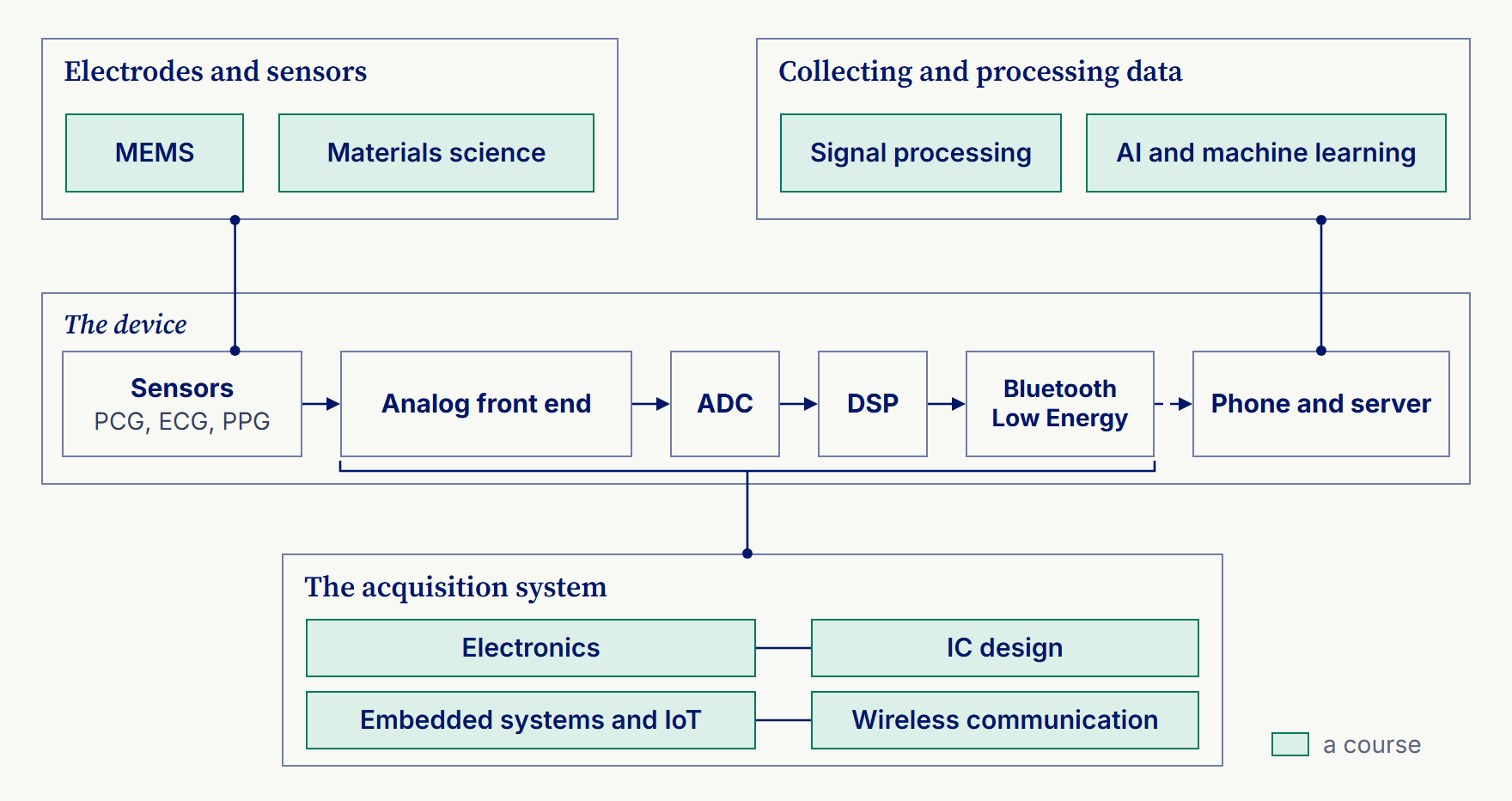
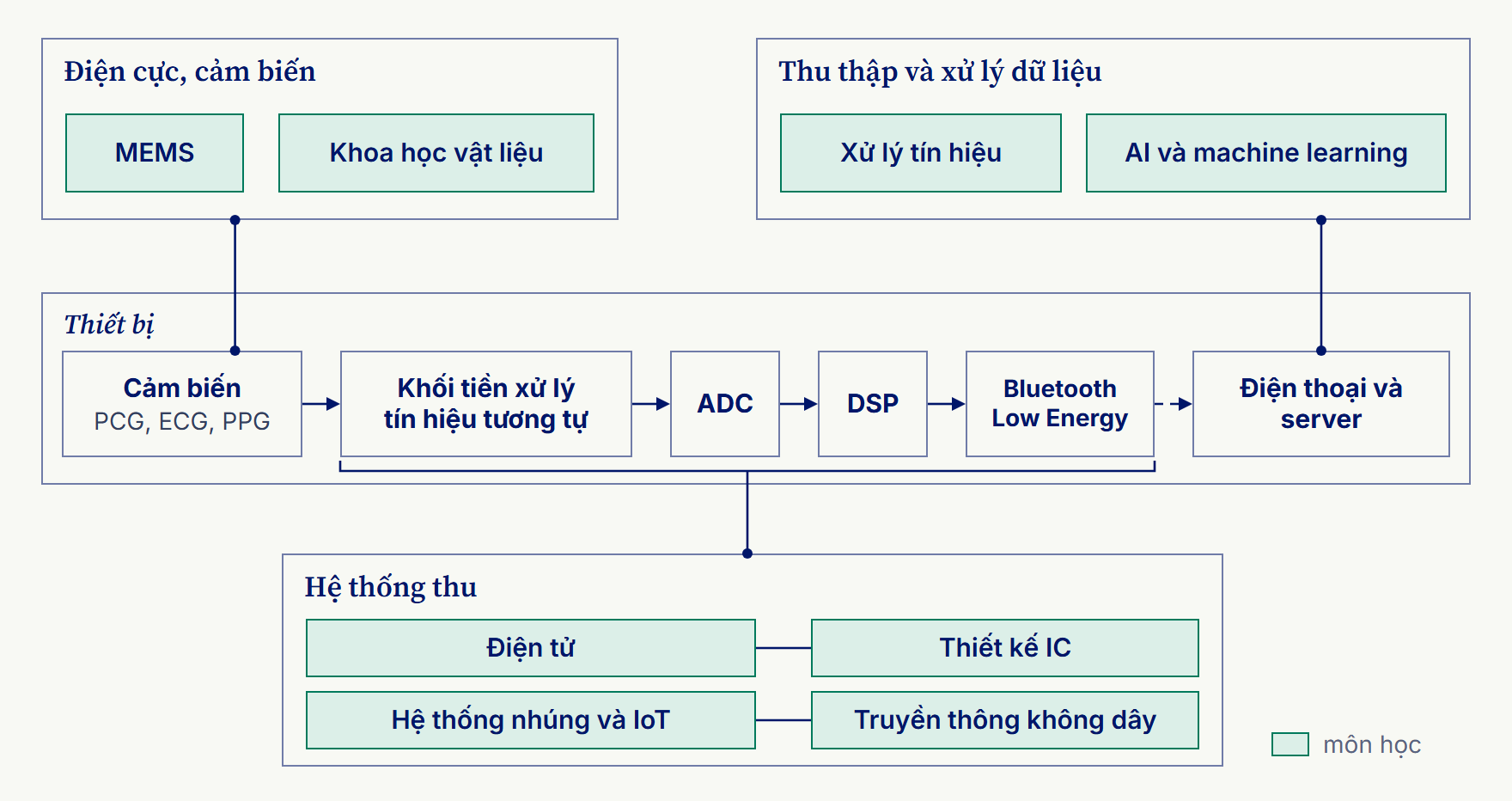
Chip design draws on electrical and electronic engineering, semiconductor physics, software and systems engineering. The designer of one block also has to know what happens when the blocks are joined: what the frequencies do, how much power the whole device draws, how fast it has to work. That is also why learning chip design opens more doors than chip design itself: the same grounding serves work on the front end, the radio link or the software that reads the data, each one a piece of a product like this.
Thiết kế vi mạch cần đến điện, điện tử, vật lý bán dẫn, phần mềm và kỹ thuật hệ thống. Người thiết kế một khối cũng phải hiểu điều gì xảy ra khi các khối ghép lại với nhau: tần số gây ra vấn đề gì, công suất tiêu thụ của cả thiết bị là bao nhiêu, thiết bị phải chạy nhanh đến đâu. Cũng vì thế mà học thiết kế chip mở ra nhiều hướng hơn là chỉ thiết kế chip. Cùng một nền tảng ấy có thể dẫn tới công việc ở khối tiền xử lý, ở khâu truyền thông không dây hay ở phần mềm đọc dữ liệu, mỗi thứ là một mảnh của một sản phẩm như thiết bị này.
Why chip design usually comes late in an electronics degree
Vì sao các môn thiết kế chip thường nằm ở năm cuối
In a general electronics degree, the courses on integrated circuit (IC) design come late, often in the final year, after the circuits, signals and devices courses they build on; a dedicated chip-design major starts them sooner. The device above shows why. Before a front end or an ADC can be designed as a chip, its designer has to know what it is for, what it connects to and how it behaves once it is part of a system, and the earlier years teach exactly that.
Trong một chương trình đào tạo điện tử thông thường, các môn thiết kế vi mạch nằm ở cuối, thường là năm cuối, sau các môn về mạch, tín hiệu và linh kiện mà chúng dựa vào. Một ngành học chuyên về thiết kế vi mạch thì bắt đầu các môn ấy sớm hơn. Chiếc thiết bị trên cho thấy lý do. Muốn thiết kế khối tiền xử lý hay ADC thành một con chip, người thiết kế phải biết trước khối ấy dùng để làm gì, nối với những gì và hoạt động ra sao khi đã nằm trong một hệ thống. Những năm học trước đó dạy đúng những điều này.
The courses also run in the same order as the work. They start from the transistor itself, how a MOSFET works, then build circuits from transistors, and they teach the whole path a chip takes in industry: tape-out, then the chip brought back and tested on a printed circuit board, as chapter 5 shows with a university lab’s power converters. The laws do not change on the way: Ohm's law and Kirchhoff's laws hold on a chip just as they do on a board. Not every student project reaches a real tape-out, since even a share of a wafer costs money; many end with a checked layout and its simulations.
Thứ tự các môn học cũng đi theo đúng thứ tự công việc. Các môn bắt đầu từ chính bóng bán dẫn (transistor), cách một MOSFET hoạt động, rồi dựng mạch từ các transistor. Chúng dạy cả con đường mà một con chip đi qua ngoài công nghiệp: tape-out, rồi đem chip về kiểm thử trên mạch in (PCB), như chương 5 kể lại với các bộ chuyển đổi nguồn của một phòng thí nghiệm đại học. Các định luật thì không đổi trên suốt chặng đường ấy: định luật Ohm và định luật Kirchhoff vẫn đúng trên chip như trên bo mạch. Không phải đồ án nào của sinh viên cũng đi tới một lần tape-out thật, vì ngay cả một phần wafer dùng chung cũng tốn tiền. Nhiều đồ án dừng ở một bản layout đã được kiểm tra, kèm các kết quả mô phỏng.
So a second- or third-year student who has not yet met a course on integrated circuits is not behind: the ground is still being laid. The chance to commit to chip design comes late in the degree, through an internship or a final-year project done with a chip company (chapter 9).
Vì vậy, một sinh viên năm hai, năm ba chưa gặp môn học nào về vi mạch không hề bị tụt lại: nền móng vẫn đang được đặt. Cơ hội dấn thân vào thiết kế chip đến vào những năm cuối, qua một kỳ thực tập hay một đồ án tốt nghiệp làm cùng một công ty chip (chương 9).